




The consequences of this aren't abstract. In 2024 alone, AI hallucinations contributed to an estimated $67.4 billion in widespread financial losses, and a Deloitte study found that 47% of business AI users made at least one business choice based on hallucinated content. These aren't edge cases - they're predictable failure patterns built into how large language models work.
For website owners and AEO practitioners, hallucination is a problem that cuts in two directions. First, you'll have to know when AI-generated content on your own site could contain inaccuracies that damage your credibility and authority. Second - and this is where AEO strategy gets nuanced - you'll have to know how answer engines like Google's AI Overviews or ChatGPT can hallucinate about your brand, misrepresent your products, or cite you for things you never said.
Quick Answer
Hallucination in AI refers to when a language model generates false, fabricated, or nonsensical information presented as fact. This occurs because AI models predict statistically likely text based on training data rather than truly "knowing" facts. The model may confidently produce incorrect names, dates, citations, or events that never existed. It's a key limitation of large language models. To reduce hallucinations, users should verify AI outputs against reliable sources, and developers use techniques like retrieval-augmented generation (RAG) and fine-tuning to improve accuracy.
Why AI Models Fabricate Information With Such Confidence
To understand why AI models make things up, you first need to know what they actually do. Large language models don't look up facts or pull from a verified database. Instead, they predict the next most probable word based on patterns learned from giant amounts of text; it's the whole mechanism - pattern recognition - not knowledge retrieval.
This distinction matters quite a bit. When a human expert answers a question, they draw on memory and understanding, and they usually know when they don't know something. An AI model has no such awareness - it generates text that statistically fits the context, which means it can produce a fluent, well-structured answer that's wrong.
The confidence in the output is not a signal of accuracy. A model doesn't "feel" more or less certain the way you might before answering a tough question - it just generates the most probable continuation of the text - and sometimes that continuation happens to be a fabricated citation, a made-up statistic, or a legal case that never existed.
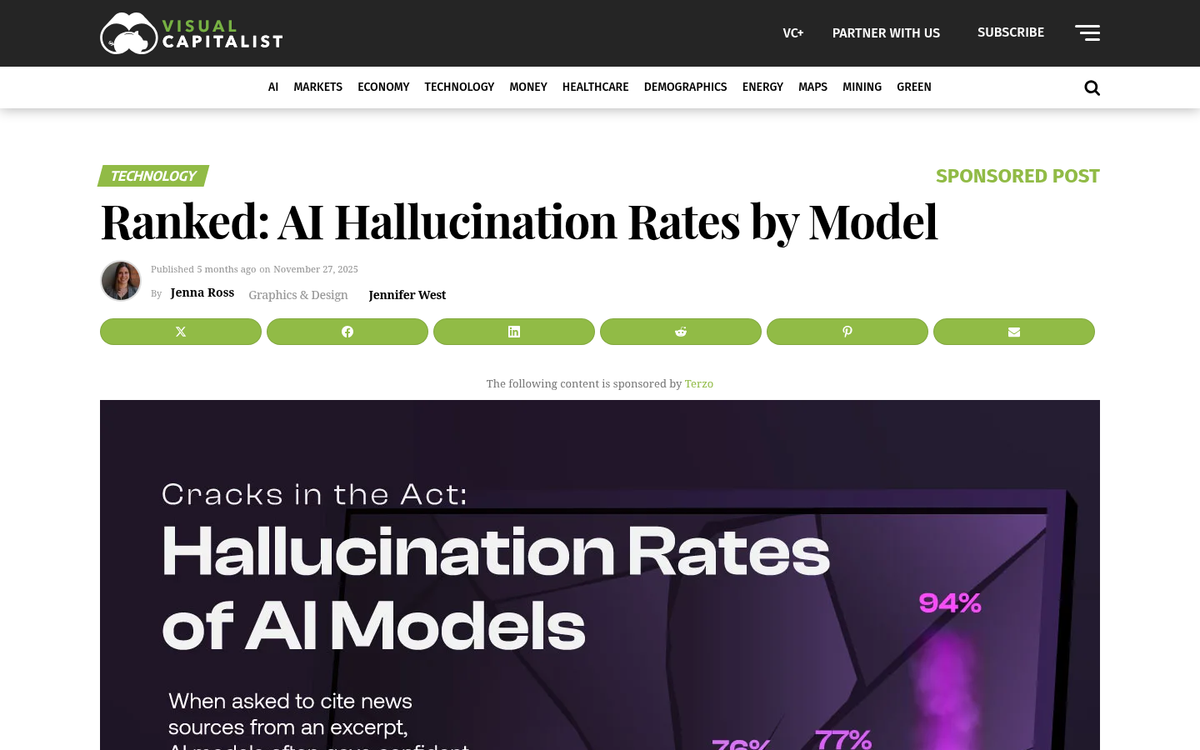
This can become alarming in high-stakes fields. Research from Stanford's RegLab and Human-Centered AI institute found that large language models hallucinate between 69% and 88% of the time when answering legal queries; it's not a small margin of error; it's a system that gets it wrong more times than it gets it right, but sounds authoritative each time.
Legal queries are a helpful test case because the answers are verifiable. Either a case exists or it doesn't. Either a statute says what the model claims or it doesn't. In domains where verification is harder - creative history, niche science, obscure policy - fabricated content can go unchecked far more easily.
The pattern-matching nature of these models also means they're especially vulnerable when a question sits outside the dense regions of their training data. If a topic wasn't well-represented in what the model learned from, it has weaker patterns to draw on and it's more likely to fill gaps with plausible-sounding content. The model isn't being deceptive - it just has no mechanism to stop and say it doesn't have enough to go on.
What makes this harder to catch is that hallucinated content doesn't look wrong - it tends to line up with the tone, format, and structure of accurate information. A fabricated legal citation looks like a real one. A made-up study title reads like a genuine research paper. The form is correct even when the substance isn't, and that's what makes it easy to miss. If you publish AI-generated content on your blog, diagnosing errors before they go live is only part of the challenge - factual accuracy requires a separate layer of verification entirely.
Hallucination Rates Vary Wildly Across AI Models
AI models are not equally unreliable. The difference between the best and worst performers is large enough to matter if you're picking a tool to help create content or build out an AEO strategy.
The table below pulls together hallucination rates from a few known models to give you a sense of the range.
| AI Model | Hallucination Rate |
|---|---|
| Google Gemini 2.0 Flash 001 | 0.7% |
| Falcon-7B-Instruct | 29.9% |
| OpenAI o3 | 33-51% |
Google's Gemini 2.0 Flash 001 at 0.7% is a great result. At that rate, the model gets it wrong less than once in every hundred responses, which puts it in a very different category from the others on this list.
Falcon-7B-Instruct at nearly 30% is a different story; it's roughly a one-in-three chance of fabricated information in any given response, which is a problem if you're using it to generate factual content without checking every line.
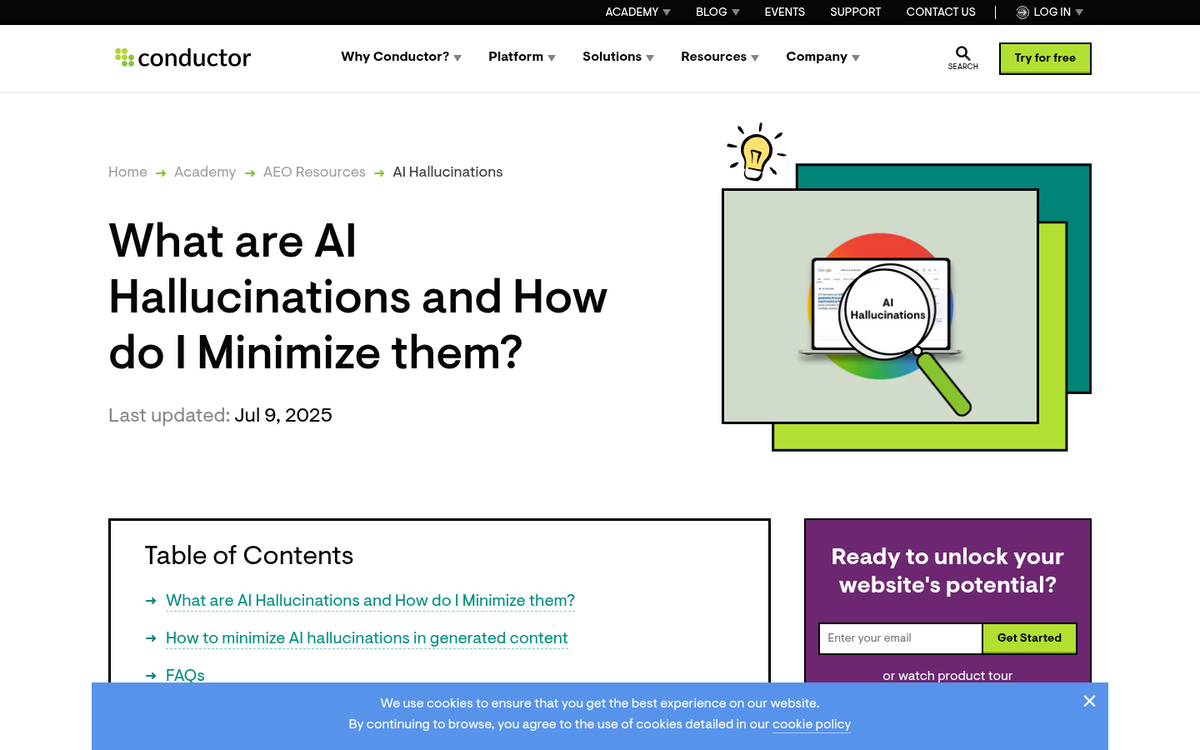
OpenAI's o3 is the most counterintuitive entry here. A hallucination rate between 33% and 51% is high on its own. But what makes it notable is that o3 hallucinates at more than double the rate of OpenAI's earlier o1 model. Most would not expect a newer, more capable model to produce less reliable facts.
Raw capability and factual accuracy don't always move in the same direction. A model can become better at reasoning, writing, and following instructions and also become more willing to produce confident-sounding information that isn't true.
The AI tool you choose for content work is not a neutral choice. If you're using a high-hallucination model to write product descriptions, answer customer questions, or generate content meant to appear in AI-powered search results, a actual portion of what it produces could have false facts.
It's also worth knowing that hallucination rates aren't fixed. They can change depending on the type of question, how the topic is framed, and how far outside the model's training data your prompt goes. Niche industries and technical subjects tend to produce more errors across all models.
Treat these rates as a starting point for how much skepticism to bring to any model's output. A 0.7% rate still means mistakes happen, and a 50% rate means you're working with a first draft that needs fact-checking before it goes anywhere near your website.
How AI Hallucinations Affect Your Website's Credibility and AEO Performance
Answer engines like Google's AI Overviews, Perplexity and ChatGPT pull content directly from websites to generate their replies. If your site contains inaccurate claims - whether they got there through AI-assisted writing or just poor fact-checking - those engines may treat your content as an unreliable source and stop citing it altogether.
That matters quite a bit more than it used to. Answer Engine Optimisation (AEO) is quickly becoming as important as traditional SEO, and citation authority is at the heart of it. Engines that surface answers to users want to pull from sources they can trust, so accuracy is now a direct ranking factor in a meaningful sense.
Consider the damage to your brand if an AI cites your site for something that turns out to be wrong. A user searches a question, gets an answer attributed to your domain, and then discovers it's false. That user is unlikely to visit your site again, and even less likely to recommend it.
The business cost of AI-generated misinformation is also real and measurable. Forrester has put the figure at around $14,200 per employee per year in mitigation costs - covering the time and resources needed to find errors, correct published content, and manage any reputational fallout. For small teams, that overhead piles up fast across a content operation.
There's a compounding effect worth mentioning. If AI tools are part of your content workflow and they generate a hallucinated claim, that claim can get published, indexed, and then picked up by another AI model as a training source or citation. Inaccurate information doesn't stay contained to one page; it can spread through the wider web of AI-generated content before anyone catches it.
Website owners and content managers are now responsible for a layer of quality control that didn't exist before. Well-written content is necessary but not enough - every factual claim, statistic, and attribution needs to be verified against a reliable source before it goes live. This is especially true for content in sectors like health, finance, and law, where a single wrong statement carries consequences for readers. It's also worth scanning your posts for errors as part of your standard publishing checklist.
AEO performance can depend on being a source that answer engines return to again and again. That reliability is built slowly through steady, accurate publishing, and it can be damaged much faster than it's earned. A handful of unchecked AI-generated posts can undermine months of credible content work. Taking time to consolidate and update older content into stronger, verified resources is one way to protect that foundation.
The good news is that this is a solvable problem - it doesn't mean scrapping AI tools from your workflow entirely - it does mean building in the right checks so that what gets published is something you'd be confident to stand behind. The next section covers how to do that.
How to Keep Hallucinations Off Your Site and Out of Your AEO Strategy
It is also worth auditing the AI-generated content already on your site. Unsupported claims that slipped through earlier may quietly be undermining your credibility with readers and AI systems looking at your content for citation. A single factual error can point to untrustworthiness at scale - and in the context of Answer Engine Optimization, that signal is expensive.
AEO is ultimately a competition for trust. AI models surface the sources they are most confident citing, and hallucinated content is the fastest way to be excluded from that consideration entirely. The websites that earn steady AI citations in the months and years ahead will be the ones that made accuracy a content standard - not an afterthought. That starts with the next piece you publish.
FAQs
What financial losses did AI hallucinations cause in 2024?
AI hallucinations contributed to an estimated $67.4 billion in financial losses in 2024, with 47% of business AI users making at least one business decision based on hallucinated content, according to a Deloitte study.
Why do AI models generate false information so confidently?
Large language models predict the next probable word based on pattern recognition, not knowledge retrieval. They have no mechanism to recognize uncertainty, so they produce fluent, authoritative-sounding text even when the content is fabricated.
Which AI models have the lowest hallucination rates?
Google Gemini 2.0 Flash 001 has a hallucination rate of just 0.7%, making it significantly more reliable than Falcon-7B-Instruct at 29.9% or OpenAI's o3, which hallucinates between 33% and 51% of the time.
How do hallucinations damage website credibility and AEO performance?
Answer engines like Google's AI Overviews prioritize trustworthy sources. If your site contains inaccurate claims, AI systems may stop citing it entirely, directly harming your AEO performance and audience trust.
How can website owners reduce AI hallucinations in published content?
Every factual claim, statistic, and attribution should be verified against reliable sources before publishing. Auditing existing AI-generated content for unsupported claims and building fact-checking into your workflow are essential steps.