





Key Takeaways
- Start new campaigns with Manual CPC to build conversion data before switching to automated Smart Bidding strategies.
- Target CPA requires at least 15-30 conversions monthly to perform reliably; below that, automation essentially guesses.
- Set daily budgets at 2-3x your Target CPA to give Google's algorithm enough room to find conversions.
- When scaling Target CPA campaigns, increase budgets in 20-30% increments and wait 1-2 weeks before adjusting again.
- Manual bid adjustments interact with Target CPA unexpectedly; a +40% mobile adjustment effectively raises your target CPA proportionally.
Google Ads Bidding Strategies in 2026: Manual CPC vs. Smart Bidding
Google Ads has several different bidding strategies you can pick from, and choosing the right one can make or break a campaign. The core choice most advertisers wrestle with is between manual bidding and Google's Smart Bidding automation - though there's quite a bit of nuance you'll miss if that's all you consider. Let's break them down and talk about when each one actually makes sense.
Before we go too deep, I want to put something upfront: neither strategy is universally better than the other. If one performed worse in every situation, Google would have killed it off years ago. The fact that both still exist - and are still widely used - should tell you they each have their place. My goal here is to help you figure out which place that is for your campaigns.
Simple Definitions
The core of each option is straightforward enough to define quickly.
Manual CPC Bidding is exactly what it sounds like: you set the bids yourself. You choose an ad campaign, an ad group, or an individual keyword, and you decide what you're willing to pay. It's a fallback option for when you want specific control over everything with no algorithmic surprises. If you're operating at the very limits of your budget, or you've developed a strategy that Google's automation simply doesn't replicate well, manual bidding is your safest bet.
Target CPA Bidding is one of several Smart Bidding strategies offered by Google Ads. Google also offers Target ROAS, Maximize Conversions, Maximize Conversion Value, and Enhanced CPC - though I'll cover those briefly later. Target CPA is an automated strategy that uses Google's machine learning to optimize your bids in real time, with the goal of hitting a specific cost per acquisition. Rather than setting individual keyword bids, you tell Google what you want to pay per conversion, and it figures out the rest. Keep in mind that switching to CPA bids can sometimes hurt conversions before the algorithm has enough data to stabilize.
When Each Bidding Strategy Works Best

Once you understand what each strategy does, you can figure out when to use one versus the other. In practice, you might use both at different stages of the same campaign.
Manual CPC Bidding gives you a much greater degree of control over your individual ads, ad groups, and campaigns. If you're the kind of marketer who likes to make granular changes and optimize every dollar, manual bidding is the way to go.
It also works well when you're trying to maximize clicks or impressions on a tight budget. You can set bid caps that prevent expensive, low-value clicks while spreading your budget across as many placements as possible. Volume of clicks isn't always the best optimization goal, but it's a solid way to harvest data you can use for future campaigns - identifying what works and cutting what doesn't.
Manual CPC is particularly valuable for newer campaigns with limited conversion history. Google's own Smart Bidding requires meaningful data before it can make smart decisions. The widely cited benchmark is 30 conversions in 30 days for most Smart Bidding strategies to perform reliably, with Target CPA sometimes viable at 15 or more conversions per month. Adalysis and other third-party analytics platforms recommend sticking with Manual CPC for accounts generating fewer than 15 conversions a month. If you don't have that conversion volume yet, automating your bids is essentially asking Google to guess - and those guesses can get expensive.
Manual CPC also works well when you want to hold a specific position in search results without over-spending. Automatic bidding can sometimes cap your bids lower than you'd like in an attempt to stretch your budget. If you've determined through testing that the top position genuinely drives better conversion rates for your specific offer, setting a firm manual bid to hold that position makes sense.
On the other hand, Target CPA Bidding comes into its own when your campaign has the data to support it. Once you've crossed that 15-30 conversion threshold, Google's algorithm has enough signal to start making genuinely useful bid adjustments across thousands of auction variables simultaneously - device, location, time of day, audience, search query intent, and more - in ways no human can replicate manually at scale.
One important nuance many advertisers miss: your daily budget matters as much as your target CPA. If your daily budget is less than twice your target CPA, Google may struggle to find enough conversion opportunities to hit your goal. A general rule of thumb is to set a daily budget of at least 2-3x your target CPA. For example, if you're targeting a $20 CPA, you want at least a $40-$60 daily budget to give the algorithm enough room to operate.
Another thing to watch when scaling: don't make sudden large budget jumps. When increasing budgets on Target CPA campaigns, stick to increments of 20-30% at a time, then give it one to two weeks to stabilize before making another increase. Aggressive budget changes can temporarily tank your performance and throw the algorithm into a learning phase.
Also worth noting: manual bid adjustments can interact with Target CPA in unexpected ways. If you apply a +40% mobile bid adjustment on a campaign with a $10 target CPA, your effective mobile target CPA rises to $14. That's not always a bad thing, but it's something you need to be intentional about rather than stumbling into accidentally.
Target CPA bidding is also the smarter choice when you're managing a large number of campaigns, ad groups, or keywords. Even the most skilled marketer is going to struggle to micromanage manual bids across thousands of keywords. Automation handles that scale far more efficiently, freeing you up to focus on strategy, creative, and offer optimization.
My general recommendation: start new campaigns on Manual CPC, build up conversion data, and then make a deliberate decision. If the campaign is performing well and hitting that 15-30 conversion threshold, consider switching to Target CPA and let the algorithm optimize from there. If it's underperforming, diagnose the problem - creative, landing page, audience - before handing it over to automation. There's no point in automating a broken campaign.
Taking Google's Recommendations
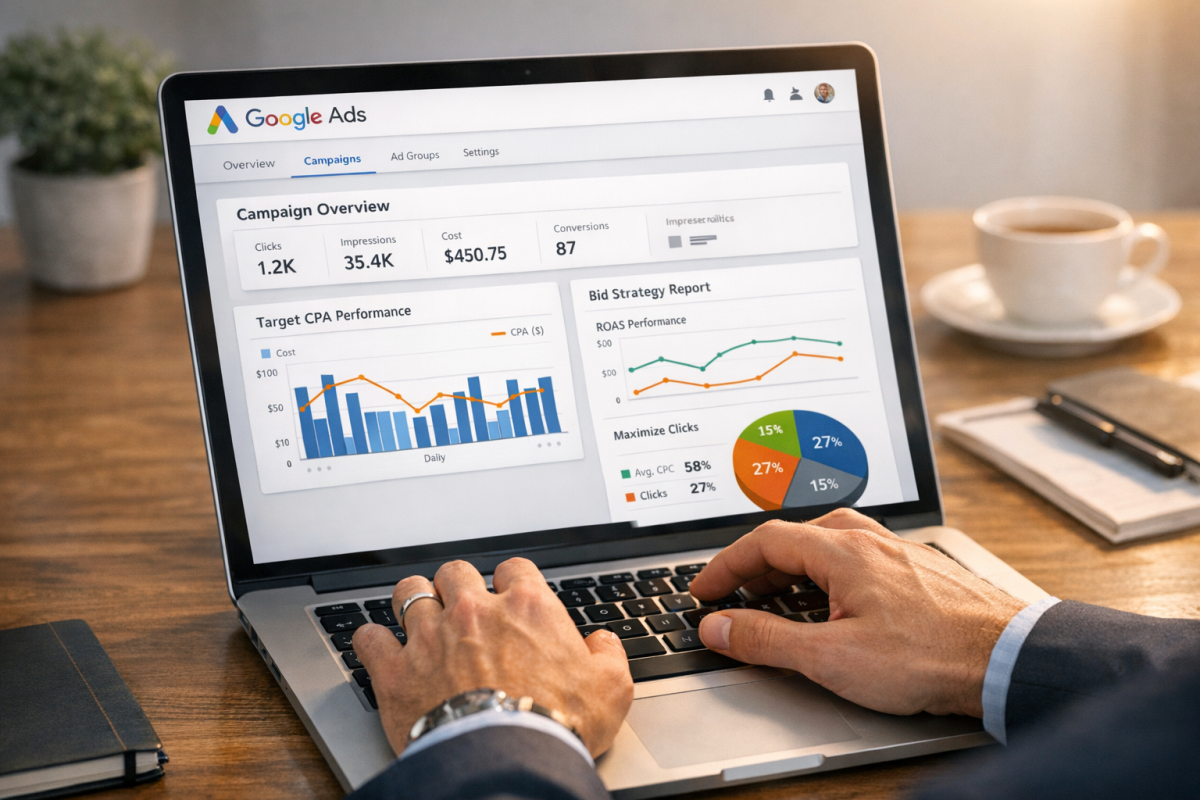
Google has access to an extraordinary amount of historical data across every advertiser on its platform, and it uses that data to suggest bid levels when you're setting up campaigns. Should you trust those recommendations?
Yes, to a point. Google's suggested bids reflect a broad average of what similar advertisers are paying, but they won't always be right for your specific situation. Setting your bid cap 10-20% higher than Google's recommendation when launching a new campaign can help you gather initial data faster, since you'll be more competitive in auctions from the start.
Conversely, setting a cap 10-20% lower can be useful if you're working with a limited budget or want to analyze the cheaper end of your traffic spectrum. Just be careful: it's easy to set a bid too low and get priced out of meaningful auctions entirely, ending up with very little data to work with.
Due to the nature of the ad auction system, costs can vary significantly even within specific bid ranges. Set what you're genuinely willing to spend, and let the system operate within that constraint. Don't over-spend on the assumption that more spend automatically produces better data or better customers - often it just raises your average cost per acquisition.
As for how long to run Manual CPC before switching to automated bidding: most guidance points to roughly 30 days and at least 30 conversions as the threshold to consider making the switch. For high-volume campaigns, you may hit that threshold faster. For lower-volume campaigns, you may need to wait longer. The conversion count matters more than the calendar. Fifteen conversions might be a few hours of data for a large national retailer - that's not an adequate sample. Let it breathe.
Other Bidding Strategies Worth Knowing
Beyond Manual CPC and Target CPA, Google Ads offers several other bidding strategies worth understanding.
Target ROAS (Return on Ad Spend) is Smart Bidding focused on revenue rather than conversion volume. It's extremely useful when your conversions have variable values - optimizing for a $500 order rather than a $20 order, for example. It requires even more conversion data than Target CPA to function reliably, so it's typically best for more mature campaigns.
Maximize Conversions tells Google to get you as many conversions as possible within your budget, without a specific CPA target. This is great when you want volume and have budget to support it, but can be dangerous on limited budgets where cost-per-conversion efficiency matters.
Maximize Conversion Value is the revenue-focused equivalent - get as much total conversion value as possible within your budget. Similar caveats apply.
Enhanced CPC (eCPC) is a hybrid that starts with your manual bids but allows Google to adjust them up or down based on the likelihood of conversion. It splits the difference between full manual control and full automation, though Google has been gradually deprecating eCPC for Search and Shopping campaigns in recent years, so its long-term availability is worth keeping an eye on.
Maximize Clicks does exactly what it says: gets you as many clicks as possible for your budget with no consideration for conversion quality. This can be useful in very specific data-gathering scenarios, but it's not a sustainable performance strategy on its own.
Target Impression Share lets you bid to hit a specific impression share - top of page, absolute top, or anywhere on the results page. You can also use it to outrank a specific competitor's domain. Be cautious with the competitor outranking option specifically: if they've set the same strategy targeting you, you can end up in a bidding war that drives both of your costs up dramatically until one of you hits a budget cap.
CPM and vCPM strategies are impression-focused and most applicable to display and video campaigns where brand visibility is the primary goal rather than clicks or conversions. If you're running YouTube ads or display campaigns for awareness, these are worth exploring - but for search campaigns chasing measurable ROI, a CPA or ROAS strategy will almost always serve you better.
The landscape of Google Ads bidding has shifted significantly toward automation, and that trend is only accelerating. But automation isn't a substitute for strategy - it's a tool that amplifies whatever foundation you build underneath it. Get the fundamentals right first: solid conversion tracking, a compelling offer, a well-structured campaign, and enough data to work with. Then let the algorithms do what they do best.

1 response
Thoughtful replies only - we moderate for spam, AI slop, and off-topic rants.
Yep, be very careful using Target CPA, it was bleeding disaster for one of my customers - clicks and conversions dropped by 90%...