Key Takeaways
- Boredom is a serious threat to bloggers; when you stop caring, sites die and become forgotten failures.
- Reading broadly outside your niche can spark fresh ideas and unexpected connections back to your core topic.
- Branching into podcasts, videos, infographics, or interactive content introduces new creative challenges that combat stagnation.
- Challenging yourself with experiments, original research, or 30-day topic challenges can reignite enthusiasm and improve measurable results.
- When boredom feels insurmountable, outsourcing blog management lets you focus on rewarding aspects while keeping revenue flowing.
For some, blogging is like a dream come true. You can make a living - a living from home! All it takes is some web hosting, a little technical know-how, and the ability to write blog posts on a regular basis. There's nothing to it!
Well, the great age of blogging is long over. These days, the basic barrier to entry is much higher. Blogging can be as much or more responsibility than a 9-5 job, and worse, if you have a bad week, a medical issue, or a catastrophe, you're on your own. You don't get paid if your site isn't working. There's no back-up, no vacation time, no benefits.
Anyone who has ever tried to turn a hobby into something they do for a living knows one dark secret. That phrase "when you do what you love, you'll never work a day in your life"? It's supposed to be placating, uplifting - it's supposed to tell you that if you love what you do, your work won't feel like work.
The dark secret is that the opposite is usually true. If you take what you love and try to make a living with it, more often than not you'll come to hate it. People who grind card game tournaments for a living end up hating the game. People who make art for a living stall out with their inspiration, have a hard time coming up with something that will sell, instead of something they like.
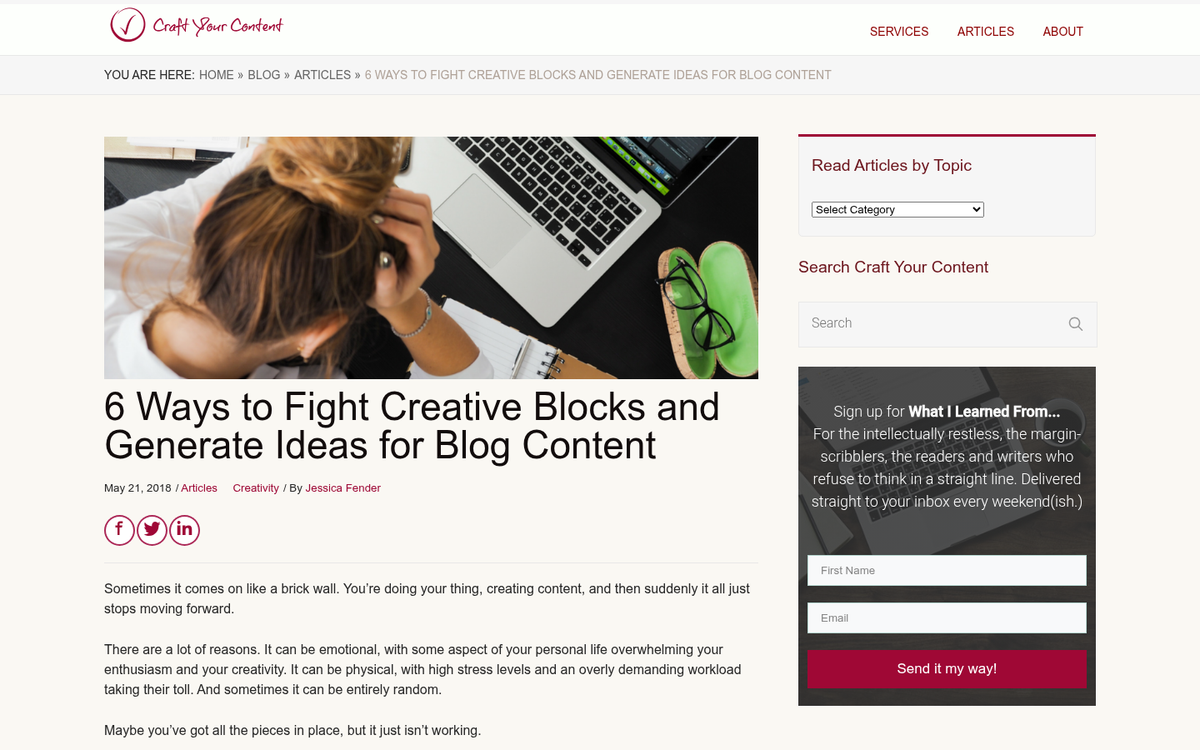
And those who write, who blog for a living? Well, we run into all kinds of problems. Writer's block can make it hard to put words on paper. Keyword research takes passion out of the equation and replaces it with commercialism. And, worst of all, sometimes we just get bored.
Boredom is a threat. It's a giant threat. When you're bored, you just stop caring. When you stop caring, it's easy to let a site die, and at that point it can become just one of a million failed websites floating around the web, or fading into obscurity. Eventually, people might only vaguely remember your brand name, and the only way they can find your content is through the Wayback Machine.
And consider this: according to Orbit Media, the average blog post now takes 3 hours and 51 minutes to write - a 60% increase from just a decade ago. Blogging is harder, more time-consuming, and more competitive than ever - it's no wonder burnout and boredom set in. 60% of B2B marketers say they have a hard time creating engaging content. You're not alone.
Thankfully, boredom can be fought - it's not a death sentence, it's just a rut, a lull. You can work past it. I'm not going to lie; sometimes it takes effort to get past. Even so, anyone who has reached a phase of boredom with their site has a number of options they can explore.
Bring the Magic Back
When you're starting out with a new blog, you have untapped potential around every corner. Once you've been blogging for a while, it's easy to run into dry wells. So how can you bring the magic back?
Read more. Read more and read broadly. Just because you're writing about, say, marketing and social media on a daily basis doesn't mean you have to restrict yourself to reading about those topics around the clock. Follow your passions, your interests!
One of the biggest driving factors for boredom in blogging is basically reaching the 80/20 point. You've done the basic and intermediate reading and learning. The more you read, the more is already familiar to you, and the fewer new topics you find to read about. You've become something close to an expert, or at least a journeyman, and it's harder to find ways to progress.
So why not read about other topics? Just pick up something and learn about it. Sometimes the simple act of finding something new to read about is enough to solve some boredom. Sometimes you can find some angle on that new topic that ties it back to your core blogging topic.
For example, maybe you're tired of reading about social media. But you pick up a book on the behavior of pack animals. You read about the great flocks of starlings, or about the pack dynamics in a herd of deer, or about herd immunity in humans - it has nothing to do with marketing. But it's learning about the world around you.
And maybe it gives you inspiration on how to visualize a social media audience, and how you can guide the behavior of a group through herd dynamics.
Use AI as a creative sparring partner. This one wasn't out there as an option even a few years ago. But it's now one of the most helpful ways to shake off creative stagnation. According to Orbit Media, 66% of bloggers use AI tools to help generate ideas - up sharply from 43% in 2023. Others use it to draft headlines (58%) or outlines (54%).
The key is to treat AI as a brainstorming tool - not a ghostwriter. Throw a vague topic at it and ask for ten unusual angles. Ask it to steelman an argument you disagree with. Use it to break through the blank page problem, then take it from there in your own voice. When the well feels dry, AI can at least help you find the bucket.
Branch out into new formats. Writing is easy. Good writing is tough. Technical writing requires mastery over grammar and spelling, and web writing requires mastery over vocabulary. Even so, after a few years of standard blogging, it's easy to have mastered the blog post format.
Why Not Try Something New?
You wrote one giant, high quality blog post. But you can do so much more with it.
- Condense and convert your blog post into a script and read that script as part of a podcast. Now you have an entire new medium to learn: the spoken word. There's a lot more to a good audio piece than just a script, and you'll have plenty to learn as you give it a try.
- Further condense your script into an outline and convert that into an infographic. Now you have another new medium! You get to study existing infographics and learn graphic design, pick up new software to play with, and seek inspiration from the imagery of your industry.
- Take your podcast and put it to video. YouTube remains a massive market, and a good video can not only draw in a new audience but make you money as well. You already have the audio, so all you need to do is create a video. But wait, how do you even start doing that? Do you pick up a program for animation? Do you buy a camera to record yourself demonstrating it? Welcome to an entirely new format to explore.
- Add interactive content to the mix. Quizzes, calculators, polls, and assessments don't just keep readers engaged longer - research from MediaFly shows interactive content drives 52.6% more engagement than static content. Building something interactive around your expertise can reignite your own enthusiasm while delivering genuinely more value to your audience.
You can even take a different perspective and lean away from your content to find other avenues to learn. Why not try to add some merchandise to your site? You can design stickers and pins, you can print t-shirts, you can work on mailers and pamphlets; there's all kinds of tertiary forms of marketing you can check out; failure isn't devastating.
Talk to others in your industry. There are two strategies you can take to this: professional and casual.
On the casual front, you can simply reach out to your industry peers on social media, at trade events, or just via email. Chat with them, talk to them, get to know them. Trust me; blog owners are going to welcome the chance to socialize, without the expectation of making interview-ready content or having it all lead to some partnership deal.
On the professional side of things, target influencers with an eye for new content. Interview them about a topic. Create a small survey and send it out to a number of influencers to see what they have to say. Sometimes building connections can be just as fun as starting your blog was.
Talk to your audience. You're building them up, why not have a talk? You can do this in a community forum, a dedicated Discord server, a Facebook group, or just with a Q&A post on your site. Ask your readers what they do when they're bored of their work. Ask about imposter syndrome, about networking, or about business decisions. Just have a talk, solicit audience feedback, and see where it leads.
Challenge yourself. Nothing gets the creative juices flowing quite like a challenge, which is why there are so many challenge systems out there. Here are a few ideas you could give a try:
- The 30-day topic challenge. Pick a single topic and try to write a new blog post about that topic every day. Pick different angles, argue different perspectives, dig deep into data or cover it broadly and superficially; just explore the topic in as much detail as you possibly can, learn everything you can about it, and write for your audience to explain it. Note that bloggers who publish frequently - 2 to 6 times per week - are 50% more likely to report strong results, according to Orbit Media. Consistency pays off.
- The original research challenge. Conduct your own survey, run your own experiment, or dig into publicly available data and present original findings. Bloggers who publish original research are 41% more likely to report strong results (Orbit Media), and there's a reason for that: it's genuinely exciting to discover something and be the first to write about it. It also earns links naturally, which never hurts.
- The outreach challenge. Reaching out to contact and network with other industry blogs can be tricky, especially when your site is small. It makes a lot of writers risk-averse. "Oh, they won't want to talk to me, my site is tiny!" you say, justifying inaction. Put yourself out there and ask; the worst they can do is say no, and that's no penalty at all.
- The grand experiment. Pick a hypothesis and test it! Experiment with different content formats, ad configurations, email sequences, or traffic sources. When you create and perform an experiment, you're doing something new and interesting that you wouldn't normally do. More importantly, you can use that experiment to create a compelling case study that earns links and attention from other bloggers.
Whatever you pick, pick something that will challenge you without being truly impossible. You want something you can do that will push you forward - not something that will drive you to quit from the scale of the job.

Take a field trip. Most industries have events of varying scales you can attend. Check your local city for networking events or events in your industry. You could be surprised at what shows up. Many small events don't actually have much marketing, and you can get involved just by showing up. Others may be national or widespread events with thousands in attendance, and they can be awesome.
Have you attended a speech from an industry influencer? Participated in a workshop? Just traveled knowing that the other end of the trip will be full of inspiration and new ideas? Traveling for an event gives you plenty of great information.
Start a new site. Managing multiple sites can get out of hand if you're not careful. But if you're only keeping a couple of sites going, it won't become too much to manage. If you're bored with your site in your latest topic, don't abandon it. But spice up your blogging life by picking a new, very different topic and writing about that.
Affiliate and niche content sites are great for this. You can pick a topic that has nothing to do with anything else you do. But focus it around a product line or subject area you have some genuine interest in. Now you're drawing from your previous blogging experience to build a new site, while actively learning about a new industry and new niche at the same time. Success has the immediate result of a new influx of cash, and who can say no to that?
Outsource it. Sometimes boredom ends up being nigh-insurmountable, and you find yourself staring down the barrel of an account cancellation. You just don't care anymore. But your site still makes money, so you're loathe to kill it off or sell it. So why not outsource it?
Hire someone to manage your blog for you and focus your attentions on the bigger parts of running a site. When you outsource the parts that take up quite a bit of time and energy and aren't rewarding to you personally, you can enjoy the parts that are rewarding, and that brings you right out of the slump. It does cost money to hire someone to manage blogging. But that's not necessarily a bad thing. As long as you're paying out less than you're bringing in, you're good to go.