That question turns out to be a lot more interesting than it first appears. Perplexity is not basically running a search and pulling quotes from the top results. The process sitting between your query and those final citations involves a few layers - crawling, retrieval, ranking and the judgment calls of a large language model - all working together in a matter of seconds. Most users never see any of it, which is partly the point.
The scale makes it worth examining. Perplexity now processes hundreds of millions of queries every month, which means its citation decisions are quietly shaping how a giant number of people see information online. What gets cited and what gets left out is not random, and it's not purely algorithmic in the traditional sense either - it's something in between, and that middle ground is where things get legitimately tough.
What follows is a close look at how that process actually works - the mechanics, the tradeoffs, and the design options that determine which sources make the cut.
Key Takeaways
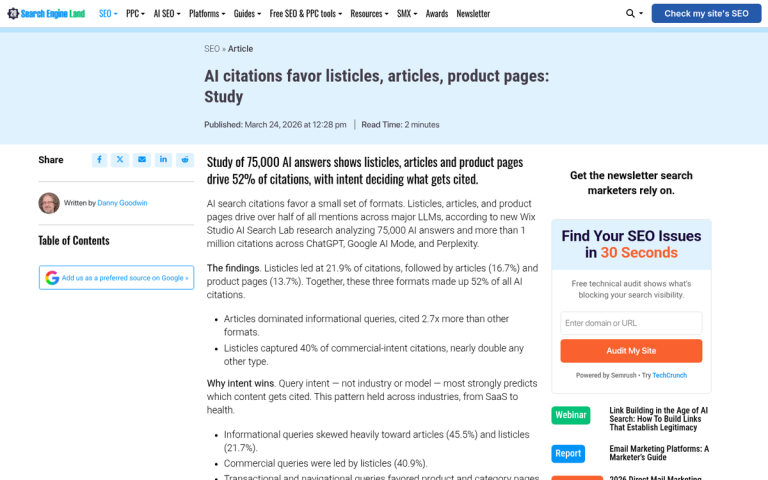
- Perplexity uses a 6-stage pipeline-from query parsing to LLM synthesis-before generating any cited answer.
- Hybrid retrieval combines keyword (BM25) and semantic search to narrow roughly 5 billion URLs down to ~10 candidate pages.
- Pages answering queries within the first 100 words, published recently, and using schema markup earn significantly more citations.
- Benchmark accuracy reaches 93.9%, but a 2025 Columbia Journalism Review audit found a 37% real-world citation error rate.
- 80% of Perplexity-cited URLs don't rank in Google's top results, meaning AI citation and traditional SEO require different strategies.
The 6-Stage Pipeline That Produces Every Cited Answer
Every answer Perplexity gives you passes through a fixed sequence of decisions before a single word gets written.
Here is a plain-language overview of each stage.
| Stage | What It's Called | What It Decides |
|---|---|---|
| 1 | Query Intent Parsing | What the user actually wants - a fact, a comparison, a list, or an explanation |
| 2 | Real-Time Web Retrieval | Which parts of the web to pull from using both keyword and semantic search |
| 3 | Multi-Layer Reranking | Which retrieved pages are most relevant after three rounds of ML scoring |
| 4 | Content Extraction | Which specific passages within those pages are worth keeping |
| 5 | Prompt Assembly | How the retrieved passages get structured and tagged before the LLM sees them |
| 6 | LLM Synthesis | How the model writes the final answer using only what was passed in |
Stage one is easy to forget. But it shapes everything downstream. Perplexity doesn't treat your query as a string of keywords - it tries to classify what answer you need before it goes looking for anything.
Stage two is where retrieval happens and it means two different search methods running at the same time. One strategy matches exact terms and the other matches meaning, so the system can catch relevant pages even when they don't use your exact words. The next section covers this in quite a bit more depth.

Stages three and four are about narrowing down. The reranker runs three passes over the retrieved pages to score them, and then the system pulls the most helpful passages from the survivors. By the time stage five starts, the result is a small set of pre-tagged text blocks with citation markers already built in.
Stage six is what most people picture when they think about how Perplexity works - the LLM writing the answer. The citations you see in the final answer were basically chosen in stages two through four, long before any text got written. Understanding answer engine optimization can help you see why content structure matters so much in this process.
How Hybrid Retrieval Narrows 5 Billion URLs Down to 10 Pages
Perplexity's crawler index holds around 5 billion URLs; it's the pool every query draws from, and the retrieval stage has to get from that number down to a workable shortlist - fast. The mechanism that makes this possible is called hybrid retrieval, and it runs two very different search methods at the same time.
The first strategy is BM25, a keyword-based algorithm that looks for exact term matches between your query and the indexed text - it's been a search industry workhorse for decades because it's fast and fairly reliable at finding pages that use the precise words you typed. But it falls apart when the right page uses different wording to say the same thing.
That's where dense vector embeddings come in. Instead of matching words, this converts the query and each document into numerical representations that capture meaning. Two sentences can share zero words and still land close together in this vector space if they're about the same idea. Running both methods together means Perplexity catches exact matches and conceptual ones - a benefit for queries that are phrased naturally instead of as keyword strings.
The outputs from both methods get combined into a single ranked list. From 5 billion URLs, this process surfaces roughly 10 candidate pages per query - not 100, not 50, about 10.
It's worth pausing on that number. Those 10 pages are all that reach the next stage of the pipeline. Everything else in the index, no matter how relevant it might actually be, is out of the running. The retrieval stage acts as a very tight filter, and the quality of what gets cited later depends very much on whether the right pages made it into that shortlist.
That's also why hybrid retrieval matters. A keyword-only strategy would miss pages that are legitimately on-topic but phrased differently. A semantic-only strategy can sometimes drift toward pages that feel related but don't contain the precise information the query needs. Together, they balance each other out and produce a shortlist that's precise and large enough to be helpful. This principle also applies to how WordPress pages and posts rank differently in traditional search engines.
The next stage - reranking - takes those 10 pages and decides which ones deserve to be cited in the final answer; it's where things get more selective.
What the Three-Tier Reranker Actually Looks for in a Source
At this point, the retrieval pipeline has handed the reranker roughly 10 candidate pages. The job is to cut that down to 3 or 4 citations, and the signals used for that are telling.
The biggest one is answer placement. If the direct answer to a query doesn't appear in the first 100 words of the page, the chances of that page being cited drop dramatically. Around 90% of top-cited pages put the answer right at the top. Pages that build up slowly - with long introductions or background sections before getting to the point - tend to get passed over, regardless of how good the rest of the content is.
Freshness matters quite a bit too. About 70% of top citations come from content published within the last 12 to 18 months - it's worth asking if that aligns with accuracy or if the model treats recency as a stand-in for trust. For fast-moving topics, older content may legitimately be outdated. But for stable topics, the model still seems to lean toward newer pages, which suggests recency carries weight as a trust signal in its own right. This is one reason publishing consistently can affect your rankings over time.
Then there's schema markup. Pages with structured data tagging reach a Top-3 citation rate of 47%, compared to 28% for pages without it; it's an actual gap, and it likely depends on how readily the model can parse the page's content. Our review of All in One Schema.org Rich Snippets goes into how this kind of tagging works in practice.

| Citation Signal | What It Measures | Impact on Citation Rate |
|---|---|---|
| Answer in first 100 words | Answer placement speed | 90% of top citations follow this |
| Content freshness | Published within 12-18 months | 70% of top citations meet this |
| Schema markup presence | Structured data tagging | 47% vs. 28% Top-3 citation rate |
Schema markup tells the model what content it's looking at and where the important information lives. If you don't have it, the reranker has to work harder to extract meaning from the page, and that extra friction can cost a citation slot.
Consider content that buries its main point three paragraphs in, or a page that skips structured data entirely. The underlying information could be excellent. But the reranker is working fast and rewarding pages that make its job easy.
Where Perplexity's Citation Accuracy Holds Up - and Where It Breaks Down
The numbers Perplexity puts forward are strong. Its retrieval model scores 93.9% on SimpleQA benchmarks and Deep Research hits 92.3% citation accuracy in controlled evaluations. Those are not small margins.
But the Columbia Journalism Review ran an audit in 2025 and found a 37% error rate in real-world citations; it's a wide gap from the benchmark figures and it deserves a look instead of a quick dismissal in either direction.
Both sets of numbers can be accurate at the same time. Benchmark tests use well-formed questions with verifiable answers. The retrieval model performs well when the query is precise and the source pool is stable. Real-world queries are messier, more ambiguous and they pull from a much wider number of source types.
A 37% error rate in practice means that more than one in three citations has some problem. That could be a source that doesn't support the claim, a page that has since changed, or a document that was technically retrieved but only loosely relevant to the point it's attached to. Not every error means the cited content is wrong - but it does mean the citation isn't doing the job it seems to.
For a user, this has an effect on how much trust is reasonable to place in a cited source without checking it. If you're researching something low-stakes, a citation that's directionally correct is probably fine. If the answer matters - medical, legal, financial - a citation attached to a claim is not the same as that claim being verified.
The model also works with some query types better than others. Factual lookups, recent news from indexed publishers and structured data questions tend to produce more reliable citations. Open-ended analytical questions, niche topics and anything that requires synthesis across sources introduce more room for the citation layer to slip. Understanding what signals indicate healthy user engagement can help you evaluate whether your own content holds up under similar scrutiny.
| Query Type | Citation Reliability |
|---|---|
| Factual lookups with a single answer | High |
| Recent news from major indexed publishers | High |
| Niche or specialist topics | Lower |
| Multi-source analytical questions | Lower |
The difference between benchmark performance and real-world accuracy isn't unique to Perplexity - it's a known tension in retrieval-augmented generation. Benchmarks test the model under conditions that favor it.
Why Pages Perplexity Cites Often Don't Rank on Google
Ahrefs analyzed 15,000 prompts sent to AI assistants and found that 80% of the URLs cited in replies don't rank in Google's top results for the same query; it's not a small gap - it tells you that Google SEO and AI citation are legitimately different games.
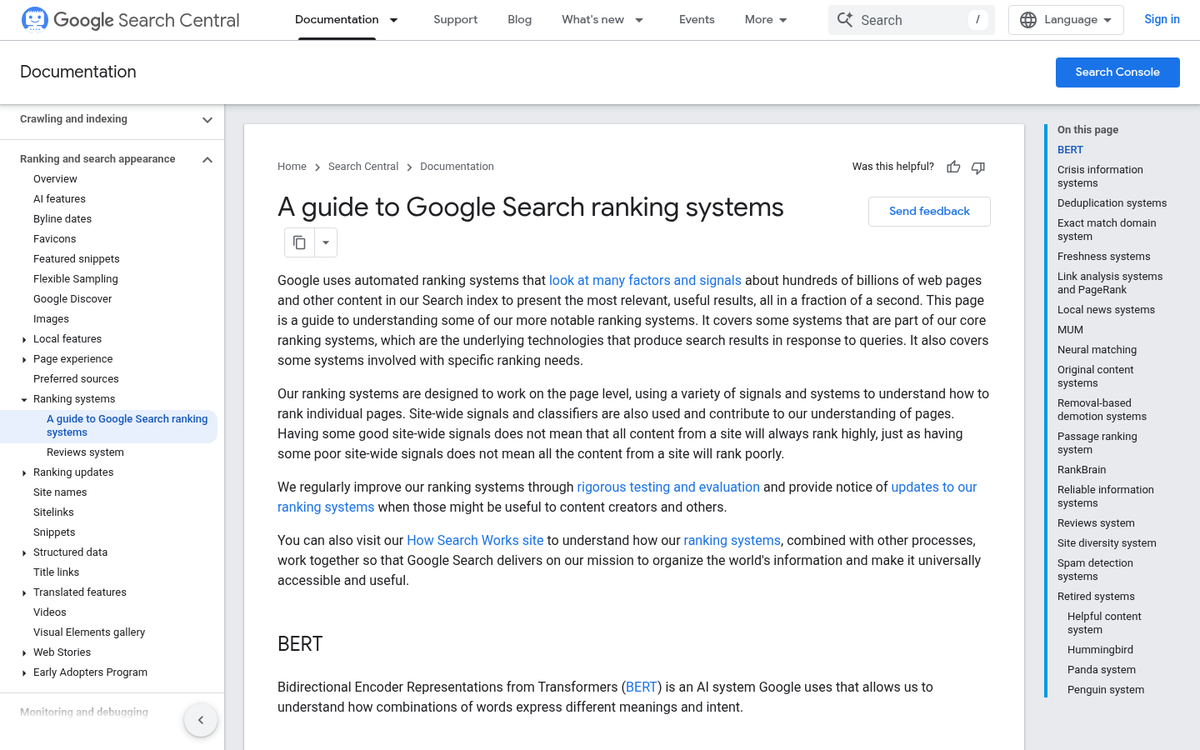
It makes sense to think about what each system is trying for. Google's ranking algorithm leans heavily on authority signals like backlinks, domain reputation and engagement data. Perplexity's retrieval model isn't running that same calculation - it's looking for pages that answer a question directly, present information in a structured way and are recent enough to be worth citing.
A page with a modest backlink profile but a well-organized, direct answer can get pulled into a Perplexity response even if it sits on page four of Google. On the other end, a high-authority page that buries its answer in long paragraphs might not get cited at all.
This raises a strategic question for anyone who creates content. If your goal is to appear in AI-generated answers, optimizing for Google's ranking alone won't get you there. The signals that move you up in search results aren't the same signals that make Perplexity want to cite you.
What seems to matter for AI citation is closer to editorial clarity than search authority. Pages that lead with the answer, use headings that match how people ask questions, and keep information up to date appear to fare better in retrieval; it's a different writing discipline compared to what traditional SEO has trained most content teams to do.
Perplexity's retrieval model isn't looking for tricks - it's looking for pages that do the job of answering a question well. The pages that tend to get cited are the ones that would satisfy a reader faster - not the ones that are technically optimized around keyword density or internal linking structures.
If you're making content with AI visibility in mind, it's worth treating that as a separate goal with its own set of standards. A page can rank well on Google and never get cited by Perplexity. Another page can get cited and barely register in traditional search. The two results don't cancel each other out - they just need different thinking.
What Understanding Perplexity's Citations Actually Changes for You
Understanding how Perplexity works means structuring content so a retrieval model can parse it cleanly. It means building topical authority that signals genuine expertise and formatting information in ways that make it easy to lift and cite accurately. It also means accepting that the model will sometimes get things wrong - misattribute, hallucinate, or skip your best content entirely. Knowing how the machine works doesn't mean trusting it blindly - it means you stop leaving your visibility to chance and start building content that's engineered to be chosen. One way to measure how well your content is positioned is with a tool like the AEO Content Grader, which can reveal gaps before they cost you citations.
That's the thinking behind BlogPros. Our process was built for this reality - combining AI-powered scale with human editorial oversight to produce content optimized for Google, Perplexity, ChatGPT, Gemini, and every answer engine changing how people find information. Every piece we produce is structured for citability, reviewed by editors, and built with AEO and schema optimization baked in - not bolted on as an afterthought. If you want to go further, improving your blog's E-A-T score is one of the most direct ways to become a source AI systems actually trust and reference. If you're ready to stop being invisible in AI-driven search and start being the source those systems actually reference, try BlogPros free for your first month - no contracts, no credit card, no commitment. Just content built for the way search works.