





In the world of buying traffic, there are literally thousands of websites that sell, and orders of magnitude more who buy. There's no shame in it, if you do it right. It's not illegal. It's not even unethical, again as long as you're not doing it for an illegal purpose or to scam someone.
We are one such site that provides traffic, but I'm not here to be self-promotional. Rather, I'd like to take a moment to talk about another in the industry. As you may have guessed from the title, I'm referring to WebTrafficGeeks. They have been around for a number of years now and continue to attract attention from those looking to buy targeted traffic, so I thought I'd address what I know of them.
Note: You're not about to read a 2,000-word negative review about how you should ignore them and go with us. I'm going to attempt to provide an unbiased view.
Key Takeaways
- WebTrafficGeeks appears legitimate based on domain registration, reverse image checks, and positive Trustpilot (4.5/5) and Sitejabber (4.3/5) ratings.
- Third-party testing shows traffic arrives but engagement is low, averaging 30-60 second sessions and roughly 1.2 pages per visit.
- WTG warns their high-volume traffic can trigger AdSense penalties, recommending moderation or avoidance for AdSense-monetized sites.
- Traffic delivery can be spread over time rather than delivered in one burst, helping avoid unnatural spikes that harm your site.
- Always start with a small one-time purchase before subscribing, and only continue if the traffic demonstrably generates profit.
Looking at the Details
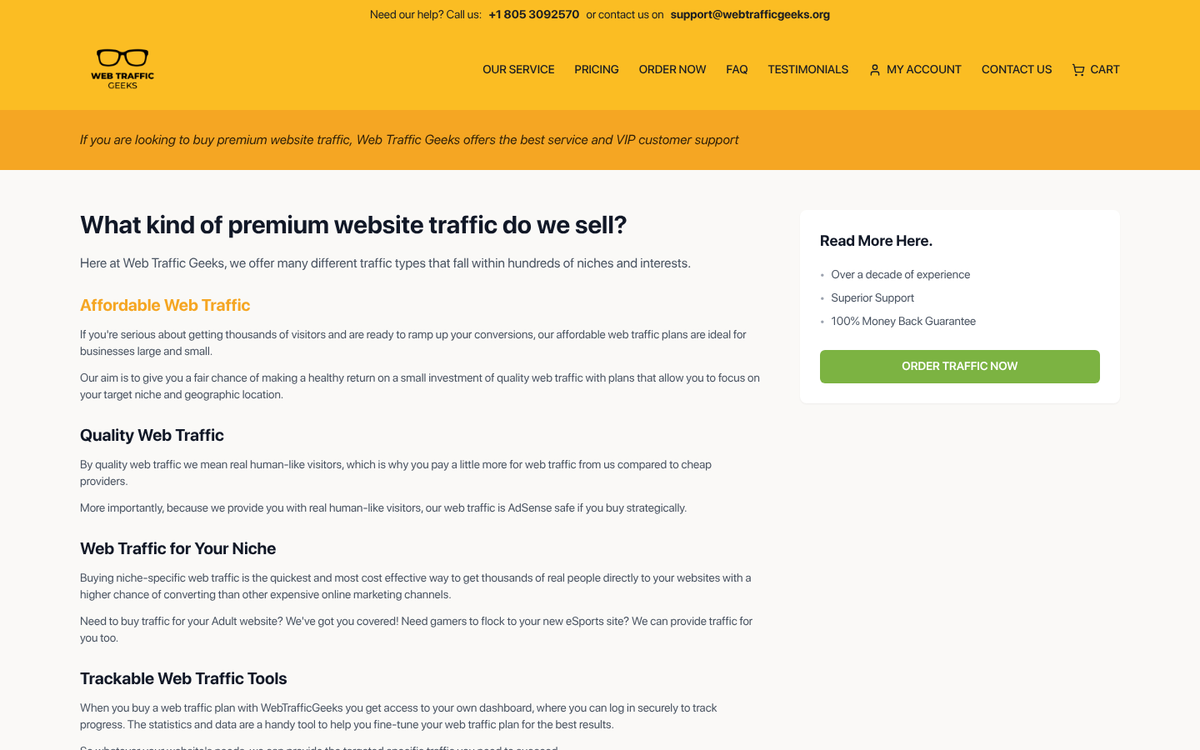
WTG - I'll abbreviate it for the sake of brevity - claims a capacity of up to 1.5 million visitors per day and offers traffic across 130+ targeted niches and from over 40 countries, so you can control the traffic you get on a deep level. Ordering is a simple process. Pick a niche and a country, pick a volume level, submit the order, and wait for it to come in. They promise delivery within 24-48 hours.
They do have a 100% money back guarantee, and a warning on their homepage. While they say their traffic is AdSense safe, they also say that they have seen large volumes of traffic - such as what they deliver - earning penalties for AdSense accounts. They recommend using their service in moderation or not at all, for AdSense-enabled websites. This is a good sign; many of the worst fake traffic providers will bend over backwards to claim their traffic is AdSense safe and that you should buy $1,000 worth immediately.
They also claim that their traffic is 100% real, targeted, legitimate traffic. No bots, no PPC traffic, and no incentivized traffic included. As for how true that claim is, third-party testing has shown that while the traffic does appear in GA4, average session duration tends to run just 30-60 seconds with around 1.2 pages per visit. In other words, visitors show up but don't engage deeply. Keep that in mind when weighing the value of what you're buying.
Interestingly, they are a global and international group focusing on many clients outside of the United States. This puts them in a unique position where they don't have to worry about many of the restrictions, filters, and penalties that come with selling traffic to primarily US businesses. It also means they are well positioned to sell international traffic from one non-US country to another. They themselves are based in the Netherlands.
What about their pricing? Plans currently range from around $50-$200 per month for 5,000-20,000 visitors, scaling up to $500-$2,000 per month for 50,000-200,000 visitors. They offer both one-time purchases and a monthly subscription model. As always, starting with a smaller one-time package before committing to a subscription is the wise move.
They have a fairly standard list of niches, ranging from advertising and dating to politics and religion. They also have a range of adult niches, if you're looking to buy traffic to sites that host adult videos, pictures, casinos, or products, among others. You can see the full list of niches and countries on their purchase page.
One good thing going for them is the ability to spread out the traffic you buy. You can choose to have it delivered over a period of time rather than all at once. This is very good, because if your site gets 3,000 hits daily, you don't want a purchase of 50,000 delivered in a single burst. The unnatural spike is hugely detrimental. Spreading out the traffic is a much better plan.
It is worth noting that support is email-only, with response times typically running 48-72 hours. If you're someone who expects live chat or fast turnaround on questions, that is something to factor into your decision.
Deeper Investigation
Doing some digging, both on their site and off, reveals some more details.
For one thing, I'm not a fan of some of their website copy. Some of it is stilted English that leaves a bad impression in my mind, but it's at least higher quality than what you might get from a low-tier content mill or cheap foreign ESL copywriter. I chalk this up to the differences between Dutch and English. Even fluent bilinguals make mistakes.
One trick I like to use in investigations is checking into the user profiles they provide. Copy a picture from a site's team page and run a reverse image search. Where does that picture show up? In this case, the pictures they provide all show up in the same few places, which is a sign of legitimacy. There's no instance of the same picture being used as the face of six different businesses under different names in different locations, which would indicate the use of generic stock photography. So far so good.
The domain is registered in the Netherlands, which is consistent with their stated base of operations there. If you're still weighing your options, it may help to read about the difference between good traffic and bad traffic before making a decision.
Their Testimonials and Third Party Reviews
So what do users have to say about them? I'll be aggregating reviews here, but bear in mind it's not personal experience on my part. I haven't used their service myself.
To begin, you can read all of the positive reviews on their site itself. They're all over the map in terms of provided information and detail, but what else is new in this industry?
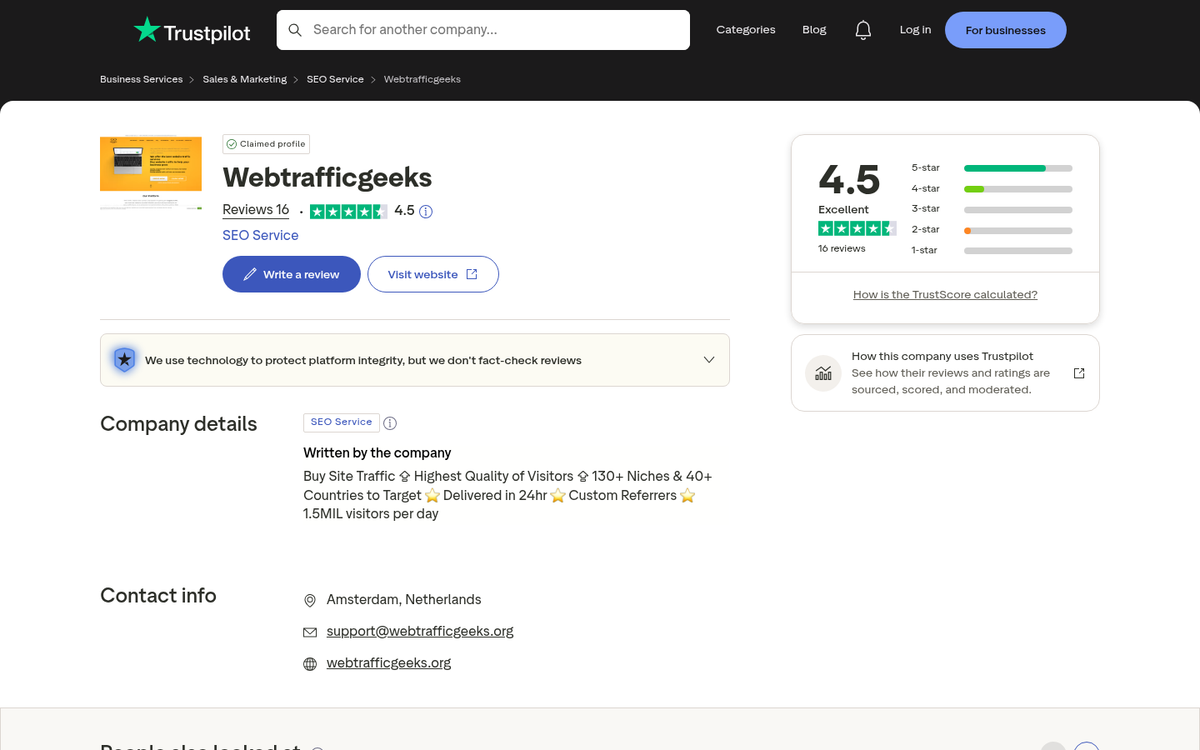
On Trustpilot, WebTrafficGeeks currently holds a 4.5 out of 5 score based on 16 reviews, with 75% being 5-star and 19% being 4-star. Only 6% left a 2-star review and none left a 1-star. That's a reasonably positive picture, though the sample size is small enough that a few bad experiences could shift things noticeably.
On Sitejabber, they carry a 4.3-star rating from 6 reviews, which is similarly positive but again based on a limited number of responses.
Third-party testing has shown that while traffic does arrive as promised, engagement metrics are modest - around 30-60 second sessions and just over one page per visit on average. This is not unusual for purchased traffic, but it does underscore the point that bought traffic and organic traffic are not the same thing. Don't expect conversion rates comparable to what you'd get from search or social.
Overall, reviews skew positive, which is a step up from the more mixed picture that existed in earlier years. That said, no traffic seller has a perfect record, and a small review pool means you should still proceed carefully. For more perspective on similar services, our Max Visits review covers our experience and conversions in useful detail.
Things to Watch For When Buying Traffic

If you're interested in using a service like WTG or any other traffic seller, remember that it's a gray hat industry. There are legitimate sellers, and there are sellers hawking resold traffic, bot traffic, or untargeted traffic. It's a very "buyer beware" atmosphere, and you often have little recourse if you don't like the traffic you get. Here are some tips you can follow.
Start small. The best thing you can possibly do when buying traffic is take it nice and easy. Don't go in for a subscription model right away, because you never know how tricky it will be to cancel if you want to stop payments. Don't go in for a huge amount of traffic, because you don't know what quality it will be and how it will take to your site. For WTG, you would want to go for one of their smaller one-time packages first, and see what it gets you. If it works, and only if it works, should you consider getting more. Only once they have proven themselves should you consider subscribing.
Read the terms and conditions. You want to make sure there aren't any tricky terms about rights transfers or anything else. It's entirely possible to fight legal terms in court if it comes down to it, but you don't want to put yourself into that situation.
Avoid using an ad program that bans you for excess bots. AdSense is the big one here, and like WTG says; they're picky with the traffic they detect coming in to your site. If they don't like it, even if it is more or less legitimate, they have the right to block you from the program at a moment's notice. If you're relying on an ad program to make your living, you might want to be very careful about what traffic you buy and from where.
Make sure any money back guarantee is real. The shady sellers out there are liable to disappear when questioned or confronted. Their site works just fine, they'll take new orders just fine, but the moment you go to request a money back claim, they clam up and won't respond. Alternatively, some of them will respond, but will point out a clause in their terms for their guarantee that for some reason invalidates your order from the claim. Once again; buyer beware.
Look up current reviews. I've referenced a few reviews in this post, but that's just a handful out of who knows how many. They will swiftly grow out of date, and you never know what changes a company might undergo. Formerly high quality providers might sell their company to someone, only for that new owner to try to maximize profits by dropping traffic quality and customer service out the window. Always look up current information before you try to purchase.
Only run one program at a time, so you can test the traffic it brings. Make sure you're taking multiple data points before and after your order. You need detailed analytics - ideally GA4 in 2026 - to make sure you're getting traffic as promised. If you buy 10,000 hits from Germany, you don't want to receive 500 hits from Germany and 9,500 hits from India. If you're buying 10,000 hits targeted to the automotive niche, you don't want a ton of traffic referred to you from DIY knitting blogs. Don't be shy about requesting that money back guarantee if the traffic doesn't work for you. These sorts of businesses would rather have a customer satisfied with a refund than an angry customer leaving negative reviews.
Don't invest more than the minimum unless you can make a profit. I don't care how targeted or how legitimate the traffic you receive is, if you're not making money from it, it's a loss. If you spend $50 on 5,000 hits and make one sale for $20, you're out $30. Maybe some of those people will come back, or maybe not. You'd have to do more testing to find out, and if you're willing to test for two months in losses to see if they do, that's your prerogative. I just recommend never buying traffic if you can't successfully monetize it.
If you're careful, slow, methodical and low-volume with your testing, you can slip under the radar of programs like AdSense, and you can stay with the program while testing your traffic. It's only when you have unnatural surges of poor traffic that you're at high risk.
After all of this, what's my verdict about Web Traffic Geeks? Evidence points to their legitimacy, and recent review aggregators like Trustpilot and Sitejabber back that up to a reasonable degree. That said, engagement metrics from third-party testing suggest their traffic is better suited to vanity metrics and volume goals than to driving meaningful conversions. Start small, if you choose to order from them, and make sure the traffic they deliver is targeted, legitimate, and on time.


7 responses
Thoughtful replies only - we moderate for spam, AI slop, and off-topic rants.
We bought some of their traffic for http://webhost.pro but never got a conversion. At most I would only do it to boost Alexa.
I have used wtg for 2 months with adsense site. Adsense always take amount of my money for invalid traffic more than other traffic source...
I tried their smallest 10000 to start, and it was authentic traffic from what I can tell. I sent them to a landing page created specifically for this test. I did not get a single conversion, but I got alot of interactions from the visitors. Bounce rate averaged 30-33. But most importantly, they were all over the site. Which helps my stats all over.. I have purchased 3 other webtraffic sources - and this was the only one that came with a very low advertising bounce rate and such an indepth customer interaction. No two visits ever looked the same.
I upped my purchase to 25000 to see if that differed in any way and subscribed.
I have now tried Web Traffic Geeks. This is not real people visiting your site.
We have a site that requires human interaction, we can see that the traffic is generated by bot's. We wanted to target the Swedish market, but 50% or more comes from countries outside Sweden. We can also see that the traffic uses crawling and follows links with no value at all.
Since i'm a developer and have been working with Analytics for many years its very easy to see that this is NOT live traffic. Yes i'm getting hits but its a bot generating the hits.
I know how my users behave on our site and what kind of foot prints they leave in Analytics. I have sent a mail to the Geeks but no answer
Janne
Hello, we tested them. They are a SCAM. The traffic is bot traffic only. You can easily identify this by screenrecording your visitors. The bot traffic can also easily be spotted using GoogleAnalytics. It's clicking on ANY link on your site and then doing nothing.
I ordered 10,000 visitors to a HIGHLY converting squeeze page.
I got ZERO opt-ins from Web Traffic Geeks over 1 month for the 10,000 clicks.
After receiving approximately 5,000 clicks I emailed Web Traffic Geeks to enquire about the terrible conversion and see if something could be done to improve the conversion, I received an auto-reply email advising someone would reply within 48 hours but I have not received any reply over two weeks later.
Terrible customer service, terrible traffic, total waste of my time and money.
I ordered the 10k traffic and on my end i could not see the traffic that was supposedly going to my website. I fell this was a complete waste of money. Perhaps someone will have better luck.