





Building links with expired domains is a somewhat uncommon strategy. We've mentioned it and written about it before. It's a pretty simple process, but it requires a bit of research and investment to do properly. Here's what you do:
- Locate a valuable, relevant expired domain.
- Vet that domain to make sure it isn't part of a spam network.
- Turn that domain into value for you.
The bulk of this article is going to be about step 1, but I'll cover steps 2 and 3 here briefly. Let's start from the end and work our way to the beginning, shall we?
Key Takeaways
- 301 redirects are the safest method, passing link equity and residual traffic from expired domains to your main site.
- Vetting is critical-check existing links, prior content, spam history, indexation, and domain age before purchasing.
- Five tools for finding expired domains: Xenu's Link Sleuth, ExpiredDomains.net, DomCop, GoDaddy Auctions, and Spamzilla.
- Relevance matters-redirecting unrelated expired domains provides little value and may appear manipulative to Google.
- PBNs are increasingly risky in 2026; only 3.82% of analyzed expired domains were used in PBNs.
Making an Expired Domain Work for You

How can you turn an expired domain into value? There are a few different methods people use. The most popular is also the simplest: a 301 redirect. A 301 redirect passes link equity from the expired domain to your site and redirects any residual traffic along with it. According to SEMrush, websites leveraging authoritative expired domains this way see 20-40% faster traffic growth compared to starting with a brand-new domain.
Another option is to build out a microsite on the expired domain and use it as a filter. This cuts the amount of direct traffic and links that reach your main site, but it acts as a pre-qualifier - sending only the most interested, relevant visitors through to your main site. Think of it like a landing page.
A third option is to build out a basic blog and add it to a private blog network powering your main site. Be cautious here. PBNs remain on Google's radar in 2026, and the risks are real. A 2025 analysis of 915 expired domains (DR 20+) purchased on GoDaddy found that only 3.82% were actually used in PBNs - most buyers are moving toward safer strategies like redirects and legitimate money sites, and for good reason.
Generally, the 301 redirect is the safest and most sustainable method, particularly when you focus on redirecting relevant domains that previously hosted content closely related to your niche. The less relevant the expired domain's prior content is to your site, the less value that redirect is going to carry.
Vetting an Expired Domain

That's where vetting the domain comes in. You want to make sure that the domain you're considering buying isn't going to harm you when you use it, and that it has enough residual value to actually move the needle. Here are some things to check and look out for.
- Existing links. A lot of expired domains were once part of a churn and burn scheme or a black hat blog network. That means many of the links pointing to them come from spam sites. You don't want spam sites linking to your main site, so carefully evaluate whether the domain is worth buying once you factor in cleanup work. Most of the time, it won't be.
- Existing redirects. As part of gray or black hat link schemes, people set up redirects from spammy domains pointing at the expired domain you're considering. These are harder to clean up than individual links, so you really need to know if they exist before you buy.
- Prior content. If the site once hosted spam, you may not want to redirect it to your main site. Even if it's been expired for a while, that negative history can still exist in Google's index - and a site that's been expired long enough to lose that baggage has probably also lost most of its residual value anyway.
- Prior reputation. Check to see if the site had branding, and whether that branding is tied to negative reviews or a bad reputation. Occasionally you can spin it as a takeover, but most of the time it's not worth the hassle.
- Existing audience. If there's a forum or community attached to the domain, is it still active? You may be able to leverage that along with the domain itself.
- Indexation. Make sure the domain is still indexed in Google. Redirecting traffic from a de-indexed domain will get you virtually nothing.
- Domain history and age. Use the Wayback Machine to check what the site used to be. A domain with years of legitimate, relevant content behind it is worth significantly more than one that was clearly built for manipulation. A 2025 analysis of 1,200 domain sales found that domains with prior active content sold for over 3x more than undeveloped domains - the market knows what it's looking for.
In general, as you can see, it's a list of factors that affect SEO but aren't really about the content of the site itself. That's because you don't care about the site - you care about the incoming traffic, incoming links, and any existing community. Those are the valuable resources you can leverage, or the harmful poison you want to avoid, depending on their quality. If you're unsure whether your link-building approach is still sound, it's worth reviewing outdated SEO techniques to avoid before you invest in any expired domain strategy.
Finding Expired Domains

Generally, there are only a few factors to consider relating to the domain itself when you're looking to buy it.
The first is relevance. You want the domain to be related to your niche, so that any residual traffic is actually interested in what your site offers. It's no good redirecting a site about pool supplies to your site about bug collecting. Google may also identify that as manipulative and discount - or penalize - the redirect entirely.
The second is keywords or branding in the domain. Exact match domains are no longer valuable for main site branding, but they're not completely worthless when used purely for 301 redirects, so don't exclude them entirely.
The third is timing. Most registrars offer a grace period of 30 to 45 days after expiration before the domain enters the redemption phase. Once it clears that window, it becomes available for registration - but it can also get snapped up fast by other buyers watching the same tools you are. Move quickly when you find something worth buying.
The fourth is, of course, cost. Domains with long histories and established link profiles are going to be expensive. The question you need to answer is whether the potential value justifies the cost, or whether you're paying a premium that will never translate to a meaningful ROI.
So how do you find these expired domains in the first place? Here are a few solid options.
Option 1: Xenu's Link Sleuth
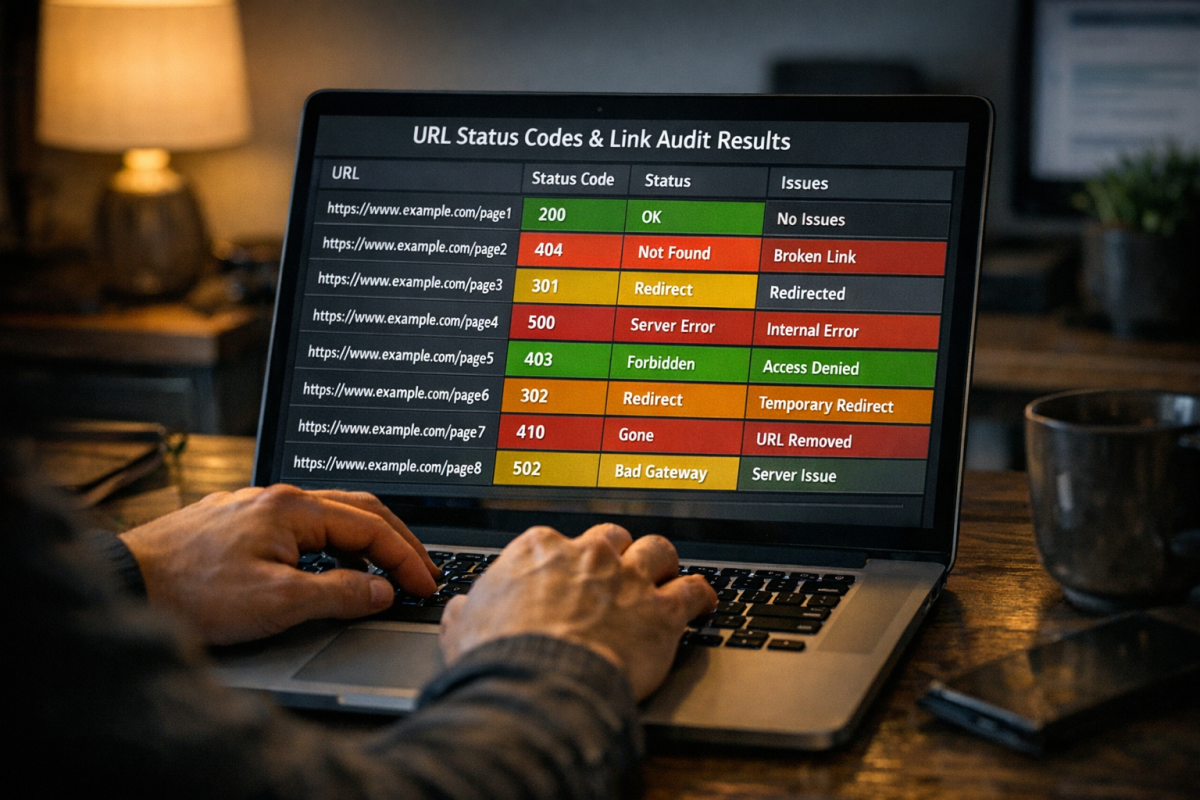
Xenu's Link Sleuth was originally built as a broken link checker, and it still does that job well. The developer prioritized pure functionality over a polished interface, and honestly that's fine - it works.
It's relatively easy to get running. Visit the homepage and download the program, install it, and you're ready to go.
Next, run some Google searches for resource pages in your niche - pages with large collections of outbound links. Searches like [keyword] + "links" or site:edu "resources" are good starting points. Ideally, filter your results to a custom date range spanning several years but excluding the most recent two or three - you're looking for pages that haven't been updated in a while, which increases the odds of finding dead links.
In Xenu, go to Options > Preferences and set the maximum depth to 1 so it only checks links on that specific page, not the entire site. Then click File > Check URL, enter the page you found, and hit OK.
You'll get a list of all the links on that page along with their status codes. You're looking for "no such host" errors - that means the domain is no longer pointed at valid hosting and may be available for registration. Finding domains that still get traffic is the real goal here.
Harvest a lot of potential URLs from this process. You're only going to have about a 5% success rate on finding broken links with available domains. When you do find available ones, run them through your vetting criteria and determine which are worth pursuing. Building links from authoritative pages like these can meaningfully boost your site's rankings when done right.
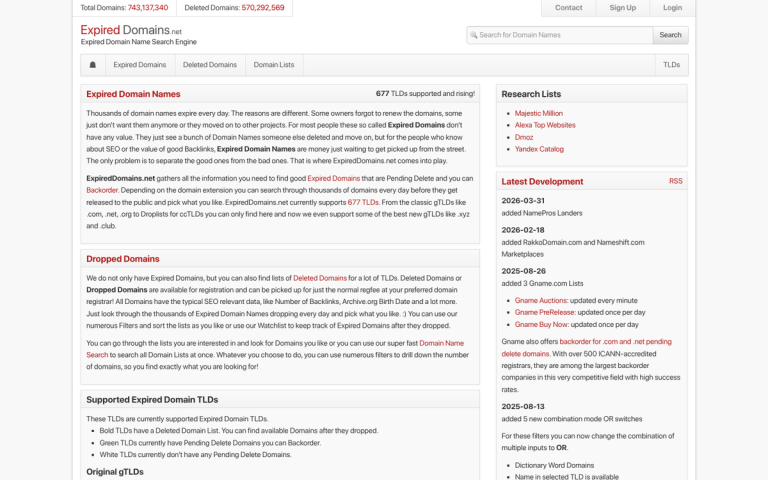
Option 2: ExpiredDomains.net
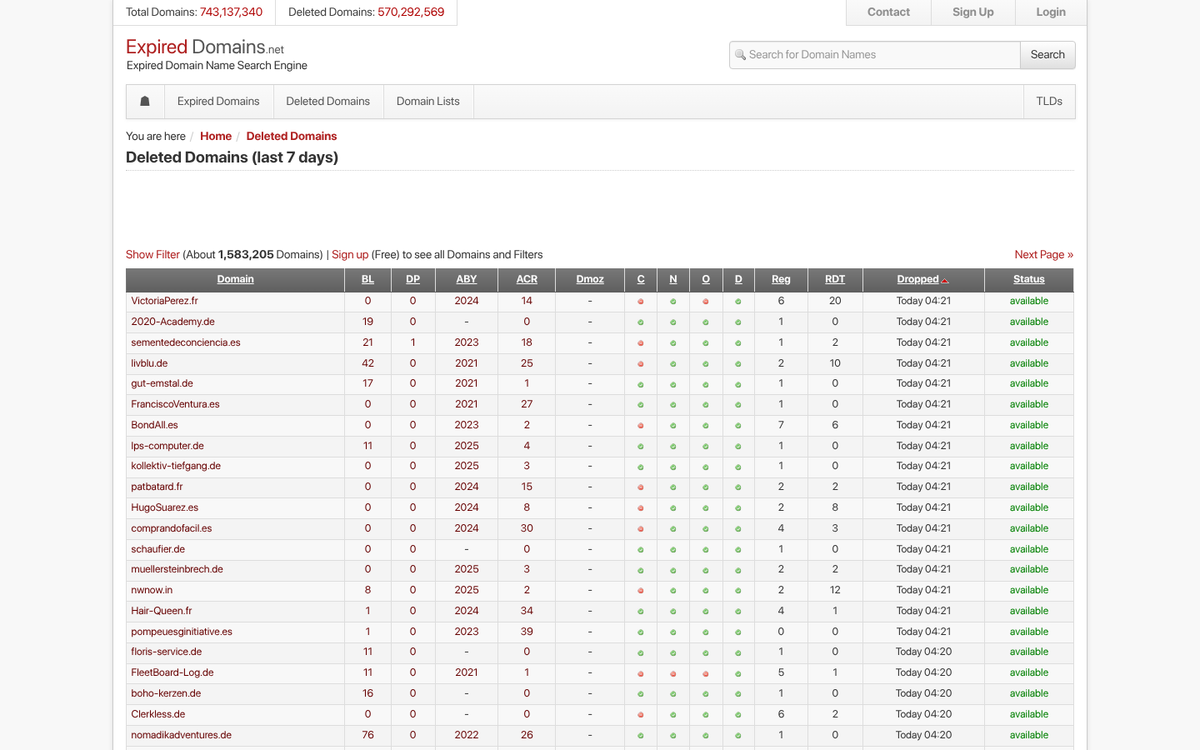
This option is easier than Xenu because you're not hunting through resource pages hoping to strike gold. ExpiredDomains.net already does the scanning for you and lets you find and evaluate domains in one place.
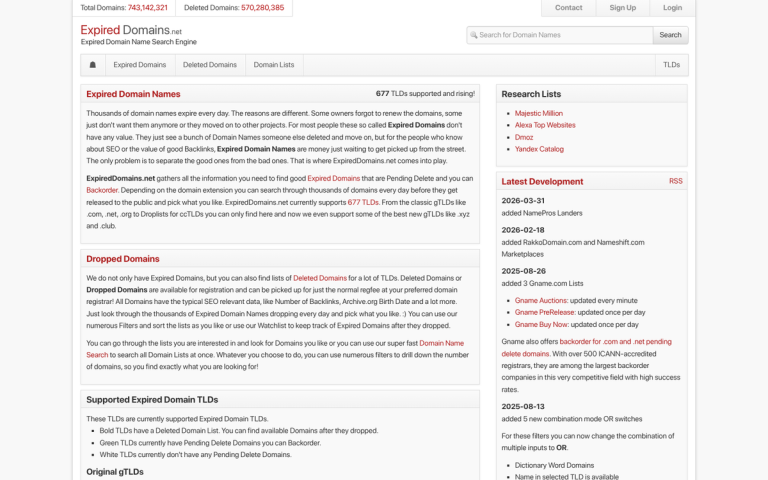
Visit ExpiredDomains.net and create a free account - it only takes a name and email. Once logged in, navigate to the Deleted Domains section and filter to .com domains. These are generally the most valuable for link building purposes.
The unfiltered list is enormous - we're talking millions of domains - so you'll need to narrow it down. Filter out domains with suspicious or fake metrics, prioritize those with real backlink profiles (check against Ahrefs or Majestic data where available), and look for domains that have been dropped recently. The quicker you move after a drop, the less competition you'll face.
Once you have a manageable list, evaluate each candidate against your criteria, and move on the ones that clear your vetting process.
Option 3: DomCop
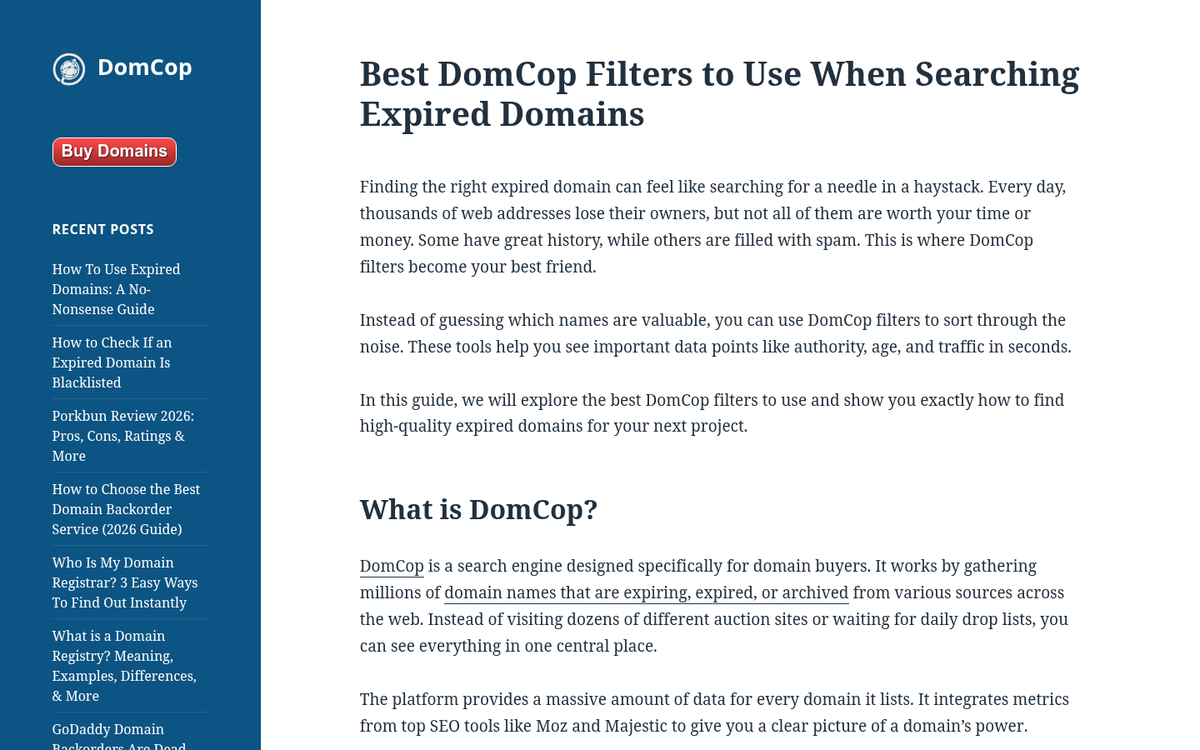
DomCop pulls from a different database than ExpiredDomains.net and offers a more robust filtering and metrics system, which makes it worth using alongside other tools rather than instead of them.
You can find it at domcop.com. Limited browsing is available without an account, but you'll want to register to access the full feature set. Pricing has evolved over the years, so check their current plans - it's worth the cost if you're making expired domain acquisition a regular part of your strategy.
Head to the Advanced tab and click "show filters" to access the full range of options. Narrow your extension selection to .com, filter out adult and spammy domains, and ignore metrics like Alexa rank which are no longer relevant. Focus on domains with solid backlink profiles and recent drop dates.
This should give you a workable, targeted list. Browse through it, adjust filters as needed, and move quickly on anything that looks promising - good domains at this level get picked up fast.
Option 4: GoDaddy Auctions

GoDaddy Auctions has become one of the most active marketplaces for expired domains, and it's worth treating as a dedicated tool rather than an afterthought. A 2025 analysis of 915 expired domains (DR 20+) purchased on GoDaddy over just a 14-day window found that 42.2% were used for money sites or redirects - meaning serious SEOs are actively buying here at scale.
Visit auctions.godaddy.com and use the search and filter tools to narrow results by category, keyword relevance, or metrics pulled from Moz and other providers. You can set up alerts for domains matching your criteria so you don't miss drops as they happen.
The competitive nature of GoDaddy Auctions means you may pay more here than on some other platforms, but the volume and frequency of quality drops makes it one of the best places to find legitimate, established domains. Set a clear budget ceiling before you start bidding - it's easy to get caught up in auction dynamics and overpay.
Option 5: Spamzilla
Spamzilla is a more modern tool built specifically for finding expired domains with strong backlink profiles, and it's become a go-to for many SEOs who want deeper filtering than the older platforms offer.
You can find it at spamzilla.io. As the name implies, it's built around spam detection - it actively helps you filter out domains with toxic link profiles so you're not wasting time vetting junk manually. It integrates with Ahrefs and Majestic data, and you can filter by DR, traffic, niche relevance, and a range of spam signals.
It's a paid tool, but the time savings on vetting alone tend to justify the cost if you're doing this regularly. If you want one tool that combines discovery and spam filtering in one interface, this is currently one of the strongest options available.
A Note on Private Blog Networks in 2026

Some people will still tell you that a PBN is a great shortcut. Spin up some content, build template sites on expired domains, point them at your money site. Quick link juice, minimal effort - what's not to like?
The reality in 2026 is that Google has become significantly better at identifying PBN footprints, and the risk-reward equation has shifted further against them. The data reflects this: only 3.82% of the DR 20+ expired domains analyzed in a 2025 study were used in PBNs. Buyers who know what they're doing have largely moved on to safer applications.
A PBN can still produce short-term results, but unless you're constantly rotating new domains in and retiring exposed ones, it's a leaky strategy that demands ongoing maintenance just to stay neutral. One manual action can wipe out months of work.
Meanwhile, Ahrefs data shows that over 90% of domains never gain organic traction due to a lack of backlinks - which means a well-chosen expired domain used as a clean 301 redirect or the foundation of a legitimate microsite is still a meaningful competitive advantage. You just don't need to take on PBN risk to capture that value.
Focus your energy on the 301 redirect approach, keep your acquisitions relevant, vet everything carefully, and you'll get the benefit without the exposure.
1 response
Thoughtful replies only - we moderate for spam, AI slop, and off-topic rants.
To rank blogs with good content in medium and high competitives niches, the key is to find dropped domains with very good metrics you can buy for 6$ and have full control over them.