





A few years ago, Google was king with the metric everyone wanted to monitor and improve. That metric was PageRank, and it was as close to a direct indicator of search engine success as it was possible to squeeze out of Google. Since then, though, Google has put a damper on the idea of a metric you can monitor and improve with a direct relationship to search ranking. They want you to improve your site in many ways, not just in a few fixed ways that raise a number without necessarily improving your site.
As a response, Google officially killed PageRank as a public-facing metric back in 2016, when they removed it from the Google Toolbar entirely. It had already been stagnant for years - the last known public update was in December 2013 - and by 2016, Google made it official. PageRank is dead, and it has been for a long time.
This post isn't about PageRank, though. I just bring it up to set the stage. In the wake of PageRank's decline, other sites stepped up to fill the void with their own authority metrics that webmasters could actually monitor and act on. One of these was Moz's Domain Authority and Page Authority. These are useful, but they're also not the focus of our attention today. The real focus is Majestic SEO's Trust Flow.
Key Takeaways
- Trust Flow measures link quality through a 0-100 logarithmic scale, making it harder to game than volume-based metrics.
- Majestic actively resets manipulated scores to zero, meaning any artificial Trust Flow gains are only temporary.
- A "good" Trust Flow score typically falls between 30 and 40, with major publications scoring above 60.
- Trust Flow can be used for competitive intelligence, link penalty recovery, and identifying quality link-building opportunities.
- Earning followed links from high-Trust Flow, topically relevant sites is the most reliable way to improve your score.
Majestic SEO's Trust Flow
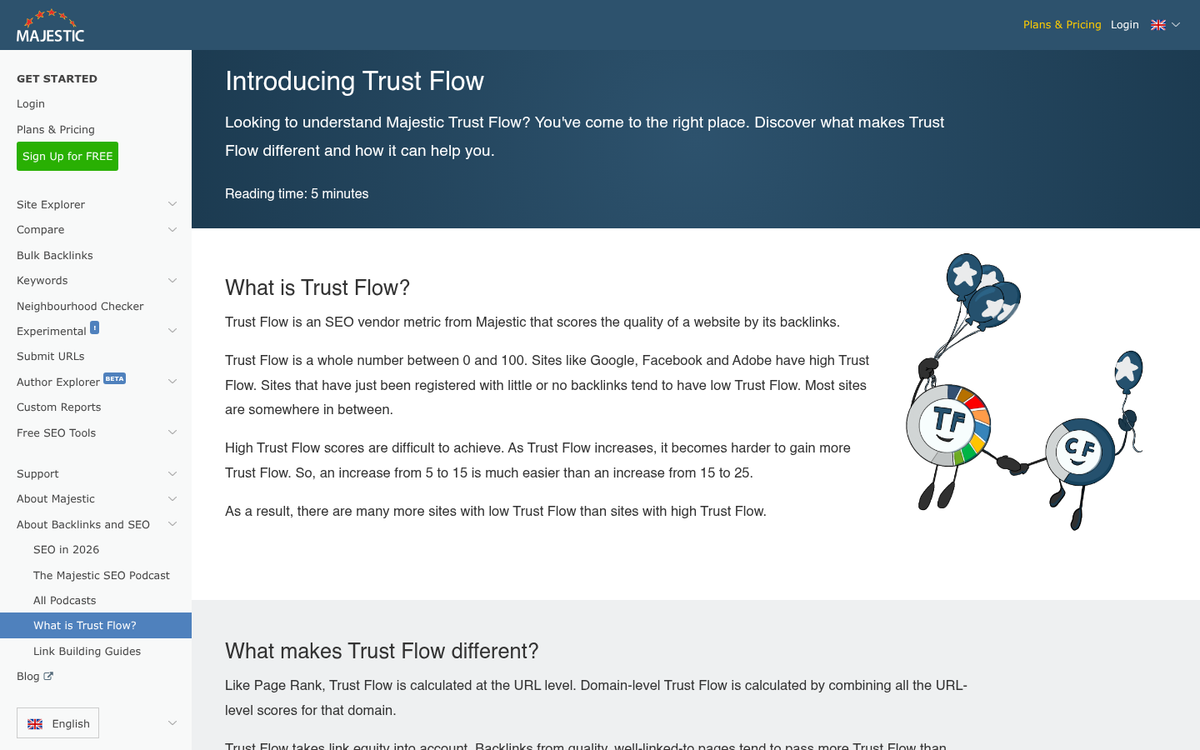
Majestic actually has a few interrelated metrics here. Trust Flow, Citation Flow, and Topical Trust Flow are all similar in how they're measured and put together, based on Majestic's proprietary analysis of the web. Majestic operates one of the largest commercial link intelligence databases in existence, cataloguing approximately one billion URLs per day. That scale is part of what makes their metrics meaningful. We'll focus on Trust Flow for now.
Trust Flow is a measurement of the quality of an incoming link, based on the quality of links pointing to that linking site. A site with a lot of quality coming in will pass a lot of quality onwards. A site with very little quality coming in will not have much value attached to its link. This operates independently of volume, which is what really makes it special. Trust Flow is scored on a 0-100 logarithmic scale, meaning higher scores become progressively harder to achieve - the jump from 50 to 60 is significantly more difficult than the jump from 10 to 20.
Why is this important? It makes it a lot harder to game the system. You can spend hundreds of hours running apps to generate backlinks for your site, sending thousands of them all at a filter site, which in turn links to your money site. According to Trust Flow, that link to your money site won't have much value, because there's not a lot of value coming in to that site. One single link from an authority site like a major industry publication, a .gov, or another industry giant will be far more valuable than all the hundreds of links behind the other example.
That said, it's worth noting that attempts to manipulate Trust Flow artificially do happen. A study by Xamsor demonstrated that TF scores on two domains could be temporarily inflated through paid link manipulation - however, by April 2024, Majestic had reset both sites' scores to zero. This is a good reminder that Majestic actively monitors for manipulation, and that any short-term gains from gaming the metric are just that - short-term.
By contrast, Citation Flow is the measurement of volume of links, independent of trust. A page with 100 links from various domains will have a higher Citation Flow rating than a site with only 10 incoming links. It doesn't matter if the 100 links are from brand new WordPress sites and the 10 links are from big name blogs; Citation Flow counts volume as a priority. Except, that's not strictly true. Citation Flow isn't just a measure of the incoming links to your site; it's a measure of the incoming links to the sites linking to you, and the sites linking to those sites, and on and on.
That's why a single link from a major authority site will give you a ton of Citation Flow value as well as Trust Flow. There are thousands and thousands of sites linking to these authority domains, and so any link they publish carries significant Citation Flow weight behind it.
If you want to vastly simplify things, you could say that Citation Flow is a measurement of potential second and third degree connections and thus traffic, whereas Trust Flow is a measurement of perceived value, and thus is a better indicator of search engine performance.
Citation Flow is a lot like the old PageRank in this way, as it's also susceptible to link spam, whereas Trust Flow is a lot more like a modern incarnation, which measures value rather than an exploitable metric.
Don't think I forgot about Topical Trust Flow, by the way. It's just Trust Flow, but it adds a filter for general topic category. Majestic's Topical Trust Flow algorithm classifies over 800 pools of sites by topic, weighting links not just by their overall value, but by their relevance to one another. A major marketing blog linking out to a car parts retailer won't be a particularly strong link, because the two topics are unrelated. It's a way of cutting out irrelevant links and rewarding genuine topical authority.
Monitoring Trust Flow
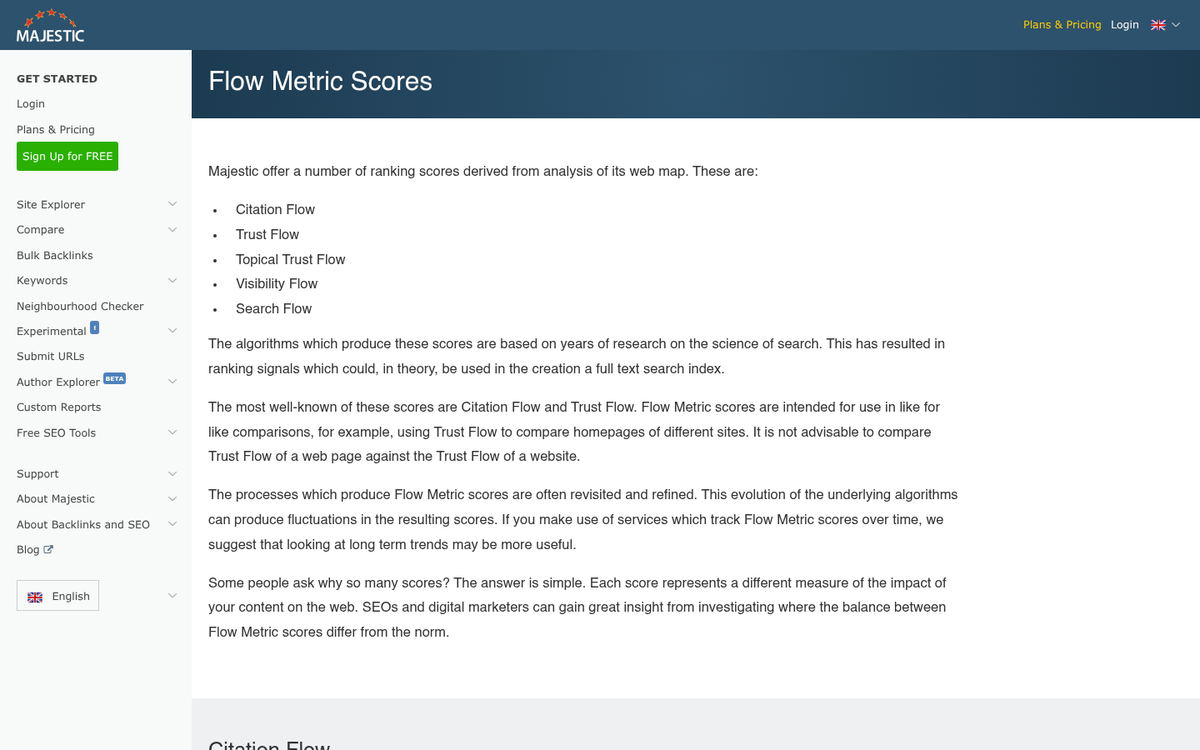
Reasonably enough, if you want to check into the Trust Flow, Citation Flow, or another metric measured by Majestic, all you have to do is go to the Majestic website. Once there, plug in the URL of the page you want to analyze. Use the fresh index for the most accurate data. Majestic updates their index daily to keep data accurate.
When you load up the metric, you will see a measurement of both Trust Flow and Citation Flow at the top. You will see a number of external backlinks, referring domains, referring IPs, and referring subnets - all measurements of the uniqueness of the links pointing at your site. You get a graph of where your backlinks show up on a chart with the X and Y axes measuring both Trust and Citation Flow. Information goes from there; you can check it out yourself.
As a general benchmark, a "good" Trust Flow score typically falls somewhere between 30 and 40, according to AgencyAnalytics. A niche community website might score in the 20s or 30s, while a national media outlet or major industry publication may score above 60. Don't panic if your score is lower - Trust Flow is logarithmic, so even moving from 15 to 25 represents meaningful progress.
In addition, you can check various sites by using the Majestic browser extension for Chrome. This shows you a limited version of the data shown by the Majestic site itself, with the option to click through to more detailed analytics.
If you want to compare more than one site at a time, you can use the Bulk Link Checker tool, found here. Additionally, various third party tools pull from the Majestic API to incorporate their data into broader SEO platforms, so you may already have access to Trust Flow data through tools you're currently using.
If you would like to compare Moz's Domain Authority and Majestic's Trust Flow, you can certainly do that. Just be aware that the two measure link authority from different angles - DA leans heavily on link volume and diversity, while Trust Flow is more purely focused on link quality propagation. In general, Majestic Trust Flow tends to be a more direct predictor of search engine ranking performance when used in isolation.
Ways to Use Trust Flow
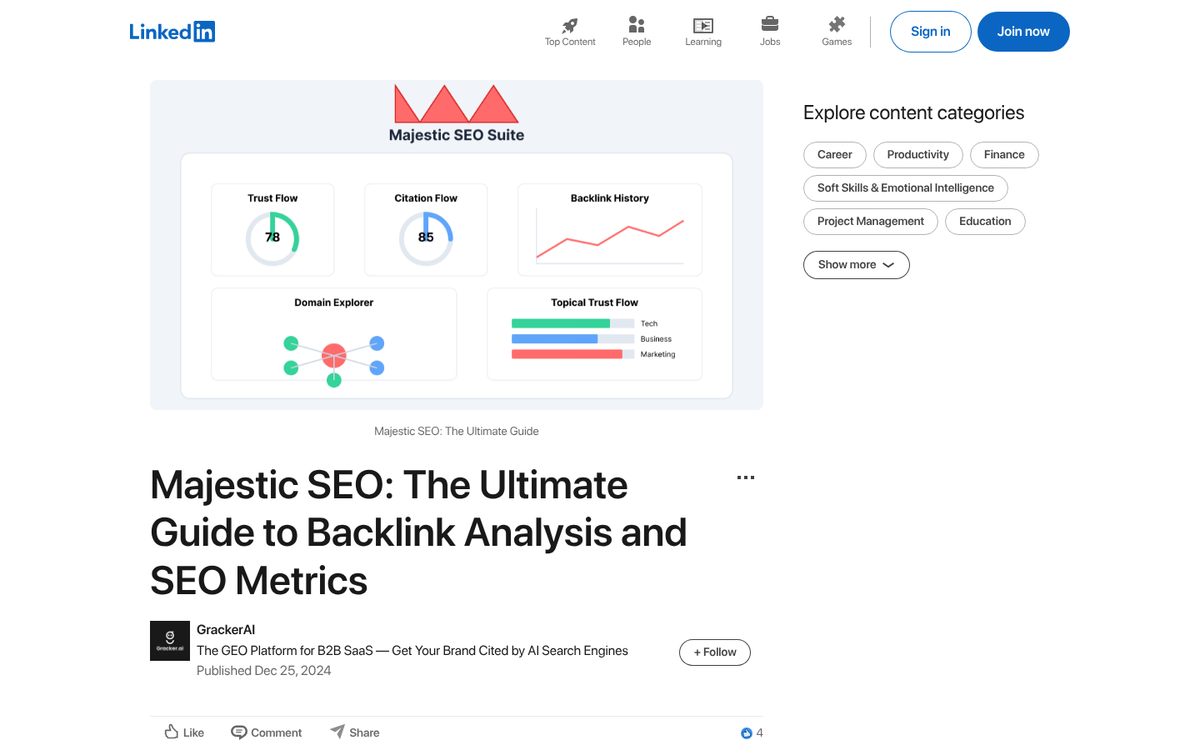
The obvious way to use the Trust Flow measurement is just as an indicator of your own success. Trust Flow has been proven to be one of the most accurate single metrics to measure site quality, relevance, and performance in a way that correlates to search engine ranking. In other words, actions that improve your Trust Flow will also improve your search engine ranking, more reliably than actions that improve metrics like Domain Authority or the long-defunct PageRank.
Still, that's just one self-centered way to use Trust Flow. You can do a whole lot more with it. For example...
You can use Trust Flow for competitive intelligence gathering. Come up with a keyword you want to rank for and run a search for it. Export the top-ranking URLs and bring them into Majestic's bulk backlink analysis tool. Sort your data by Trust Flow and you'll have a list of the most relevant, highest-quality links pointing at your competition. This gives you a list of targets for outreach and link acquisition.
You can use Trust Flow to help you recover from a link penalty. Both Trust Flow and Topical Trust Flow are important here. Both, when low, mean the links are at best doing nothing for you. At worst, they are actively hurting you. Essentially, the process works like this. First, run your site through Majestic to get an analysis of your links. Second, find any link that is topically irrelevant according to Topical Trust Flow and any link that has a low - generally sub-10 - Trust Flow. Third, follow a typical process of your choice for removing those links. Whether this means outreach, cease and desist letters, or disavowal is up to you.
You can use Trust Flow for link prospecting. Whenever you find an opportunity to guest post, submit your site to a directory, buy an expired domain, or generally pursue any link-building opportunity, run it through Majestic first. Use the bulk backlinks tool to find other sites linking to those sites, and follow the chain to uncover more and more potential opportunities.
Boosting Trust Flow
If Trust Flow is the best indicator of search engine success, you obviously want to take steps to increase it. Essentially, this is all about building authoritative backlinks. Majestic follows much the same set of rules as Google - which makes sense given how accurate it is - which means spam links are bad, authoritative domains are good, and nofollow links pass nothing toward Trust Flow.
Identify an Industry Influencer
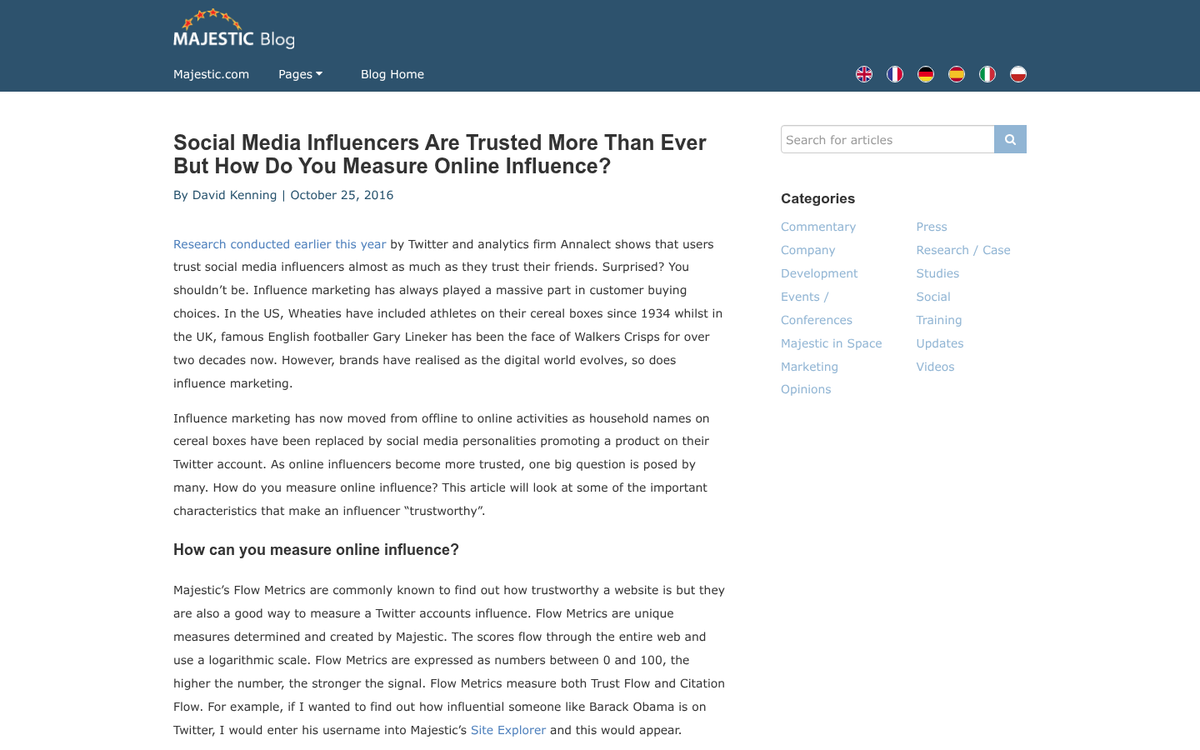
This step is all about finding a seed, though you have the added benefit of using them to earn an authoritative link as well. How you go about this will depend on the kind of relationship you have or want with the influencer. I like to take a personalized route. I study what it is they write about frequently, and then I figure out what sort of data, case study, guide, or original research they would love to read. Then I produce that kind of content. Ultimate guides are great for this, as are detailed statistical analyses and original data studies. All of this content has the potential to be shared by your influencer of choice. You just need to make sure of a few things before you dig in too deep.
- Make sure the influencer is actually an influencer, not an imposter. Run them through Majestic to make sure they actually have a high Trust Flow and that their Topical Trust Flow is in the niches you're targeting.
- Make sure the content you want to produce isn't something they've already covered thoroughly. There's no point pitching a definitive guide on a topic they already own.
- Make sure you can do the topic justice. If you're not bringing anything new to the table, you're not going to attract their attention.
The end goal is to have a piece of content you can send to them under the guise of "hey, you're an expert in this field, what do you think?" Send them the link and they should check it out. If it's good enough, it will inspire them to create content that cites it, or at least it will sit as something they can link to as an illustrative point in a future piece they create. If you're looking for more ways to reach out, learn how to get well known bloggers to write for you as a complementary strategy.
Analyze Your Influencer to Find More Influencers
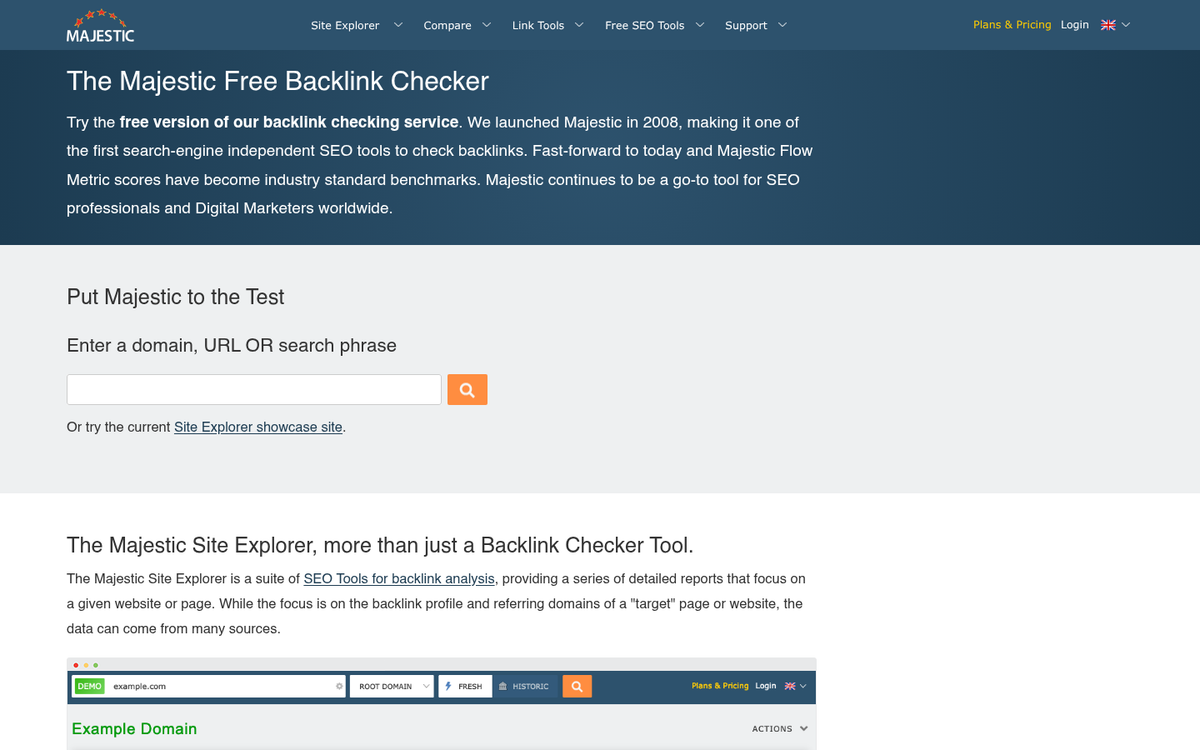
While you're working to earn a link with your chosen influencer, you should also run them through the Majestic backlink checker to find the most influential sites that are linking to that influencer. After all, no high profile site got to where it was without the support of other high profile sites. The industry community is very much that; a community. People know each other, and even if their companies compete for the same niche, they can still treat each other with respect.
The goal here is to find other influencers you can target in the same way that you're targeting the first. In many cases, the content you're producing for one influencer in the niche will work for the same purpose for another influencer. That's great - you're killing two birds with one stone. However, for a more personal touch, you can create direct response content. Pick a controversial post the influencer has made recently, then write a post that argues for the other side of the coin. Even if you eventually end up agreeing with them, the controversy might be something they want to address, and they might link to the post when they do. Just try not to be so antagonistic that you fall into the "a notable blogger contested my opinion, so I'm going to not name names and indirectly reference them" zone.
Search Out Guest Posting Opportunities
There's a well-defined way to find guest posting openings around the web these days, and it works for SEO as long as you're not doing it in an exploitative way. I just recommend adding one more step to the process.
When you find a site that you think is promising for a guest blogging opportunity, run it through Majestic. Take a look at its actual Trust Flow rating and see if it's as highly rated as you would like it to be. Many sites will tend to be in the 20-40 range, with sites in the 50s and above proving exceptional. If a site is under 10, you probably don't want to prioritize it for Trust Flow purposes. You won't get much out of it.
Equally important is the ability to check if the links they allow in guest posts are followed. If the links are nofollow, the guest posting opportunity won't do anything for your Trust Flow. That's not to say it's worthless, of course. It builds branding, it works for Citation Flow, and it gains you exposure to another audience. It just won't move the needle on Trust Flow.
The lesson here is simple: run sites, people, profiles, and opportunities through Majestic to check their Trust Flow before you invest time in them. The lower their Trust Flow, the less you should prioritize earning followed links from them. The higher it is, the more effort is justified in pursuit of that link.

2 responses
Thoughtful replies only - we moderate for spam, AI slop, and off-topic rants.
Majestice one of the best tools for SEO and two factors one of them Trust flow and other citation flow, where to know about any websites and If get any backlinks from any website, both the value is high, its more benefits for that websites, Otherwise nice article, and Thumb's up.. 🙂
The problem with SEO and to extension DA/PA and Trust Flow / Citation Flow is that while it is pretty easy to up them on blogs and websites it is really hard on e-commerce as you add products and descriptions, for example the website I am administrating is an orthopedics equipment e-shop. It is virtually impossible to get quality backlinks on topic, as in order to write a medical document and publish it you need to be a doctor. There are very few things that you can do, or so I have found out over time.