





Key Takeaways
- Directory submission value depends heavily on implementation and context, not the tactic itself.
- Local business directories are genuinely valuable, contributing to 37% of all local SEO citation ranking factors.
- Paid directory submissions risk violating Google's link scheme guidelines, making them hard to justify on SEO grounds.
- Niche-specific directories with real traffic and editorial standards are worth evaluating; generic bulk directories are potentially harmful.
- 68% of SEO professionals still use directory submissions, but results likely reflect local citations and niche directories, not bulk submissions.
Directory Submission for SEO in 2026: Still Worth It?
Directory submission is one of those SEO techniques that has existed practically since the dawn of SEO, and that has a rocky history in terms of value. For years, the conventional wisdom swung hard against directories - and for good reason. But the landscape in 2026 looks a bit more nuanced than the "directories are dead" narrative that dominated the 2010s.
As with any SEO technique, the value comes down to implementation and context. Directory submission alone isn't going to kill your site if you do it properly. However, it remains one of those tools that can easily backfire if approached carelessly - particularly with low-quality, paid, or irrelevant directories.
A Wide Range of Quality
The biggest determining factor for directory submission is the quality of the directories you're using. There are still thousands of link and site directories on the web, ranging from highly authoritative niche directories to outright spam traps.
Picking the right directories is practically the entire game. Here are the elements you should evaluate:
- What industry or niche the directory serves. The closer the directory's focus is to your own niche, the better. A beauty blog submitting to a beauty-focused community directory will fare far better than submitting to a generic catch-all list. Relevance has only grown in importance as Google's algorithms have matured.
- The quality of the directory as a whole. Some directories list anything that comes their way, while others maintain strong editorial standards. You want the latter. If the directory is showcasing a lot of low-quality content, that association can reflect poorly on your site. Use tools like Moz or Ahrefs to pull metrics like Domain Authority (DA) and evaluate the overall link profile of the directory itself.
- Whether the directory is indexed in Google. If the directory itself doesn't appear in Google search results, it's essentially invisible. Links from non-indexed pages carry no SEO value and likely generate no meaningful traffic. Run a site:www.directory.com search to verify indexation before investing any time.
- The quality of the sites already listed in the directory. Spend a few minutes browsing the directory's listings. Are the sites credible, active, and indexed themselves? A directory full of abandoned or penalized sites is a warning sign. You want good neighbors.
- Whether there's a fee for submission or premium placement. Paying for a followed link is a violation of Google's link scheme guidelines. Paid submissions require extra scrutiny - if the link is followed, you're in risky territory. More on this below.
Directories remain minefields full of potential reasons to avoid them. If anything looks even slightly objectionable, skip it. At best, a bad directory link will be completely valueless. At worst, it can contribute to a toxic link profile that requires a disavow effort to clean up.
Where do you find directories worth evaluating? A targeted Google search such as "your industry + directory" or "best [niche] directories 2026" is a reasonable starting point. Industry blogs and local SEO resources often maintain updated lists. Once you have a list, vet each one carefully before submitting. For a head start, check out this list of high-authority free directory submission sites worth considering.
The Cost of Directory Submission
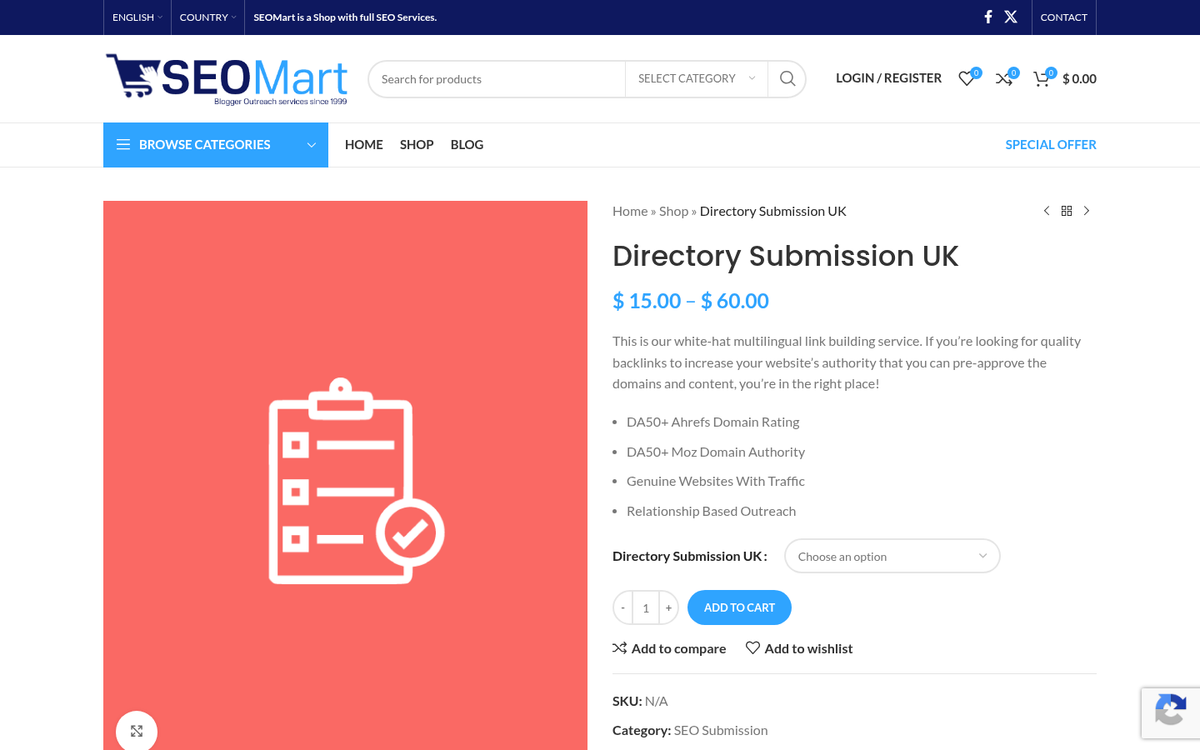
There are two costs associated with directory submissions: time and money.
On the time front, finding and vetting directories takes real effort. The initial investment is high, but once you've built a vetted shortlist of legitimate directories relevant to your niche, ongoing maintenance becomes much lighter.
On the money front, paid directory submissions are still common. The average cost for a paid directory submission in 2024-2026 ranges between $50 and $300 per year. Some directories offer tiered accounts, monthly subscriptions, or credit-based systems for link visibility.
The critical question with any paid submission is whether the link is followed or nofollowed, and whether the directory has genuine traffic and authority. Most paid directories offering followed links are operating in direct conflict with Google's guidelines on link schemes. Unless the directory offers demonstrable referral traffic and niche relevance, most paid submissions are difficult to justify purely on SEO grounds.
The Value of Directory Links for SEO
The SEO value of any link comes down to a few core factors:
- The relevance of the linking site to the linked site.
- The overall authority and quality of the linking site.
- The placement of the link on the linking page.
- Whether or not the link is followed.
Directories present challenges on each of these fronts - but it's not a completely lost cause in 2026.
For relevance, generalist directories remain largely irrelevant to any specific site or topic. Niche and local directories, however, have grown in relative value precisely because they serve a defined audience and topic area.
For authority, most directories don't rank highly themselves because they produce little original content and their link profiles are often weak. The oldest and most established directories still carry more weight, but even they rarely compete with a high-quality editorial link from a respected industry site.
For link placement, a link that is the entirety of the "content" carries less weight than a contextual link embedded in a relevant article. Directory links are by nature listings, not editorial endorsements.
For follow status, it's worth clarifying a common misconception: as of 2024, approximately 30% of online directory links are nofollowed, according to Moz data - which means the majority are actually followed. However, a followed link from a low-authority, irrelevant directory still carries very little positive weight, and could contribute to a spammy link profile if overused. Quality and relevance still trump follow status.
Where Directories Do Have Real Value: Local SEO

This is where the conversation shifts meaningfully. In 2026, the strongest legitimate case for directory submission is local SEO, and the data supports it.
- Business directories contribute to 37% of all citations used for local SEO ranking factors.
- Directories appear in 31% of top ten organic results for local-intent searches.
- A BrightLocal study found that 76% of consumers who search for a local business on their phone visit that business within 24 hours.
- Companies that actively maintain their directory listings have been associated with a 20% improvement in domain authority in SEMrush studies, likely reflecting the broader citation and brand signal benefits rather than raw link equity alone.
For local businesses, maintaining accurate and consistent listings across directories like Google Business Profile, Yelp, Apple Maps, Bing Places, and industry-specific directories isn't optional - it's foundational. This is not the same as submitting to bulk link directories for SEO value; it's about citation consistency and local visibility.
The distinction matters: local business directories in 2026 are genuinely valuable. Generic link directories designed primarily to sell link placements are not.
The Broader Picture in 2026

It would be an overstatement to say directories are completely dead. As of 2024, 68% of SEO professionals report that directory submissions remain part of their link-building strategy, according to Moz. But context matters enormously. That figure almost certainly reflects a mix of local citation building, niche directory submissions, and legacy practices - not bulk submission to generic directories.
42% of businesses report an increase in referral traffic after submitting to directories, per Ahrefs data. Again, this likely reflects quality niche and local directories driving genuine visitors, not the spray-and-pray approach of submitting to hundreds of generic directories.
The directories that dominated conversations a decade ago are largely gone. DMOZ shut down in 2017. Technorati's blog directory disappeared in 2014. The generic, catch-all web directory model simply didn't survive. What remains are either niche-specific directories with real audiences, local business directories that serve a genuine consumer need, or low-quality link farms best avoided entirely.
The Bottom Line
In 2026, directory submission is neither the tactic it was in 2005 nor as completely worthless as it was portrayed at peak anti-directory sentiment around 2016-2018. The reality is more specific:
- Local business directories: Genuinely valuable. Maintain them actively.
- High-quality niche directories with real traffic and editorial standards: Worth evaluating on a case-by-case basis.
- Generic bulk link directories or paid link directories with no real audience: Not worth your time or money, and potentially harmful.
If you are going to use directories at all, be selective to the point of being almost reluctant. The bar for a directory being worth your time should be high. And if someone is trying to sell you a directory submission package promising SEO results from hundreds of directories, walk away - that pitch was questionable in 2010 and it hasn't improved with age.


3 responses
Thoughtful replies only - we moderate for spam, AI slop, and off-topic rants.
Thanks for sharing this useful information on investing money over directory submissions. I'd rather not invest on it.
I was so close to investing money on directory submissions thought it'll get me more backlinks. After reading your article , I wouldn't go for it.
Although the site seems to be penalized it remains indexed, as evident in the screenshot below of a search for the site URL.