There are a few reasons why your Google Ads conversions suddenly drop to nothing, or near nothing. Almost all of those reasons have to do with budgetary considerations. Before I get into that, though, there's one cause we need to discuss.
Key Takeaways
- Sudden conversion drops often stem from budget depletion, broken tracking, new competition, seasonality, or forgotten ad scheduling.
- If you made recent changes and conversions dropped, revert them first; always test one element at a time to isolate causes.
- New or aggressive competitors can drive up CPCs and push your ads down, causing sharp overnight conversion declines.
- Broken conversion tracking can mimic a real performance drop; privacy regulations can cause GA4 to undercount conversions by 18-40%.
- Google platform updates can disrupt existing campaign setups, requiring advertisers to audit and realign their structure accordingly.
Changes You Made
The primary focus of this post is on causes of a conversion drop that aren't immediately preceded by a change you made to your ads in some way. If you made changes and saw a drop in conversions, well, it's pretty darn easy to identify the problem, isn't it?
Look at it this way. Even if data tells you that changing from A to B means you should get an increase in conversions, if you then actually make the change from A to B and see your conversions drop, it's pretty clear that your change made conversions drop.
Now, it might not be the change from A to B that caused it, but some other related change you made at the same time. Changing your targeting from A to B might mean you're focused on a better audience, but if you changed your ad copy at the same time, maybe that new copy doesn't resonate with the new audience as well. Or vice versa; maybe you didn't change the copy, and the old copy doesn't work as well with the new audience.
This is part of the problem with split testing, particularly split testing audience targeting. If you test Ad Copy A and Ad Copy B on Audience 1, and you test Ad Copy A on Audience 2, you have an incomplete split test. You might discover that Audience 2 converts better than Audience 1, and you might discover that Ad Copy B works better than Ad Copy A. So you switch to Ad Copy B and Audience 2, but that's not a result you tested. You might discover that A works better than B with 2, but you didn't discover that until after the fact because your split testing didn't cover all the bases.
This is why, when you test different elements, you need to make sure you test each variation and combination of elements. It's also why we generally recommend that you only test one element at a time; the more elements you test at once, the harder it is to discern which element changing has which impact. Sure, you can run six split tests at once, but the more tests you run, the more variations you need to run at once, at an exponential curve. Even if you have an automated system to manage those iterations in all their variety, you still need the budget to run all of those tests.
In any case, this is all a digression. If you make a change and your conversions drop, revert the change and they should come back. If you make a change and conversions drop, and you revert the change and they don't come back, well, you might have other issues.
More importantly, if you don't make a change and you see an abrupt drop in conversions, something may have happened externally that caused it. That's what I'm trying to help you diagnose today. One related factor worth understanding is why your cost per conversion fluctuates daily, as external variables can shift performance even when nothing on your end has changed. It's also worth considering whether increasing your ad budget could actually lower conversions in some scenarios.
External Causes of Dropped Conversions

There are two ways conversions can drop: slowly and gradually, and abruptly or sharply.
Slow and gradual drops in conversions are fairly natural. Over time, your ads lose their effectiveness. Ad saturation leads to ad blindness, and your audience may eventually become saturated themselves. If you've managed to sell to everyone in your target audience, no amount of changing your ad is going to get those people to buy again, at least for a lot of one-time sale products. Think of how often you need to buy a toaster or a washing machine. Barring damage or equipment failure, you're not going to get repeat customers very often, at least not outside of the B2B case.
It's also worth noting that across industries, Google Ads conversion rates have been under pressure industry-wide. In 2024, conversion rates declined in 13 of 14 industries tracked year-over-year, even as click-through rates rose. In other words, more people are clicking but fewer are converting - which means a slow decline in your numbers isn't always a sign something is broken on your end. It can simply reflect a broader market trend.
Constant testing, iteration, and improvement help keep your ads fresh and relevant and, most importantly, worth clicking. When your ads become stale, users stop caring about them, and they stop converting. With a large enough audience, though, this won't happen overnight.
No, the issue we're most concerned about today is abrupt, sharp declines in your conversions. Something that happens overnight or over the span of two or three days is characterized as abrupt, when marketing trends are measured in weeks or months or years.
So what might happen to cause an abrupt drop in conversions without you making a change to cause it? There are a few options.
- New competition hits the market.
- Old competition becomes fierce.
- Scheduling you forgot about ends.
- Seasonality rears its head.
- Your budget runs out.
- Your tracking breaks.
- Google makes a change to their system.
Let's look at each of these in detail.
A New Challenger Approaches

As time goes on, it becomes easier and easier to start a new business. Globalization has led to the proliferation of easy contact between suppliers and manufacturers with the people who have new ideas. On top of that, the range of cheap or free tools available for growth marketing means a business can go from concept to actively selling a product in as little as a month or two. Experienced entrepreneurs can build their systems and launch, grow, and sell multiple businesses in a single year.
This means that a lot of markets that are not traditionally agile need to become agile. Industries that once moved slowly now find themselves disrupted by direct-to-consumer startups with lean operations, no retail overhead, and a willingness to outspend established players in their early months.
Now suddenly an established company's advertising is hit hard. They see a dramatic drop in conversions because a new competitor has entered the market, targeting all of the same keywords with a fresh and aggressive budget. These new entrants often want to invest heavily in their first wave of sales, so they dominate search results and paid listings by using venture capital or investor funding to run high-volume, high-position ads.
It's the age-old problem of supply and demand. There are a limited number of competitive ad slots at any given time. When a new, well-funded competitor enters the auction, they drive up CPCs and push established advertisers down in position or out of rotation entirely. Even a modest drop in ad position can meaningfully reduce conversion volume, particularly for campaigns that were already operating on tight margins.
Now, if this new company succeeds, they'll eventually have to dial back their spending and settle into a new normal. The older brand can adapt and compete again, though it might be troublesome for a few months or even years. Still, abrupt new competition can definitely cause an abrupt drop in conversions from campaigns that haven't adapted to account for it.
Old Competition Levels Up
The same sort of niche domination can happen when an older competitor decides they want to compete more aggressively on a front where you've been comfortable. Maybe you've operated alongside a large enterprise competitor without much friction, but they introduce a new lower-tier offering that pulls directly from your customer base. The effect on your conversion volume can be just as sharp as a brand-new entrant.
This is actually often a more manageable situation than dealing with a newcomer burning through venture capital. An established competitor expanding into your space is more likely to be disciplined about their spending, which means there's more room to compete intelligently rather than simply being outspent.
Your Time Ran Out

I'm only going to gloss over this one because it's a pretty simple error and it's extremely easy to correct. Often times, when you're setting up ads, you set a schedule for them to run. It might be centered around a holiday or a sale, or just focused on historically high-converting months, but it exists.
It's easy to just monitor your ads from day to day, forgetting that one day they are scheduled to end. Then that day comes and you suddenly see a drop in conversions. There's always going to be that moment of panic before you realize what happened, but thankfully, it's an easy enough fix.
Of course, disciplined ad managers don't let ad coverage slip like this. Your always-on campaigns should maintain a baseline of conversions, and any scheduled or promotional campaigns should be managed with clear start and end dates that don't accidentally swallow your broader coverage. Switching bid strategies mid-campaign can also compound these issues if your timing isn't carefully planned.
Changing Seasons

As a related issue to scheduling, seasonality often has a significant impact on certain industries. It's natural for a company selling snow blowers to see a spike in conversions when the first snowstorms of the year hit, but once winter is over, that level of demand simply isn't there anymore.
If your conversions drop somewhat abruptly, it's worth considering whether the seasonal peak for your product or service has passed. Generally, you should know the strong and weak periods for your business. This one should rarely come as a surprise, but it's easy to overlook when you're deep in the day-to-day. If you're also noticing broader shifts in your traffic, it may be worth investigating a drop in traffic on Google Analytics to rule out other causes.
The Well Runs Dry

Budgeting concerns are, well, always a concern. If you run out of budget, your ads stop running, and your conversions dry up. There's no mystery there.
What is worth understanding is how directly budget and conversion volume are linked. Research has shown that if a campaign spends roughly 10% less in a given period, you can expect conversion performance to drop by approximately the same proportion. Conversions don't just trail off softly when budget tightens - they tend to mirror the spend reduction fairly closely.
There are two things you need to monitor about every ad you run: the volume of conversions and the cost per conversion. A keyword with a very low cost per conversion might not move the needle if it only drives two conversions a month. Conversely, a keyword generating hundreds of conversions a month can still be a liability if each conversion costs far more than it's worth.
Once you've been running ads for a while, you'll settle on standard campaigns and keywords that perform consistently. It's worth isolating these into their own campaigns with dedicated budgets, separate from your experimental or test campaigns. This way, a test that gets out of hand won't quietly drain the budget you depend on for consistent results.
Your Conversion Tracking Broke

This one deserves its own entry because it's more common than most advertisers realize, and it can look exactly like a real drop in conversions when the actual problem is that you've stopped measuring them correctly.
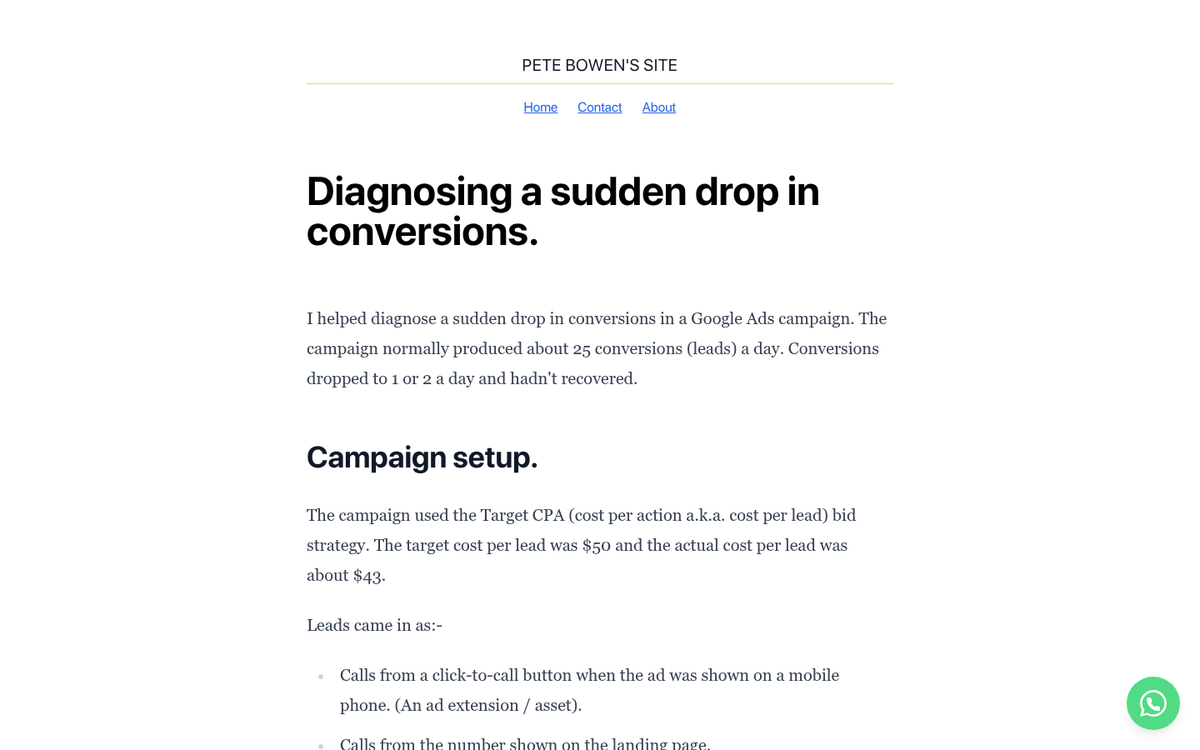
Broken tracking can happen for all sorts of reasons. A developer updates the site and removes a tag. A phone number changes and the call tracking stops firing. A form gets rebuilt and the thank-you page URL changes without the conversion pixel being updated. In documented real-world cases, campaigns that were producing around 25 conversions per day dropped to 1 or 2 per day overnight - not because performance cratered, but because the tracking stopped recording. In some cases, large accounts generating thousands of leads per month have had broken tracking go unnoticed for nearly a week before someone caught it.
There's another layer to this problem in 2026: cookie consent and privacy regulations. GA4 is known to undercount paid campaign conversions by 18 to 35 percent when users reject cookies, and in regions with high consent rejection rates, Google's Consent Mode v2 can produce undercounts of 20 to 40 percent. This means your reported conversion numbers may be significantly lower than your actual conversion activity - not because your ads are underperforming, but because your measurement setup isn't accounting for consent-based data gaps.
If you see a sudden drop in reported conversions, checking your tracking setup should be one of the first things you do before drawing any conclusions about campaign performance.
The World Changes Around You
A final note here is that, sometimes, Google makes a change to the way Google Ads works. The platform has evolved considerably over the years - from the retirement of broad match modifier, to the expansion of Smart Bidding and Performance Max campaigns, to ongoing changes in how conversion data is modeled and reported. When the system changes, sometimes your existing setup is caught in a new filter, a previously valid technique stops working, or your campaign structure is no longer optimized for how the platform now operates.
If you can't identify why your ads have stopped converting and everything on your end looks fine, it's worth checking whether Google has rolled out any updates or policy changes around that time. Unfortunately, the only real response in these situations is to adapt to the new normal - audit your campaign structure, review your bidding strategies, and make sure your setup aligns with how the platform currently works rather than how it worked when you first built it.