





Cryptocurrencies have had a turbulent but enduring run. They've evolved far beyond a curiosity into an established - if still volatile - asset class. While debates about intrinsic value haven't gone away, the ecosystem has matured considerably since the early days, with institutional adoption, ETF approvals, and regulatory frameworks now shaping the landscape in ways that weren't imaginable a decade ago.
If you've invested in Bitcoin or one of the thousands of altcoins now in existence, you're probably looking at ways to put it to practical use - including in advertising payments. After all, they are meant to be currencies.
Key Takeaways
- Most platforms "accepting Bitcoin" actually convert crypto to USD on the backend - advertisers rarely interact with raw cryptocurrency directly.
- Crypto-first ad networks remain risky; many have shut down, and legitimate networks treat crypto as one of several payment options.
- Credible crypto-niche networks like Bitmedia, Coinzilla, and AADS have demonstrated real scale and staying power worth considering.
- BuySellAds and BidVertiser offer practical crypto payment support within legitimate, established network infrastructure.
- Bitcoin transaction speed issues are mostly improved via Lightning Network, but pre-funding accounts remains smarter than real-time campaign payments.
Using Cryptocurrencies for Payments
One persistent quirk of cryptocurrencies is that they still don't hold much trust among the average consumer or business operator. If someone pays you $100 worth of BTC for an hour of services, that $100 isn't locked in. If Bitcoin surges tomorrow, great - you made more. If it crashes, you were effectively underpaid. Bitcoin remains a volatile asset, and most businesses still don't want significant exposure to it on their balance sheets.
Most smaller cryptocurrencies share similar volatility, though the arrival of stablecoins like USDC and USDT has given parts of the crypto ecosystem a more predictable payment rail. Even so, the broader advertising world hasn't rushed to embrace crypto-native payment flows.
The practical result is the same as it's always been: to use cryptocurrency for advertising payments, you almost always go through a payment processor or exchange first. Many platforms that "accept Bitcoin" are really accepting a USD equivalent after conversion on the backend - you never actually see the advertiser or publisher holding raw BTC.
For altcoins beyond the major players like Ethereum and Litecoin, you'll still often need to convert first into a more widely accepted cryptocurrency, then complete the transaction through the platform's preferred processor. Extra steps mean extra fees, extra time, and more exposure to price swings in between. If you're evaluating your options, it helps to understand how to integrate additional payment methods into your existing checkout or billing flow.
The bottom line remains: you can always convert crypto to fiat and use any ad network you want. The networks listed below are those that have made a genuine effort to integrate cryptocurrency as a direct or near-direct payment option.
CoinAd and Similar Crypto-First Networks - Still Approach With Caution

The warning from years ago still holds: be very cautious with any ad network that is built entirely around cryptocurrency. The space has seen enormous turnover. Networks that appeared on "best of" lists just a few years ago are now dead links. The gimmick of being crypto-branded is not a substitute for having a legitimate publisher network, transparent reporting, or reliable payouts.
CoinAd in particular has not improved its reputation. The invite-only model, the thin statistics, and the persistent pattern of non-payment complaints haven't gone away. Avoid it.
What you want are legitimate ad networks that accept cryptocurrency as one of several payment options, or crypto-native networks that have demonstrated staying power, scale, and verifiable traffic. A handful of those do exist now, and the list has actually gotten more credible over time. It's also worth knowing how to tell if paid traffic is real or fake before committing budget to any of these platforms.
The one clear exception is if you're advertising a cryptocurrency-focused product or service. In that case, niche crypto ad networks can make sense because their audience is your audience. Here's where things actually stand today:
- Bitmedia - Established in 2014, Bitmedia has grown into one of the more credible crypto-niche networks, now home to over 4,000 crypto websites generating roughly 40 million impressions daily. Minimum publisher payout is $20, paid directly to a Bitcoin wallet. If your product is crypto-adjacent, this is a reasonable option with real scale behind it.
- Coinzilla - Has grown significantly and now processes over 1 billion monthly impressions across more than 650 websites worldwide. Payment options have expanded considerably through CoinGate integration, accepting BTC, ETH, DOGE, BNB, ADA, TRX, XLM, and others. Still focused on crypto and finance verticals, but the scale is now genuinely competitive.
- AADS (Anonymous Ads) - One of the oldest crypto ad networks still operating, having been active since 2011. Still focused on anonymity and simplicity, requiring no personal information to get started. A niche choice, but a stable and long-running one.
- Adshares - A newer entrant worth noting. Their ADS blockchain is built specifically for advertising transactions and claims to process up to 1.4 million transactions per second, which directly addresses the old Bitcoin confirmation time problem. An interesting infrastructure play for crypto-native advertising.
- Cointraffic - Pays publishers in Bitcoin upon reaching a $25 threshold; bank transfers require a minimum of €300. Focused on the crypto and blockchain niche.
- Mellow Ads - Still operational, still small, still focused on simplicity. Fine for supplemental exposure in the crypto niche but not a primary channel.
As before, anyone browsing a crypto-focused site is statistically likely to be running an ad blocker, so temper your expectations accordingly. These networks are most useful for targeted audience reach, not broad traffic volume.
BuySellAds
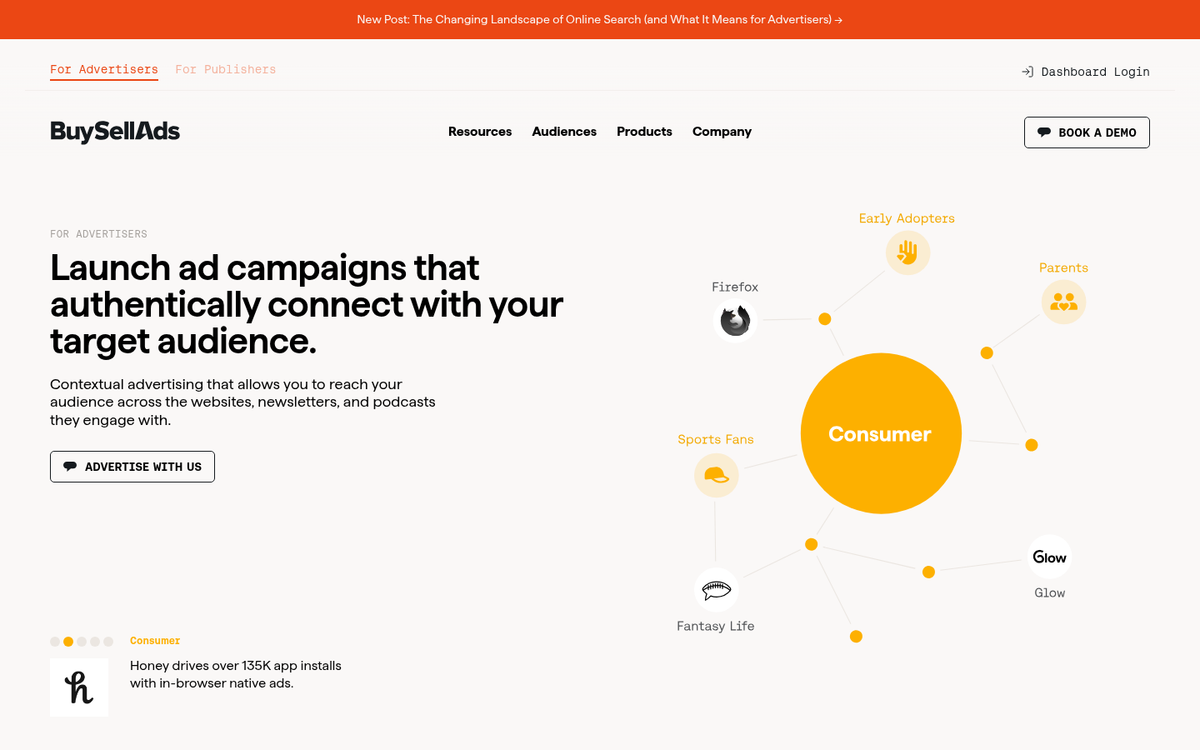
BSA remains one of the more credible traditional ad networks with crypto payment support. Their model hasn't changed dramatically - you fund an account through Coinbase or a similar exchange, converting your crypto to USD credit, which you then spend on display, native, podcast, sponsored content, or email placements. It's an extra step, but BSA's publisher network, transparency, and longevity make it a far safer bet than most crypto-first alternatives.
BSA was among the first major networks to embrace crypto payments and has maintained a solid industry reputation since. If you want access to a broad, legitimate publisher network and the ability to use Bitcoin as part of your payment flow, BSA remains a strong default choice.
BidVertiser

Worth adding to this list is BidVertiser, which offers publishers Bitcoin as a withdrawal option alongside PayPal. The minimum withdrawal threshold is just $10, making it accessible for smaller publishers. It's a more traditional performance-focused network that happens to support crypto payouts, which fits the profile of what you should actually be looking for: legitimate first, crypto-enabled second.
The Transaction Speed Problem - Mostly Solved, With Caveats

A major concern in earlier years was Bitcoin's notoriously slow and unpredictable confirmation times - sometimes stretching to hours or even days during periods of high network congestion. This made real-time advertising payments genuinely impractical.
The situation has improved, though not uniformly. The Lightning Network has made Bitcoin microtransactions faster and cheaper for platforms that have integrated it. Ethereum's move to proof-of-stake has also improved its transaction throughput. Stablecoins operating on faster chains have become a practical alternative for crypto-native businesses that need speed and price stability simultaneously.
That said, on-chain Bitcoin transactions can still slow significantly during congestion events. The practical advice remains the same: pre-fund your account with whatever platform you're using rather than trying to pay per campaign in real time. Don't rely on a live BTC transaction to unlock a time-sensitive ad buy.
The broader takeaway heading into 2026 is that the crypto advertising space has consolidated. The weakest players have largely disappeared, a handful of credible crypto-niche networks have established real scale, and the most practical path for most advertisers is still a mainstream network that accepts crypto as one of several payment options. Start small, verify returns before scaling, and treat any network that leads with its crypto branding over its actual traffic metrics with appropriate skepticism.


2 responses
Thoughtful replies only - we moderate for spam, AI slop, and off-topic rants.
Hi james
While you were researching this article, did you find any affiliate software vendors I can use to create a ppc affiliate programme that pays out the ppc commissions in my chosen crypto?
The end product is a physical product sale but I want to reward my affiliates for clicks in the crypto, track where end sales come from so I can then pay those affiliates in fiat us$ if the referree goes on to buy the product
Hey Dennis! That's a really interesting setup you're looking to build. While our research focused mainly on ad networks, a few affiliate platforms like Post Affiliate Pro and Tapfiliate do offer flexible commission structures that might work for your needs. You'd likely need to combine one of these with a crypto payment processor to achieve the hybrid fiat/crypto payout model you're describing. It might be worth reaching out directly to those platforms to ask about custom payout configurations. Hope that helps point you in the right direction!