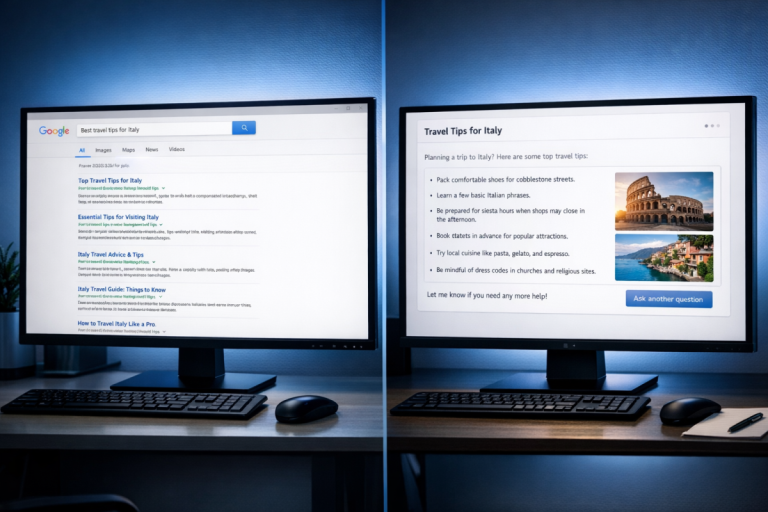
Google and these AI systems are no longer simply reading your words and matching them to keywords. They're recognizing the entities on your page - the places, organizations, products and concepts - and determining how central each one is to what the content is actually about. Two pages can have identical text. But if one establishes its subject matter more clearly through the way it's structured and written, it will outperform the other in AI-generated replies.
That concept - the degree to which an entity is recognized as the true focus of a piece of content - sits at the heart of something called entity salience. It's not a household term, but it's quietly becoming one of the most consequential things in Answer Engine Optimization.
What follows is a helpful overview of what entity salience actually means, how search engines measure it, and why it could be the difference between your content being cited by an AI answer engine or being passed over entirely.
Key Takeaways
- Entity salience measures how central an entity is to a page's content, scored by Google's Natural Language API from 0 to 1.
- Pages with salience scores above 0.7 rank an average of 4.2 positions higher than pages scoring below 0.3.
- Sites optimizing for entities earn 40% more AI-generated citations than those relying solely on keyword-based strategies.
- Pages with five or more contextual internal links from topically related pages achieve 62% higher entity salience scores.
- Diluted content that spreads focus across multiple competing entities weakens salience signals for every topic it touches.
How Google Scores the Importance of Entities on a Page
Google's Natural Language API assigns every entity on a page a salience score between 0 and 1. A score close to 1 means that entity is basically what the whole page is about. A score close to 0 means it just gets a passing mention.
An entity is a thing Google can find and identify.
What actually makes a page feel about something instead of just touching on it depends on how dedicated the page is to that subject. If a page mentions a person in the headline, the introduction, multiple body sections, and the meta description, that entity scores high. If the same person gets one line in a longer post about something else, the score drops fast.

This matters more than you might expect. According to Kalicube's 2025 research, pages with an entity salience score above 0.7 rank an average of 4.2 positions higher than pages scoring below 0.3; it's a real gap that comes down to how focused a page is on its subject.
| Salience Score Range | What It Signals to Google | Avg. Ranking Impact |
|---|---|---|
| 0.7 - 1.0 | Entity is the central subject of the page | +4.2 positions on average |
| 0.3 - 0.69 | Entity is discussed but shares attention | Moderate ranking performance |
| 0.0 - 0.29 | Entity is mentioned but not a focus | Little to no ranking benefit |
A page can mention dozens of entities. But Google is always working out which one the page is fundamentally for. The salience score is how it formalises that judgment.
The Link Between Entity Clarity and AI-Generated Answers
AI answer engines don't scan pages for relevant keywords. They pull from sources that have an established primary entity - a page that's unmistakably about one thing and backs that up with supporting context throughout.
This is where salience scoring connects directly to Answer Engine Optimisation. When an AI model needs to generate a response, it gravitates toward pages where the main entity has a strong, steady presence. Pages that scatter focus across too loosely related topics get treated as less authoritative - even if the information on them is accurate.
The data supports this. A 2025 Authoritas analysis found that sites optimising for entities earn 40% more AI-generated citations than sites relying on keyword-only strategies. That gap is not small, and it goes well with how fundamentally different AI retrieval is from traditional search ranking.
A lot of this traces back to Google's Knowledge Graph, which holds around 500 billion facts and five billion entities. That graph is basically the reference layer that AI systems use to know relationships between things in the world. If your page goes hand in hand with how an entity is represented in that graph, you become a more credible source to draw from.
Consider your own pages for a bit. Does each one read as an authoritative source on one thing, or does it feel more like a general topic overview that touches on a dozen different ideas without committing to any of them?
For most pages, the honest answer is somewhere in the middle - and that's the problem. A page that sits in the middle doesn't get treated as a strong signal for any single entity - it gets treated as background noise instead of a primary source.
Entity salience is about making sure that the primary entity on a page is the dominant presence - the thing that everything else on the page supports and connects back to - not about stripping content down to one idea.
Why Diluted Content Tanks Your Salience Score
One of the most common mistakes is cramming too many entities into a single page and it doesn't make any one of them the focus. When a page tries to be about everything, AI systems have a hard time assigning it a dominant entity and it loses ground to pages that follow one.
Think about a product page that starts with the product itself, then drifts into brand history, then pulls in industry trends and finishes with a FAQ section covering loosely related questions. Every one of the topics introduces new entities and none of them get enough weight to register as the main subject. The page ends up being near things instead of being about one thing.
That distinction matters more than most account for. Search systems and AI answer engines use entity salience to choose what a page actually represents and who it should serve. A page that spreads its focus too thin gets treated as a weak signal for every topic it touches instead of a strong signal for any single one.
Content at Scale saw this play out with their AI Detector page - it dropped roughly 32,000 clicks between May and June of 2023. After they worked to sharpen the entity focus and restructure the content around a dominant subject, the page helped drive a recovery to around 150,000 monthly organic visits. That result doesn't come from adding more content - it comes from making the existing content mean something more precise.

Diluted content is easy to create by accident. A related section gets added for thoroughness, then another to answer a follow-up question and before long the page has three or four competing focal points and each addition feels helpful in isolation but weakens the entity signal. Automating your blog content can make this problem worse, generating bloated pages that drift across topics without ever committing to one.
The honest question to ask about any page you publish is whether it's legitimately about something or just in the vicinity of it. A page that orbits a topic without anchoring to it is unlikely to earn a place in an AI-generated answer. Improving your blog's E-A-T score starts with exactly this kind of editorial discipline - committing to a focused subject and making every section serve it.
Internal Linking as an Entity Salience Signal
The way pages connect to each other tells search engines which entities matter most across your content as a whole.
Botify's 2025 research found that pages with five or more contextual internal links from topically related pages achieve 62% higher entity salience scores than pages with fewer than two. That gap is worth taking note of.
The key phrase there is "topically related." A link from a page about email marketing to your page about segmentation makes sense - they share context and reinforce the same subject territory. A link from a page about logo design to that same segmentation page does not carry the same weight because there's no shared topic thread to strengthen.

Random internal links are basically noise to a search engine. They don't reinforce what an entity page is fundamentally about because there's no connected meaning behind them.
Topic clusters matter here. When a main page is linked to by a few related pages that all orbit the same subject, it builds a pattern. That pattern tells search engines that this page - and the entity it focuses on - is the authoritative center for that topic on your site.
An easy way to check your own structure is to ask if the pages linking to your entity page would make sense in the same reading session. If you read three of the linking pages back to back, your entity page should feel like the natural next step. If it does, you probably have topical togetherness working in your favor.
Two pages can live in the same silo but still not have enough shared context to pass an actual salience signal forward.
On-Page Signals That Strengthen a Primary Entity
Internal links help Google trace relationships across your site. But the page itself is where entity salience gets established first. The way you structure a page - what you mention early, how you reference it, and what surrounds it - all shapes which entity Google treats as the main subject.
Placement matters more than you might expect. Entities that appear in the first paragraph carry more weight than the ones buried halfway down the page. If your primary entity shows up in the title, the opening sentences, and the first subheading, you're giving Google a strong signal about what the page is actually about.
Frequency factors in too. But the goal is not to repeat an entity name as many times as possible. Natural variation, related terms, attributes, and descriptors actually reinforces salience better than repetition alone. Google understands that "the company," "the brand," and the name can all point to the same entity.
Structured data is one of the most direct ways to declare your primary entity. Schema types like Person, Organization, Product, and Article let you tell Google what the page is about without leaving it to interpretation. If you haven't looked into schema markup, it's worth making time for - it closes the gap between what you intend and what Google infers.

The entities that surround your primary one also matter. Semantic context from related concepts, people, or places tells Google that your content sits in the right knowledge space. A page about a financial advisor that also references relevant qualifications and institutions reads as more authoritative than one that exists in isolation.
| On-Page Signal | Relative Impact on Entity Salience |
|---|---|
| Early placement in content | High |
| Structured data markup | High |
| Natural frequency and variation | Medium |
| Surrounding semantic context | Medium |
| Entity mentions in headings | Medium |
A helpful question to sit with: if you ran your page through Google's Natural Language API right now, which entity would come back with the highest salience score - and is that the entity you want to rank for?
Measuring and Auditing Entity Salience Across Your Site
Once you understand what entity salience is and how on-page signals shape it, the next step is to look at your pages and see what's going on. You don't need expensive software to get started.
Google's Natural Language API has a free demo at cloud.google.com/natural-language. You paste in your page text and it returns a list of detected entities along with a salience score for each one. That score runs from 0 to 1, and the closer it is to 1, the more the model treats that entity as the main focus of the content.
Run a few of your most important pages through it and look at what's sitting at the top of the entity list. If the highest-scoring entity isn't the one you want to rank for, that's a signal worth acting on. You might find that a brand name, a location, or a person mentioned in passing is outscoring your target topic.

Third-party tools like Textrazor or tools built into some SEO platforms can surface similar data in bulk, which makes it easier to scan a bigger set of pages. The goal at this stage is to get a read on where dilution is happening and which pages have the biggest difference between their intended focus and what the model detects.
For prioritization, focus on pages that are already ranking in positions 4 through 15. These are close enough to page one that a salience improvement could move the needle without a full content rebuild. Tools like Alexa can help you identify which topics are worth targeting in the first place.
| What to Check | What You Want to See |
|---|---|
| Top-scoring entity | Matches the page's primary topic |
| Salience score for target entity | Above 0.5 where possible |
| Number of competing entities | Few high-scoring entities unrelated to the topic |
| Current ranking position | Prioritize pages in positions 4-15 |
A basic audit like this gives you a concrete starting point and helps you focus your edits where they're most likely to help.
Entity Salience Isn't a Trick - It's How Machines Read Trust
Optimizing for salience isn't gaming anything - it's making your content easier to know - for humans and machines alike. A page that's about one thing, supported by the right context and structured with intention, is a better page. That is what earns citations in AI-generated answers, featured snippets and knowledge panels. Drop it into Google's Natural Language API or a similar entity analysis tool and see what Google actually thinks your page is about. The answer will almost always show you where to focus next.
If what you find shows a bigger gap than a single edit can fix, a content strategy built specifically around AEO makes the difference. Our AEO Content Grader can help you see exactly where your content stands. At BlogPros, every piece of content we produce is engineered with entity salience, schema optimization and answer engine visibility at its core - not as an afterthought. For those just starting to understand how AI search can affect visibility, or ready to build a content engine that performs across Google, ChatGPT, Perplexity and Gemini, getting started is easy. Your first month is free - no contracts, no credit card, no commitment. Just content that's built to be the answer.