Key Takeaways
- New sites typically get indexed within 24-48 hours using Google Search Console, XML sitemaps, and backlinks from reputable sites.
- Indexation and ranking are very different; getting indexed is easy, but ranking competitively takes significantly longer.
- Only 1.74% of new pages reach Google's top 10 within a year; the average top-ranking page is five years old.
- AI content explosion since 2023 has raised Google's standards, with E-E-A-T, content quality, and backlinks becoming critical ranking factors.
- Local SEO offers brick-and-mortar businesses a faster path to rankings, typically three to six months in moderately competitive markets.
There's a certain cycle of life online. Newcomers create new sites and new blogs. Businesses come in to spice up their old, lackluster websites with blogs. New businesses spring up, running blogs to pitch their content. AI content farms churn out thousands of articles overnight. Black hats spin up networks of spammy sites at scale. All of this is happening on a non-stop, accelerating basis.
Add to that every website that updates every day and you get an idea of how much content is published on a daily, or hourly basis. Then you have Google at the center of it all, the favorite resource to find this new content. A person's website waits for Google to index their content. But if it takes too long, they get angry. "It's just one blog post, how long can it possibly take?"
Well, seeing that Google - one singular entity, no matter how large it is - has to index millions of pieces of new content, and the changes made to old content, every day, you start to understand; it's one heck of a big job. And with the explosion of AI-generated content since 2023, that job has grown dramatically more difficult.
How does Google manage it? Well, they have a massive fleet of pieces of software called crawlers or spiders. These bots travel the web, starting from locations chosen by Google through algorithms they have refined over the years. They compare existing content to what Google already has in the index. If the content is new or it has changed, Google makes an update to the index. The bot then crawls along, following links and visiting other sites.
How long does it take for a single webpage on your site to load? Ideally, less than a second; it's the time Google's bots need to load and compare the content.
That's how Google looks for changes and how they find new sites when they have links, but what about brand new sites? Well, let's look at how Google indexes sites.
- A link leading to a page that has changed or that they have not seen before allows them to index that page.
- A direct URL submission to Google Search Console puts a new page in a priority queue to be crawled and indexed.
- A sitemap uploaded to Google Search Console will allow them to see every page on your site you want indexed, as well as giving them a convenient list of change dates so they can safely ignore pages that haven't changed since the last time they checked.
- Pages shared prominently on major social networks like LinkedIn, Twitter/X, or Facebook can signal Google that new content exists, particularly if those posts gain traction.
- Linking a new site to Google Analytics and verifying it in Google Search Console will give them confirmation that the site exists and is actively maintained, prompting a crawl.
- Earning even a single backlink from an already-indexed, reputable website remains one of the fastest and most reliable ways to get a new page discovered.
So, with those methods, what process should you use to get a new site indexed?
Getting a New Company Blog Indexed
Before I give you a process, I should make a note here. What I'm talking about is specifically for new sites as a whole. Do not do this just for a single new page. If that new page is very important, you can request indexing via Google Search Console. But even then it's usually unnecessary once your site is already established.
Once Google has your site in the index, they will routinely check for changes and any new content will be indexed pretty quickly. It's only when you're building a new site with no backlinks and no previous presence that you'll have to dig into these strategies.

- Submit your site's root domain - your homepage - to Google via the URL Inspection tool inside Google Search Console. This is the modern replacement for the old URL submission menu, and it gives you the ability to request indexing directly.
- Verify your site in Google Search Console and link it to Google Analytics. This verification process confirms site ownership and puts you firmly on Google's radar for crawling and indexation.
- Create and upload an XML sitemap. You can upload the sitemap directly through Google Search Console under the Sitemaps section. This allows Google to see a complete list of all the content on your site without having to discover pages organically through link crawling. Most CMS platforms like WordPress generate sitemaps automatically through plugins like Yoast SEO or Rank Math.
These three steps alone should be enough to get you indexed fairly quickly. However, there are other steps you can use to supplement the process.
- Start sharing your site on social media. While Google no longer uses Google+ (which was shut down in 2019), prominence on LinkedIn, Twitter/X, Facebook, and even newer platforms like Threads can help signal that your content is live and worth crawling.
- Submit your site to a handful of relevant, high quality directories or industry resource pages. Do NOT under any circumstances use one of those "submits to 1,000+ directories" services or apps. This will look like spam and can actively harm your standing with Google.
- Plug your site on other, already-indexed sites you own. Internal and cross-site links remain one of the most reliable discovery signals for Googlebot.
- Guest post on high quality industry blogs with a link back to your site. This is a sound long-term strategy as well as a new site indexation strategy. Just make sure the placements are genuinely relevant and editorially earned.
At this point, you're well on your way to indexation, and some of the link building strategies help you grow once you're indexed.
How Long Does Indexation Take?
The vast majority of the time, using at least two of the methods listed above, your site will be indexed with Google within 24 to 48 hours. Usually it's closer to 12 hours for established sites with strong crawl authority. But for a brand new domain with no existing signals, a few days is perfectly normal. If you're time-crunched enough that you need to be in Google's index within 12 hours, you should have launched earlier.

If your site does not show up within a week, you might have some issue going on that's preventing your site from being indexed.
- You might have a problem with robots.txt. Robots.txt is a file in your root directory that tells search engines what pages to ignore. If there's an entry in this file that disallows crawling across your whole site, you can submit URLs all day and it won't matter. Google will obey those directives. This commonly happens when developers build a site in a staging environment with crawling blocked, then forget to remove that directive before launch.
- You might have a noindex tag in your page's meta robots or HTTP headers. This is increasingly common with page builders and CMS platforms that include a "discourage search engines" checkbox. It's easy to miss, and it will silently block indexation even if your robots.txt is clean.
- You might have a problem with the code on your site that causes the crawler to stall out. This is rare, but it can still happen with heavy JavaScript frameworks where content isn't rendered server-side. Google can render JavaScript, but it's slower and less reliable than plain HTML.
- You might have a problem with your web host. Downtime or persistent connection failures will stop the crawler. Google will retry, but it will delay your indexation and may suppress crawl frequency going forward.
What About Ranking?
Indexation and ranking are two very different things, and this is where site owners get a rude awakening in 2026. Getting indexed is pretty easy. Getting ranked is a different matter entirely, and the data has shifted over the past few years.
There are millions upon millions of pages competing for the same real estate. Even a query like "index a site" returns billions of results. But Google realistically surfaces only a few hundred of them, and users don't venture past the first page. If you're not in the top ten results, you're largely invisible.
What makes this harder than ever is the volume of content now being published. Since the widespread adoption of AI writing tools starting in 2023, the volume of content online has increased dramatically. Google has responded by raising the bar on what it takes to rank, placing even greater emphasis on demonstrated expertise, authority, and trustworthiness - what is broadly referred to as E-E-A-T (Experience, Expertise, Authoritativeness, and Trustworthiness).
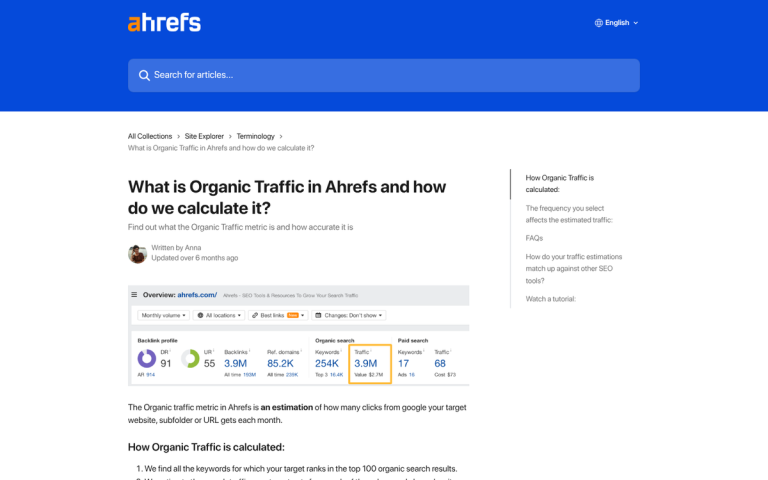
The data supports this. According to Ahrefs data from 2025, only 1.74% of newly published pages reach the top 10 within a year of being published - down from 5.7% in 2017. The average page currently sitting in the number one position is now five years old, more than double the two-year average seen in earlier studies. And 72.9% of top-10 ranking pages are more than three years old, while only 13.7% of top-10 pages are under a year old.
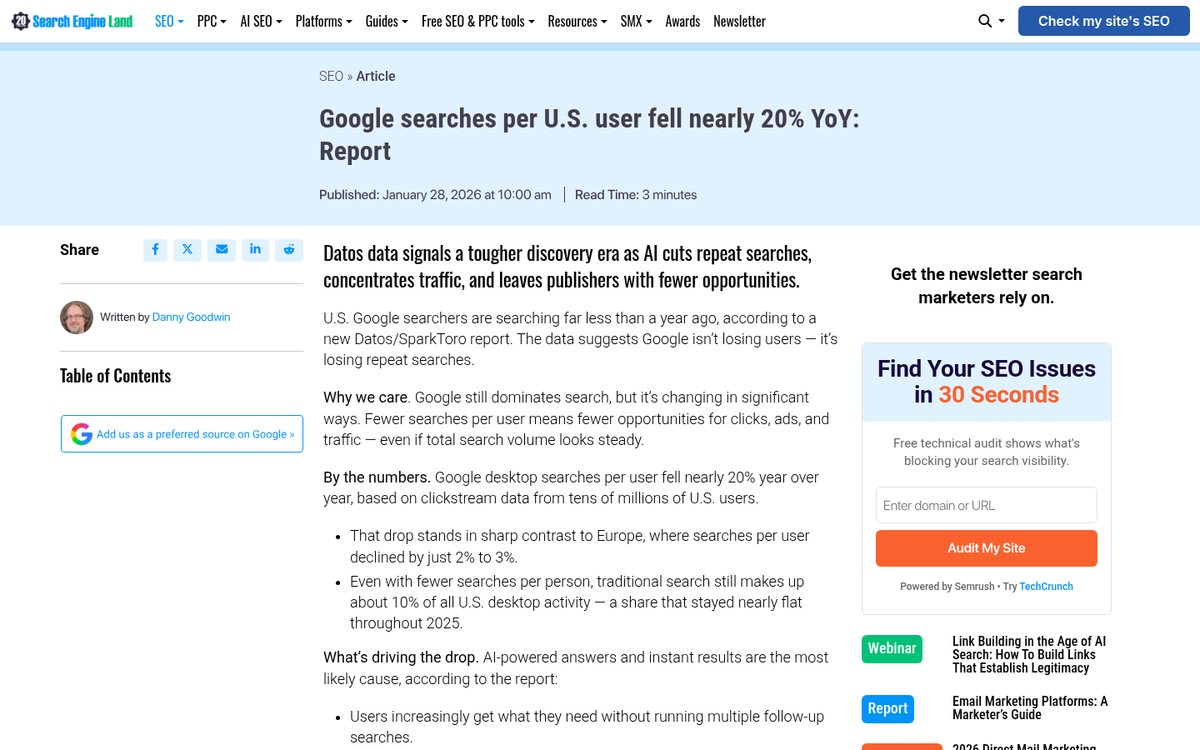
Grow & Convert, looking at ranking data across more than 40 clients, found that it takes over a year on average for a published piece of content to reach page one of Google. A Semrush study of 28,000 domains found that 41% were ranking in the top 10 after six months - but that's for established domains in moderately competitive niches, not brand new sites starting from scratch. It can take years to see meaningful results from blogging, and setting realistic expectations from the start is important.
Here are some of the most influential factors you should understand and how to improve them so you can rank.
- Incoming links. High quality incoming links remain one of the strongest ranking signals, specifically when they come from authoritative sources relevant to your niche. Low quality links and spam links are harmful. Focus on earning links through genuinely useful content, broken link building, digital PR, and guest contributions to reputable publications. Breadth of referring domains matters as much as the individual authority of any single link.
- E-E-A-T signals. Google's Quality Rater Guidelines place significant weight on demonstrated experience and expertise. This means author bios that establish real-world credentials, transparent About pages, citations to credible sources, and a consistent track record of producing reliable content in a specific subject area. In a world flooded with anonymous AI content, genuine human expertise is increasingly a differentiator.
- Content quality and depth. You need high quality content that thoroughly addresses what the searcher is actually trying to accomplish. That means going beyond surface-level coverage and providing genuine insight, original data, or a unique perspective. Length matters less than comprehensiveness and relevance, though most competitive topics reward longer, well-structured content. Thin, generic, or clearly AI-generated content with no original value is actively filtered out by Google's helpful content systems.
- Site loading and Core Web Vitals. Google's Core Web Vitals - measuring loading performance, interactivity, and visual stability - are confirmed ranking signals. A fast, stable site that works well on mobile is a baseline requirement, not a bonus. Use Google's PageSpeed Insights or Search Console's Core Web Vitals report to identify and fix issues.
- Branding and domain authority. Exact match domains are largely a relic of the past. What matters is building a recognizable brand that earns mentions, links, and searches by name over time. Brand signals - including branded search volume and consistent mentions across the web - are increasingly influential in how Google assesses the trustworthiness of a domain.
This is, of course, all just a quick summary of what has taken some sites years to pull off, some a decade to learn, and others mere weeks to achieve. It's very variable, and the competitive landscape in 2026 is more crowded than it was even a few years ago. Finding a niche where you can legitimately add value - instead of trying to compete head-on with established players - remains one of the smartest strategies for a new site.
There is one alternative for brick and mortar businesses in very competitive niches, and that's to pursue local SEO over widespread SEO. Global SEO for a local bookstore pits you against Amazon and retail chains. But if you're the most convenient option in your geographic area, local SEO gives you a lane to compete in that the big players can't dominate.
Focusing on Local SEO
Local SEO does require your brick and mortar business to have a reputation and a client base willing to help support you online. The key is to incorporate geographic keywords alongside your core service or product keywords, so when nearby customers search for what you offer, Google can prioritize your business in local results. Google wants to surface the most helpful answer for a given user, and a nearby business is usually more helpful than a national brand when someone needs something quickly.
An optimized and actively maintained Google Business Profile is now the single most important asset for local SEO. Reviews, accurate business information, regular posts, and photos all influence how prominently you appear in local pack results and Google Maps. Links from local publications, community organizations, and local directories carry extra weight for local ranking signals. Social proof - like steady positive reviews across Google, Yelp, and industry-specific places - also plays a real role.

For local SEO, actual rankings in a moderately competitive market can usually be achieved within three to six months with a focused strategy, and even faster in less saturated geographic areas. Highly competitive urban markets may take longer.
So, there are two very different answers to the questions posed by the title. How long does it take a site to get indexed? Typically, indexation takes a very short amount of time, measured in hours or days. You can confirm if your site is indexed by running a Google search for site:www.yoururl.com, or with the URL Inspection tool in Google Search Console for more detailed status information.
As for ranking, you can technically appear in results very quickly for extremely low competition queries. But for anything competitive, the data in 2026 paints a clear picture: most pages take well over a year to reach page one, the average top-ranking page is five years old, and less than 2% of new pages crack the top 10 within their first year. It takes steady publishing, genuine expertise, strategic link building, and sustained patience. Depending on your niche, realistic timelines range from six months for low-competition local markets to a few years for very competitive industries without a long-term content investment.