





A traffic exchange is one of those ideas that sounds good on paper, but in reality, with the greed of the Internet and the rules set by Google, it sounds like it might get you in trouble. So what is a traffic exchange, how should it work, does it work, and can you get away with using it in 2026?
Key Takeaways
- Traffic exchanges work by users browsing sites to earn credits, then spending those credits to promote their own websites.
- Bots and automation scripts heavily exploit traffic exchanges, making the traffic overwhelmingly non-human and low quality.
- Even real human users on traffic exchanges aren't interested in your content - they just want to earn credits.
- Google isn't explicitly banning traffic exchanges, but its AI-driven systems can detect unengaged traffic and potentially penalize your site.
- The only viable use case is promoting money-making content, using a single focused landing page to maximize conversion chances.
What is a Traffic Exchange?

A traffic exchange is a website that creates a network of websites and funnels traffic around them. Essentially, it works like this:
- A user signs up for a traffic exchange.
- That user browses other sites in the network and earns credits in their account.
- Those credits can either be redeemed for cash or spent to promote a site of their own.
- Credits applied to a site put that site into rotation within the traffic exchange network.
- The site then pulls in hits from other traffic exchange users until it runs out of credits.
In concept, it's a mutually beneficial arrangement. Users build a network of sites, funnel views around, and everyone promotes each other. The credit system acts as a regulator - similar to the seed/leech ratio in torrent trackers - preventing people from simply leeching traffic without contributing their own browsing time.
The problem with traffic exchanges is the same one it's always been: quality control. Because users can earn credits - and sometimes real money - by racking up views, the system has always been a magnet for bots, automation scripts, and browser extensions that cycle through pages without any human ever actually looking at them. And if anything, this problem has gotten significantly worse over time, not better.
If you want further proof that the SEO industry has written off traffic exchanges entirely, notice that you won't find a single reputable voice at Ahrefs, Search Engine Journal, or anywhere in the serious SEO space recommending them. There's a reason for that. If you're looking for real results, it may be worth exploring whether it's possible to get steady traffic and income without SEO instead.
Are Traffic Exchanges Black Hat?
From one angle, a traffic exchange seems perfectly legitimate - it's just another form of advertising, and a cheap one at that. You're bringing users to your site through a mutually beneficial network. How is that wrong?
From another angle, it's clearly an artificial inflation of traffic metrics with no genuine user intent behind it. Google's systems in 2026 are dramatically better at detecting low-quality, unengaged traffic signals than they were even a few years ago. With the rollout of more sophisticated engagement-based ranking signals and AI-assisted spam detection, sending bot-adjacent traffic to your site is more likely to actively hurt you than it is to help.
There's nothing in Google's guidelines that explicitly labels a traffic exchange as a black hat technique. But there's also nothing in Google's algorithm that rewards it - and increasingly, there are signals that it can do real damage to how your site is perceived.
All About the Interest
The core reason traffic exchanges don't work is traffic quality. Let's break it down:
- Fake traffic. Bots, scripts, and browser extensions cycling through pages to rack up credits. This has always been a problem with traffic exchanges, and in 2026 it's arguably more prevalent than ever. At a fraction of a penny per view, you need serious automation volume to make any money - which means the traffic you receive is overwhelmingly non-human.
- Completely off-target traffic. Even the human users browsing traffic exchanges aren't there because they're interested in your niche. They're there to earn credits for their own site. If you're running an e-commerce store or a content blog, the person sitting on your page for 15 seconds waiting for their credit timer to expire is not your customer.
- Vaguely interested traffic. These are users who might have some passing interest in your content or product but are highly unlikely to convert. They represent the absolute ceiling of what a traffic exchange can deliver - and even this group is a tiny minority of the overall traffic you'll receive.
- Highly interested, ready-to-convert traffic. These people simply do not use traffic exchanges. They find what they need through search, social media, recommendations, or paid ads. They are not spending their evenings watching credit timers tick down.
The types of people who browse traffic exchanges are not the types of people who are going to engage with your content, buy your product, or sign up for your list. They're there for one reason, and your site is just an obstacle between them and their next credit.
When Traffic Exchanges Work (Barely)
There are a handful of narrow use cases where traffic exchanges can generate some minimal return. Ironically, the main one is if your site is itself about making money online. If your content covers traffic exchanges as a strategy, some of the people browsing your page may actually be your target audience - and you might earn a small affiliate commission if they sign up through your link.
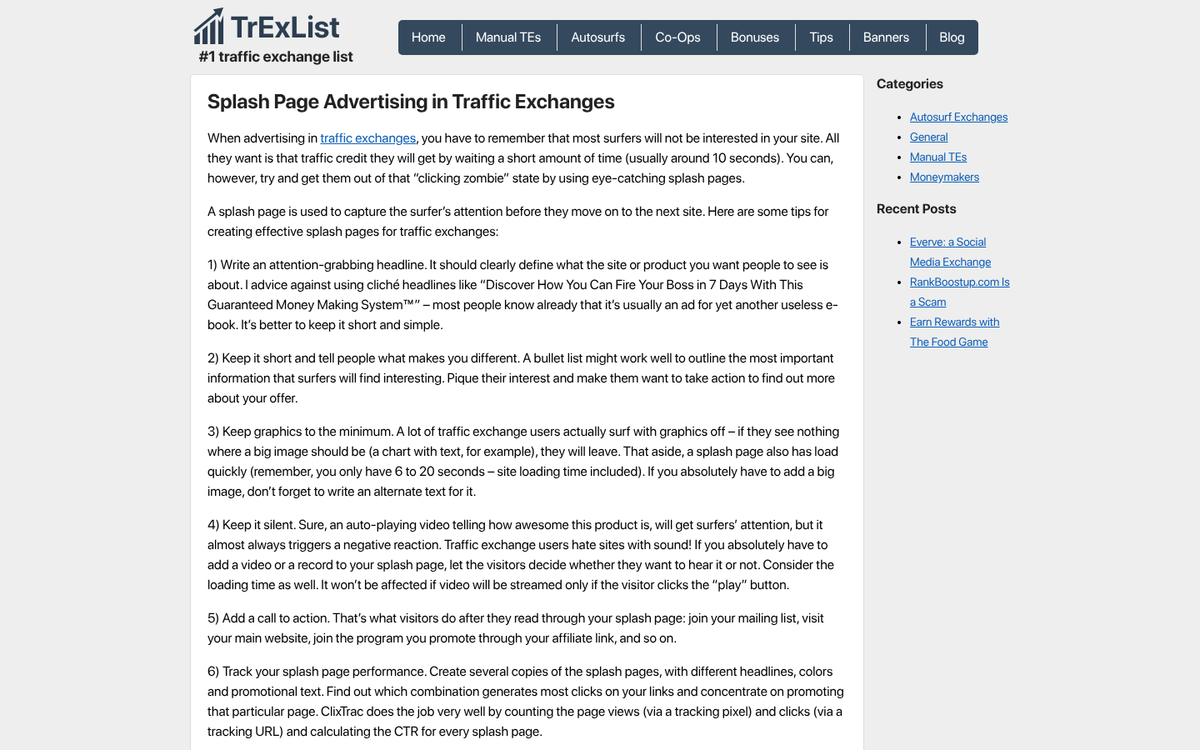
Beyond that, if you're determined to experiment with a traffic exchange anyway, your only real leverage is the splash page. Traffic exchange users have short attention spans by necessity - their timer is running. A tight, high-impact landing page with a single clear call to action gives you the best possible shot at a conversion before they move on. Don't send them to your homepage. Don't send them to a blog post. One page, one message, one action.
But in 2026, with Google's AI Overviews reshaping organic search, short-form video dominating discovery, and programmatic ad costs more accessible than ever, there are simply far better places to invest your time and budget than a traffic exchange. The juice has never really been worth the squeeze - and in today's environment, it's even less so.


9 responses
Thoughtful replies only - we moderate for spam, AI slop, and off-topic rants.
Thanks for sharing it.
Traffic exchange will make your exchange in another way. Traffic exchange help to boost your traffic rank, that is the passive income for you. You must have good ranking in traffic before you get approved for advertising or earn from advertising those pay for views.
To whoever who is looking for superb grade free traffic,
You may want to take a look at HitLeap, it provides one of the best traffic
I haven't read a post on traffic exchanges like this in a while. As a Traffic exchange owner. I am not taking this post as a dig. I see this as the common perception from people in the Online marketing Niche. Thank you for sharing - now i also have a couple things to work on to make traffic exchanges work for more people.
The problem with traffic exchanges is the same problem with safe lists, marketers marketing to other marketers!. Forget the BS credits for surfing, people want to sell their product or service when they put their links on traffic exchanges. One big problem, the only people viewing their links are sellers not buyers. Traffic exchanges are 100% BUNK and a complete waste of time, effort and money.
Most traffic exchanges are really only good at advertising offers rather than websites. Splash pages or lead pages seem to work best if they are relevant to the target audience of the traffic exchange. So marketing tools, webmaster tools, make money online, etc. are usually good niches if the traffic exchange is catering to that niche. Sending traffic to an actual content website (or even the home page of a product or service website) is usually a waste of credits.
The only traffic exchange that I know that works with real content is StumbleUpon, but that is because it regulates content in such a way that good content gets voted up, and bad content gets voted down. If you add a crappy webpage to StumbleUpon, very few people will ever see it. Plus they downplay the fact that you can buy traffic on StumbleUpon by not linking to the advertising tools page from the main website. It's not your typical traffic exchange (and probably would hate it if you called it one).
So it really comes down to the mechanics of the exchange and the niche. That will determine what can be promoted successfully on it.
Traffic exchanges can work. Before my blogs/sites started having success through organic means, I used traffic exchanges to build a list using a simple optin page. After about a year working within a group of exchanges that list is used in my offers today. There are some very dedicated members in these exchanges that can become loyal customers and followers. I am not very active using them today but I feel they more than likely have the same result
I've been using a method to send a few traffic exchanges to a coop link that pays roughly $2-$3 per thousand views. The exchanges with short timers don't work as good, but the others are generating me ad revenue from a site that allows and encourages it.
So regardless of the viewers are interested or not, I get paid this way.
That's a clever workaround, Jason! Using co-op links that monetize per impression rather than relying on engaged traffic is a smart way to extract value from exchanges. You're essentially flipping the model - instead of hoping visitors convert, you're treating the traffic itself as the product. The timer point makes total sense too. Longer timers mean more legitimate view counts. Solid strategy!