





Traffic exchanges have a long and variable history in the world of Internet marketing. At times they have been incredibly effective. At other times they have been nothing short of scams. Exchanges of all stripes exist today, with some of the best hidden behind walls of reviews and bans.
Key Takeaways
- Traffic exchanges work by earning credits through viewing others' sites, then spending credits to have your own site viewed.
- Manual exchanges enforce quality through captchas and timers; autosurf exchanges embrace bots, making their traffic essentially worthless for legitimate conversions.
- Bot abuse degrades traffic quality significantly - if 50% of users use bots, 50% of traffic received is fake.
- Traffic exchanges work best for "make money online" niches, as most active users are internet marketers, not general consumers.
- Using multiple exchanges simultaneously, spreading credits across them, and capturing email opt-ins maximizes effectiveness over direct sales attempts.
How Traffic Exchanges Work
In concept, the traffic exchange is a brilliant idea. Years ago, when the Internet was young and marketers were well meaning and naïve, they worked very well.
The idea works like this. You have a website, and you want others to see it. Your friend has a website of their own, and they want others to see it too. You send your website to your friend and tell them to look at it, and if they do, you'll look at their site too. Now scale this up; instead of you and your friend, you have thousands of marketers with websites they want seen.
The traffic exchange itself is a central hub that regulates websites and views. You register for the site, because you want your site to be viewed by other users. The traffic exchange puts a bit of a stop sign in front of you and points you towards the pool of other websites already in the system.
In order to have your site viewed, you need to spend credits. You earn credits by viewing other websites. When I talk about a ratio below, that ratio is typically how many views you need to make before you earn a credit. Most traffic exchanges also offer you the ability to purchase credits with money, to bypass the time-consuming process of viewing other pages just to get yours viewed.
The Problem With Traffic Exchanges

In a perfect world, with everyone on the up and up, a traffic exchange would be a perfectly valid and legitimate way of sharing a website. You would have webmasters from across the country, in all niches, sharing their sites. It would be like a content discovery platform; you could select interests, browse sites that interest you, and all the while earn credits to have your site added into the rotation.
We don't live in a perfect world. Someone, somewhere, way back in the early days of the Internet, created a piece of software that would view a website for them in the background while they did other things. This would earn them credits for the traffic exchange, which they could then spend for legitimate views from real users. They were essentially injecting fake traffic into the rotation and pulling legitimate traffic out.
This grew more and more widespread as people discovered the technique, bought similar software, and put it to use. The trouble is, for every user fake browsing, the quality of the traffic from the exchange drops. If 50% of the users of a traffic exchange are using bots to browse to earn credits, 50% of the traffic they - and the legitimate users - receive will be fake traffic. And that's at a 1:1 ratio. It gets worse when the exchange requires more views for a credit.
About Manual Exchanges
There are two types of traffic exchanges; the manual and the autosurf. Consider the above problem scenario with traffic exchanges. There are two ways to solve this problem.
The first way to solve the problem is to heavily regulate the traffic exchange. You would need to sample traffic and monitor the actions of the people browsing through your network. Any time you detect a bot, you would need to block that bot, invalidate the credits earned through the bot, and warn or potentially ban the user running the bot.
Manual traffic exchanges take this route. They heavily enforce ratios, they ban users who use bots, and they often require a human interface action such as a captcha in order to prove you're not a robot doing the browsing. They almost all require a certain amount of time spent on a given site in turn, in order to encourage actual usage of the site.
I'll talk about the other solution to the problem in a minute; first, though, let's look at the names that come up frequently in the world of manual traffic exchanges.
High Quality Manual Exchanges

These exchanges are all on the top side of legitimate, or as close as possible. They filter their sites to remove malware and malicious sites, they ban people trying to abuse the system, and they have high volumes of hits.
- EasyHits4u - One of the most consistently recommended manual traffic exchanges available, EasyHits4u has maintained its position in the top five traffic exchanges online for well over half a decade. It offers a 1:1 ratio and a 15-second timer, making it one of the more rewarding exchanges for your time. They allow rotators, don't require a login to surf, and offer five referral tiers for marketers looking to recruit others.
- StartXchange - This exchange has a 3:1 ratio and a 10-second timer, making it about par for the course on those metrics. What sets it apart is its sheer volume - it has recorded approximately 2.7 billion hits per six-week period, making it one of the largest manual exchanges still operating. It allows rotators and requires no login to surf.
- TE Racing League - This exchange has a 3:1 ratio and only a 5-second timer, which makes earning credits relatively quick. It has had a somewhat rocky history with fluctuating traffic volumes, but it remains an active player in the manual exchange space.
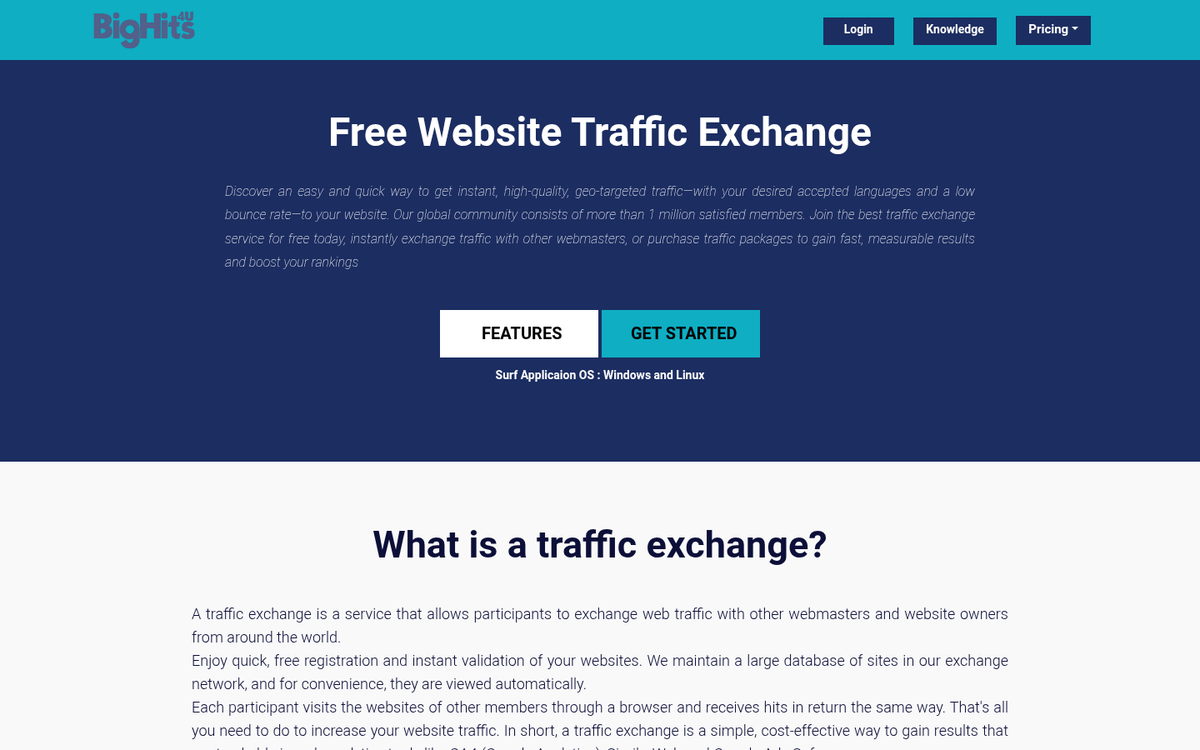
- BigHits4U - A flexible manual exchange that allows you to customize visit durations anywhere between 15 and 300 seconds, and set daily hit limits between 5 and 5,000 hits per day. This level of control makes it more versatile than many comparable exchanges for fine-tuning your campaigns.
- Tezak Traffic Power - One of the more distinctively named exchanges, this one offers a 3:1 ratio and an 8-second timer. It holds its own at the mid-tier level of quality exchanges and has maintained a reasonably consistent user base.
- I Love Hits - This exchange has a 3:1 ratio and a 6-second timer. They allow rotators and have no login requirement for surfing. They have a referral program, though it only operates on a single level, so the bonus is flat for each referral.
- TopHits4U - This exchange has a 3:1 ratio and a 10-second timer. It operates similarly to many others on this list but maintains a reliable active user base and consistent traffic volume.
Low Quality Manual Exchanges

I'm not going to go into detail about these exchanges, as you probably shouldn't even visit them. In general, they're all low volume, with either a lot of bad traffic or a lot of bots circulating through their networks. Remember, these are just a selection of the hundreds of poor-quality traffic exchanges out there. Many of the worst offenders from earlier lists have since shut down entirely, which is telling in itself.
- Surf Central Net
- AdsTab
- Global Traffic 4You
- Free Web Clicks
- Surfers Traffic Exchange
- Badger Hits
- Lighthouse-Traffic
- Hit Heifer
- WatersEdgeHits
- Firedragon-Hits
About Autosurf Exchanges

Now, think back to the problem scenario. Your traffic exchange is large, it has thousands of users, if not hundreds of thousands. There are millions of hits flying around every week. It's impossible for you to manage the exchange and enforce quality. You could use algorithms, but algorithms can be beaten, and you don't have the time, knowledge or budget to develop them faster than your legion of users can beat them.
Rather than attempt to fight off the bots, you embrace them. You remove any text on your site guaranteeing the quality of the traffic in the exchange. You drop prices on credits and raise ratios to encourage bot usage. You enable applications that rotate through sites automatically, changing up user agent and HTTP referrer as they go. You add a widget that dynamically changes the amount of time the bot spends on each site, and you virtually remove timers on viewing each site.
This is what an autosurf exchange is. You don't need your users to run a bot; you embed the bot in your exchange software itself. All the user has to do is hit play, wait a while, then redeem their credits.
The problem with an autosurf network, of course, is that all of the traffic coming through it is coming from a bot. The people using these networks all know that the traffic is bot traffic, and it's all very, very hard to use for anything legitimate. Bot traffic like this can get you booted from programs like Google AdSense, and most other sources of display ads.
Now, I'm going to list a bunch of autosurf exchanges, some better than others. Before you read on, though, I just want you to remember that even the best autosurf is still poor quality traffic, and will fare poorly compared to even mediocre manual exchanges.
High Quality Autosurf Exchanges

Autosurfs are only good for very specific purposes. You can make money with them, but you have to have a site set up to use them. Traditional splash pages and high value but low converting sales don't work. You'll have high traffic volume but low click rates. Plan accordingly.
- Hitleap comes out on top with the ability to set visits per hour on individual URLs. You can hide the referrer as well, giving you more control over how your traffic appears in analytics.
- eBesucher is a high quality site that has broadened its reach beyond its original German-focused audience over the years, though it still maintains a strong European user base. Notably, they offer the first 100 visitors for free when you sign up, making it easy to test before committing.
- Otohits offers a custom HTTP referrer, which gives you a level of control that lesser sites simply don't provide.
- 247AutoHits is a reliable autosurf network with commissions for referred members who upgrade their accounts. It's straightforward and does what it promises.
- SmileyTraffic has a 20-second timer and a large active membership base, which means it can produce significant volume relatively quickly.
- WebSyndic is primarily notable for having decent geotargeting and a hybrid English and French-speaking audience, making it more useful if you're targeting European visitors.
- Twistrix offers custom timers and the option to hide the HTTP referrer, though customization options are somewhat more limited compared to the top-tier networks.
- FeelingSurf is a French-oriented platform with a modern interface. They give you the option for unique visitors only, which eliminates unnecessary repeat visits and keeps your traffic looking cleaner in analytics.
- Homepage Exchange allows you to convert surfing minutes into cash and offers a solid referral program, making it one of the more monetization-friendly autosurf options.
Low Quality Autosurf Exchanges

One thing you'll note about the list I'm about to show you is that they're all aimed at foreign country-specific audiences with very narrow demographics. Perhaps these networks are decent for people within their target regions, but outside of those demographics they offer very little practical value.
- 24Besucher
- Auto-Surf.de
- Websurf.cz
- AutoSurf.sk
- Auto-surf.pl
- AutoVisitor
- 360clicks.de
- Lautosurf
- Autosurf.fr
Despite the similar naming conventions, they are not all run by the same company. They are simply networks that used formulaic setups on quickly purchased URLs to stake a claim in their respective regional markets.
How to Use a Traffic Exchange Effectively
With both manual and autosurf exchanges, there's one big lingering problem. Traffic exchanges may have started out as a broad interest-based discovery tool back around 2001, but they have long since narrowed considerably. As their reputation fell, it required more and more knowledge and more tricks to use them effectively. As the barrier to entry rose, the niches willing to use them dropped out. These days, the people most actively using traffic exchanges are those running websites geared toward making money online, boosting traffic, or operating within the internet marketing space itself.
Therefore, you can only really make a consistent profit out of a traffic exchange, manual or autosurf, by running a website in a niche geared towards making money online. It might be about boosting traffic, running ads, or traffic exchanges themselves - there are any number of variants of the niche. The fact is, you won't typically see cooking blogs, automobile blogs, or travel blogs performing well in the rotation. The traffic using the exchange is only interested in extracting value from it, so the only reliable way to monetize those users is to cater to their interests.
What other tips can you use to optimize your usage of traffic exchanges?
Use a lot of them. One traffic exchange limits you. Two limits you less. Each exchange tends to have a surprisingly small set of active users, so you can run into issues seeing the same sites more than once. Exchanges typically only count the first unique view of a day, so encountering the same site twice earns you no credits and does you no good.
Additionally, most exchanges have a timer you need to exhaust before you can move on to the next site. If you earn a credit for every three sites you view, and it takes you 20 seconds to exhaust the timer on each site, that's one credit per minute. If you add in a second traffic exchange with the same statistics and rules, you're earning two credits per minute by simply having another browser window open for that second exchange.
To avoid having all of your credits used up showing your site to the same people over and over, spread across multiple exchanges as well. Rather than stacking 50 credits on one site, stack 10 across five different exchanges. Each exchange tends to have a different active audience, so you'll get more unique views overall.
As for extracting value from the users browsing your site, use a splash page. These users aren't going to scroll down or explore - they want to get in and out quickly. You have exactly the size of one browser window to capture their attention before they surf away.
You're also unlikely to convert these users into paying customers directly from your splash page. Don't even try. Instead, try to get them to opt in to a mailing list. Providing an email address in exchange for some free piece of value is far more enticing than asking for money upfront. You can follow up the opt-in with a sales pitch later, once you've established some trust.
If you're consistent, you'll rack up enough credits across your various exchanges to drive a decent number of people to your site, and some of those visitors will become genuinely interested. You can then explore those leads at your leisure, and sell them products through follow-up sequences and relationship building, rather than relying solely on a landing page pitch.


7 responses
Thoughtful replies only - we moderate for spam, AI slop, and off-topic rants.
Good morning.
Can I use, for example, Trafficmonsoon on my blog created with Blogger (Google's Blog) ?
Awesome stuff, thank you. Any harm in using multiple sites like this simultaneously?
One of the best articles about traffic exchanges I've ever read
They actually MENTIONED the NECESSITY of using multiple exchanges---particularly with manual exchanges, where you're 'wasting time' if you're not checking 10-to-20 other exchanges while you wait for the timers on other exchanges to run out.
Great point, Uncle Jay! That's a smart strategy that experienced traffic exchange users swear by. Running multiple exchanges simultaneously turns those waiting periods into productive time rather than dead time. It's basically like multitasking your traffic generation - while one timer counts down, you're earning credits on several others. Definitely a more efficient approach for anyone serious about maximizing their results!
StartXchange IS NOW CLOSED
Thanks for the heads up, Uncle Jay! We really appreciate you taking the time to let us know. StartXchange closing is definitely something our readers need to know about, and we'll get the article updated to reflect that. These things change all the time in the traffic exchange world, so community updates like yours are super helpful. Much appreciated! 😊