At the end of the day, it's all about the conversions. You could have a billion visitors to your site every day, but if none of them care about your product and they don't buy anything, you get nothing. Well, you get an obscenely high bandwidth bill and probably a Guinness World Record, but those don't help your business.
If your website isn't converting, you need to find out why, and fast. The average website conversion rate across industries sits at just 2.35%, while the top 10% of websites convert at 11% or higher, according to Unbounce's 2024 Conversion Benchmark Report, which analyzed over 57 million conversions across 41,000 landing pages. There are hundreds of points of potential failure, but they boil down to three things. Let's investigate those three things and figure out where your problem may be.
Key Takeaways
- Top-converting websites achieve 11%+ conversion rates; unfocused or mismatched traffic prevents most sites from reaching that benchmark.
- Simplified copy converts better - pages written at a 5th-7th grade level convert at 11.1%, versus 5.3% for complex writing.
- Nearly 59% of global traffic is mobile; a poor mobile experience reduces future purchase likelihood by 62%.
- Around 70% of shoppers abandon their carts - streamlining checkout, offering guest options, and broadening payment methods helps recover lost sales.
- Without urgency, users delay purchases indefinitely; time-sensitive offers and limited availability indicators are proven conversion drivers.
1. Traffic
The first possible point of failure is the people coming in to your site. Are they the kinds of people who care about your product? Do they distrust you? Do they have another issue you can diagnose and fix?
Your traffic is too unfocused to convert at any reasonable rate. A billion daily visitors are worthless if they run the gamut across every demographic. It'd be much better to pull in 10,000 highly targeted, genuinely interested visitors than millions of unqualified ones. Use platform analytics and paid targeting tools to understand exactly who is landing on your site and whether they match your buyer profile.
You're targeting the wrong demographics. A site dedicated to gifts for men probably isn't going to benefit from targeting pre-teen girls. At least, not outside of Father's Day. Picking the right demographics for your target audience is critical, and it relies on you being aware of the types of people who actually want your product. Revisit your audience personas regularly - they shift over time.
You're not bringing in a sizable volume of traffic. Maybe your traffic is converting just fine, but you're not bringing in enough of it. It could be a targeting issue, it could be broken ads, it could be any number of things. Audit your traffic sources, check for underperforming campaigns, and look for gaps in your SEO and paid strategy.
You don't have a connection with your readers. The emotional connection is where content and social media come in. Your goal is to build yourself up as a trustworthy brand and a source of valuable insight. You do this by being human, not corporate. Build up that connection through genuine engagement, comment responses, and showing some personality. Users buy from brands they trust - and trust takes time to earn.
2. Site
If the people coming to your site aren't the problem, maybe the site they're landing on is. Much has been said about optimizing landing pages, but what about the rest of your site?
Your site design is unprofessional or out of date. The less professional a site looks, the more it resembles a scam to the typical user. You need a clean, modern, professional design if you want to convert. Make sure your layout, typography, and imagery all signal legitimacy and credibility. When in doubt, test it with real users - you don't want to accidentally echo a common scam aesthetic.
Your copy is too complicated. This one is easy to overlook. Unbounce data shows that landing pages written at a 5th-7th grade reading level convert at 11.1% - more than double the rate of pages written at a professional or academic level (5.3%). Attention spans have also dropped dramatically, falling from around 2.5 minutes in 2004 to just 47 seconds in 2024, according to The Science Survey. Write clearly, get to the point fast, and cut the jargon.
Your content is too promotional. The internet is very resistant to hard-sell techniques. Instead, build a reputation as a trustworthy business with a side order of "by the way, here's my product." Give users a reason to trust you, a reason to want to buy from you, and then provide them the opportunity to do so.
You're not being promotional enough. This is the flip side. So you run an excellent blog on a well-designed site - so what? If your user doesn't realize you have a product to sell, they'll never buy. Don't shy away from the marketing side of things. A clear call-to-action, a navigation link to your product, a sidebar prompt - none of these will drive users away if done tastefully.
Your site fails mobile users. As of Q1 2023, nearly 59% of all global web traffic came from mobile devices, according to Statista - and that number has only grown. Google data also shows that a poor mobile experience reduces the likelihood of a future purchase from that brand by 62%. If your site isn't fully responsive and fast on mobile, you're not just leaving money on the table - you're actively pushing customers away. Mobile optimization is no longer optional; it's foundational.
3. Product
Finally, there are issues with your product. Pulling in a ton of traffic to a well-designed site is great, but if all you're selling is a gold-plated roll of toilet paper, you're not going to ship a unit.
No one wants to buy what you're selling. Sometimes you just don't have a winning idea. This happens more often in the world of digital content, when you're trying to sell ebooks or other low-cost products without clearly demonstrating their value. When you're offering a physical product requiring manufacturing and shipping, ideally you'll have confirmed demand well before setting up an entire business around it.
You have no free samples or risk-reducing offer. We live in a try-before-you-buy culture. Some products make sampling impractical - you can't sell TVs by giving away free TVs. But you can offer a money-back guarantee. They buy it, they like it, they keep it - conversion complete. They don't like it, they return it - and you've still built goodwill. With digital products, a free trial or preview chapter can be a powerful incentive to get users over the line.
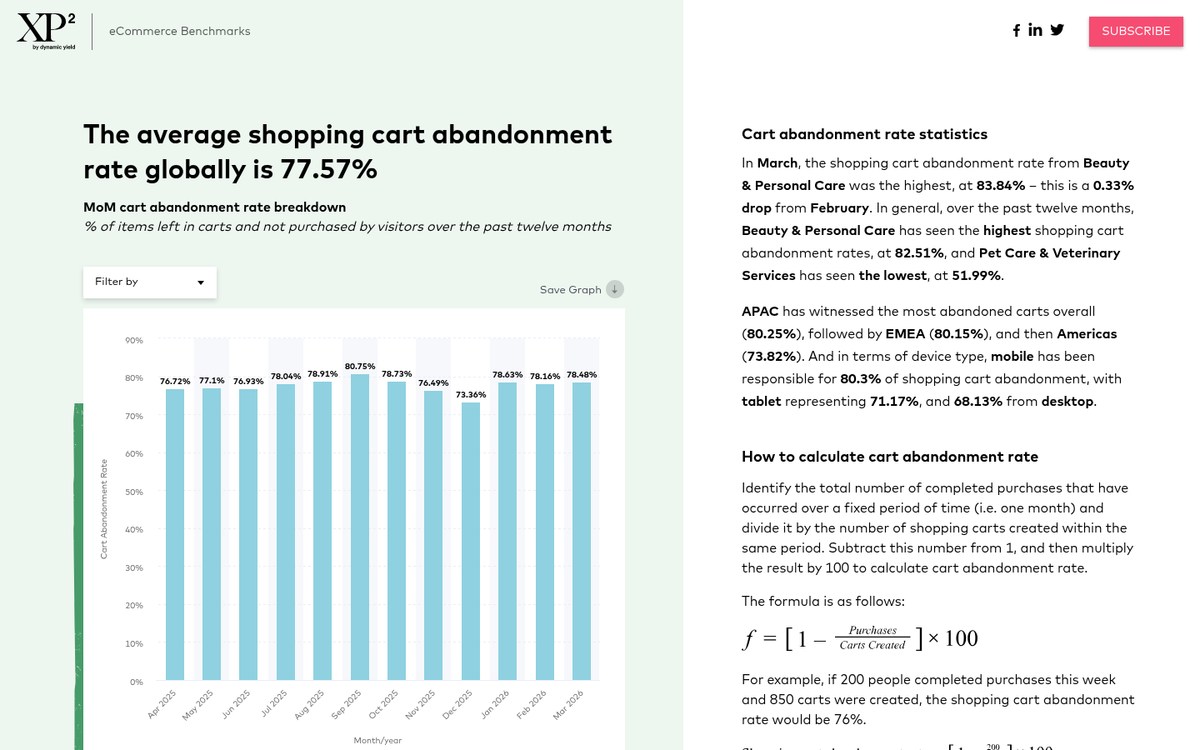
You're losing customers at checkout. Even when someone wants to buy, they often don't follow through. The Baymard Institute's analysis of 49 studies puts the global average cart abandonment rate at 70.19%. That means roughly 7 out of every 10 people who add something to their cart leave without completing the purchase. Streamline your checkout process, reduce the number of steps, offer guest checkout, and make sure your payment options are broad and trustworthy.
You've given your users no urgent reason to buy. Many users prefer to act when there's a limited quantity available or a looming deadline. If there's no reason to buy right now, they'll put it off - and keep putting it off until they've forgotten entirely. Combat this with time-sensitive offers, limited availability indicators, or expiring discounts. The pressure of an implied deadline is a genuinely powerful conversion driver when used honestly.