





Key Takeaways
- Mix.com is essentially StumbleUpon 2.0, founded in 2016 after StumbleUpon shut down, using AI-powered content recommendations.
- StumbleUpon users migrated to Mix, giving the platform an existing userbase and potentially already including your content.
- Bloggers can promote content by curating posts, adding social sharing buttons, and applying to become a featured curator.
- Mix has notable drawbacks: only 200,000 members, just 5 employees, and ongoing spam problems in its comments section.
- Despite limitations, Mix's recent 24% traffic growth suggests now may be a good time to establish a presence.
As bloggers, we're always looking for new ways to promote our posts. Thus, whenever a content sharing or curation platform shows up that's worth trying, it's worth learning about. One of these platforms is Mix, found at Mix.com, and it may be just the thing you're looking for to get your posts in front of a new, wider audience.
What is Mix?
So what is Mix? Why have you not heard of it before, or if you have, why should you use it? Well, let's take a step back and look at a bit of history first.
In the early 2000s, when social networks were growing, some had the idea of sites that shared content without relying on social networks or social relationships. Instead of friends and family, you would build circles and communities. Sites like Digg, which launched in 2004, and Del.icio.us, which launched in 2003, rode that wave.
One of the earliest examples was StumbleUpon. Stumble was innovative in two ways. The first is that it made use of a browser toolbar, back when toolbars were still cool. The second is that it added an ingredient of randomness to the formula. Rather than upvoting or sharing content from people you knew or sharing the popular content, StumbleUpon was a button that you clicked to take you to a new website. Websites would be categorized based on their topic, you chose what topics you wanted to see, and the randomness engine did the rest.
That's a simplification of the platform, of course. But it gets the core functionality across - it was a great promotion tool because of that randomness. As a blogger, all you needed to do was add your content to the Stumble index and get your followers to upvote it when a new post was made. Then you would be put in front of hundreds or thousands of new viewers who otherwise may have never known you existed.

StumbleUpon was not some small, no-name startup, either - it came about years before other content curation platforms, and while its formula kept it from reaching the heights of a site like Reddit, it still delivered personalized content to over 40 million users, serving up nearly 60 billion stumbles at its peak. It was even acquired by eBay for $75 million back in 2007.
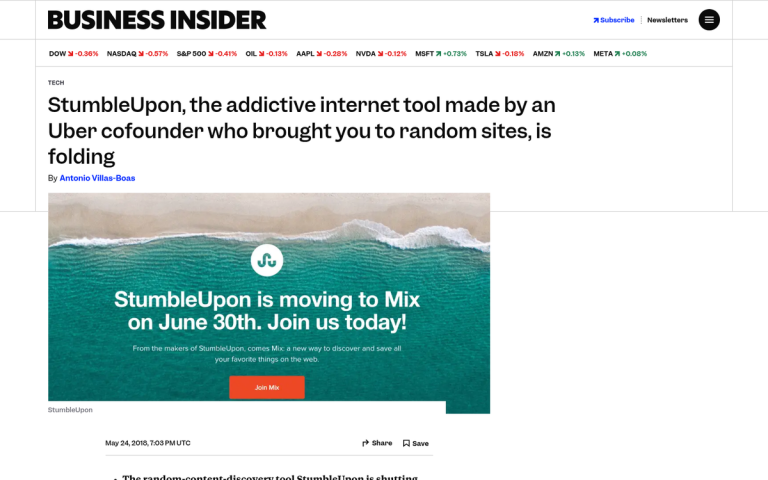
Stumble had its heyday, peaking somewhere around 2010-2012. Since then it was on a decline, laying off 30% of its workers in 2013, and finally shutting its doors in the middle of 2018.
So why do I bring this up? With Stumble closing, the formula was given new life in the form of Mix.com, founded in 2016 by Garrett Camp and Dustin Diaz out of San Francisco. Mix is the next generation of the Stumble formula, taking what they learned from the highs and lows of StumbleUpon and putting it to a new platform. Mix is, for all intents and purposes, StumbleUpon 2.0.
The Benefits of Mix
So what's great about Mix? And how does it make sense to invest in the platform?
Well, first off, StumbleUpon migrated to Mix, instead of shuttering and starting a new platform from zero - it means SU users were able to migrate their accounts over, which adds some continuity and gives the new platform a foundational userbase to build from.

Secondly, Mix learned from the mistakes of StumbleUpon, tackling its growing pains and problems. The platform uses AI-powered content recommendations to improve interest sorting, and it has a mobile app in addition to browser extensions.
Additionally, there's a basic chance some of your content is already on the platform. Any user that imported their StumbleUpon profile had everything they curated added to the Mix index. That means if anyone who imported their profile had previously shared your content, it may already be there waiting for new eyes.
If you want to learn about the vision behind the platform, you can check out the Medium profile of Garrett Camp, co-founder of StumbleUpon and Mix; he has written about the platform and its direction.
How to Use Mix
From a purely mechanical standpoint, it's easy to use Mix. I'll get into the advanced techniques and ways to take advantage of the platform later. But for now, let's get you started.
First of all, you'll have to sign up for Mix. The window for porting over a StumbleUpon account closed years ago, so you'll need to start from scratch if you don't already have an account.
When you go to Mix.com, you'll be asked to sign up for the service. You can sign in with Facebook, Twitter, or Google. All three use standard oAuth authentication: basically sign in with one of the profiles and you'll have your basic information filled out. For obvious reasons, I'd recommend a business account to sign up, and each option will have permissions to keep in mind:
- Facebook: Can see your name and profile picture, which are required. Can see your friends, and can see which friends use Mix if they've allowed their profile to be visible, which is optional. Can see your birthday and email address, also optional. Cannot post, harvest any other information, or otherwise interact with your account.
- Twitter: Can read your tweets, can see your followers, and can see your email address. Cannot follow, change your profile, post, see DMs, or access your password.
- Google: Can read your name, email address, and profile picture. Cannot access your account in any other way.
When you authenticate, Mix will ask you to set up your profile with an email address and username. You can customize it, but know that usernames are all lowercase.
Next, you have to choose some starter interests - it will show you interest categories with a thumbnail and a quick blurb. Categories range from technology and travel to history, lifehacks, green energy, and social activism. You can choose as many categories as you want, but you have to choose at least three.

Once you've chosen your interest feeds, you're brought to your main page, which gives you a few feeds to choose from.
- For You: A feed of recent content in the categories you choose. You can see a preview of a link and the reason it's in your feed, like "because of your interest in cooking" or "popular in video games".
- Following: A feed of content shared by people you follow. You can connect your Facebook or Twitter accounts to find friends already on Mix, or follow content curators you like on the platform directly.
- Popular: A feed of content that is trending at the moment, somewhat regardless of your choice in interests.
Each block shows a thumbnail, the domain hosting the content, the title and blurb, and the reason it's in your feed. There's also a small indicator showing the number of collections the post has been added to.
There are also a few controls on each block. One lets you see more details about the post - what collections it's in, who added it, and any comments. It also has the ability to flag a post as spam, blacklist a domain, or share it through apps like Twitter, Facebook, or email.
There's also an orange + sign which lets you save a post into a collection. Collections and saved posts appear on your profile, so keep in mind the combination of your business and personal accounts.
At the top is your profile; you can customize your profile picture, cover photo, name, bio, URL, and more. I recommend filling out your bio and link - and your username and display name - to match your brand as you curate content.
You can also download browser extensions for Firefox and Chrome, or the apps for iOS and Android, to give you Mix curation buttons as you browse the web.
A Few Problems
There are a few problems with Mix worth being honest about - it's not a perfect platform, and going in with realistic expectations will serve you better.
The first and biggest problem is the userbase size. Mix currently has more than 200,000 members contributing content, which, while a passionate and involved group, is a fraction of what StumbleUpon had at its peak and nowhere near the scale of places like Twitter, Pinterest, or Reddit. Web traffic has been growing - up nearly 24% in a recent month according to Similarweb - but it's still a niche platform instead of a mainstream one.

The second concern is the company's size and stability. As of the most recent available data, Mix had only 5 employees, reflecting a reduction in headcount over prior years. That raises real questions about how actively the platform is being developed and moderated going forward.
The third problem is the spam and comments quality. Mix has historically had a spam problem in its comments section that undermines its practicality as a social platform. Whether this improves over time remains to be seen.
How to Use Mix for Blog Promotion
If you want to use Mix as a platform for marketing, you can use it in the same way as you might have used StumbleUpon. Create your profile, curate and share your own content, and share content you find throughout your web browsing that seems relevant to your followers.
Occasionally mention Mix on your site and in your blog posts, to get your audience to sign up and follow you and view your content updates through the platform. You can also add a Mix social sharing button to your site. Mix is a button option in a few popular social sharing plugins, so it's easy enough to add.
You can also apply to be a featured curator, which puts you in the recommendations as a curator for others to follow. Mix also has a referral and curator points program worth exploring, which can unlock features like increased visibility and placement in the Mix newsletter.

Given the platform's growing audience and recent traffic uptick, now may actually be a good time to set up a presence before it becomes more competitive - if it continues on its latest growth trajectory.
Have you used Mix? If so, how has it been working out for you? I'm interested to hear some stories from the trenches, so to speak.


1 response
Thoughtful replies only - we moderate for spam, AI slop, and off-topic rants.
Thanks man, this makes a lot of sense.
It is going to really help me promote my contents as well.