Key Takeaways
- Medium combines blogging, social networking, and magazine-style curation, with editors and an algorithm surfacing top content.
- Businesses can use Medium as a primary blog, executive thought leadership platform, or teaser channel driving traffic elsewhere.
- Syndicating your best existing content to Medium after initial traffic dies down can revive engagement effectively.
- Using up to five tags strategically-mixing large and niche-helps the algorithm surface your content to relevant readers.
- Driving early engagement, like 100 claps within the first hour, significantly increases chances of trending on Medium.
Medium is a very interesting platform for businesses. It's a blogging platform and in some senses, it's not much different from a blog on your own site - it breaks some rules and it makes some new ones, and some businesses have used it to turn content marketing on its head. Do you want your business to invest in Medium? Do you, on a personal level, want to make your blog mainstream? If so, then you'll have to learn how it works and how to promote your posts.
How Medium Works
So how does Medium work, and how does it differ from traditional blogging platforms?
Medium is like a cross between a blogging platform, a social network, and a magazine. Individuals and businesses can create publications on the site, their own "columns" or "magazines" within the greater, overarching whole. In that sense, it's like a site like Forbes. Numerous writers coming together, writing their own content under a unified banner, usually within sub-categories.
The social network feature comes into play with how Medium strives to be somewhat democratic with the content that floats to the top of their platform - it's not quite as broadly democratic as Reddit; only the top content floats to the surface, with the rest left buried in reply chains or deep below the fold - it has some curation, and it has a paid program to promote certain kinds of content, and the usual trappings of a semi-competitive content marketplace.
The blogging platform part is, quite basically, that it's a free and open platform to use if you want to use it on a basic level - it's more connected than something like WordPress.com, where each site is segregated into its own domain. "Related posts" on Medium can point at the writing of any other author on the site, instead of just whatever your widget decides to choose.
As with all things online, there's an algorithm at play. Medium's algorithm orders content - picking what is most likely to appear on the front page or in related posts and recommended links - based on the quality and relevance of the content, its relation to other content, and who has and has not already seen it. At the head of it all, a team of Medium editors are curators, seeding the algorithm and surfacing especially strong pieces of content.
One way in which Medium works is that content is ordered by relevance and popularity - not necessarily by time. Your blog is not necessarily chronological, which will have some interesting repercussions. But they don't matter for promotion. Frankly, unless you have wild variance in the quality of your content, it should be more or less chronological save for a few viral outliers.
Creating Great Content
The first step towards promoting any blog, be it on your own domain or on Medium, is to create content. Think about it: if no one wants to read, clap for, comment on, or otherwise connect with your content, no amount of promotion will make it succeed.
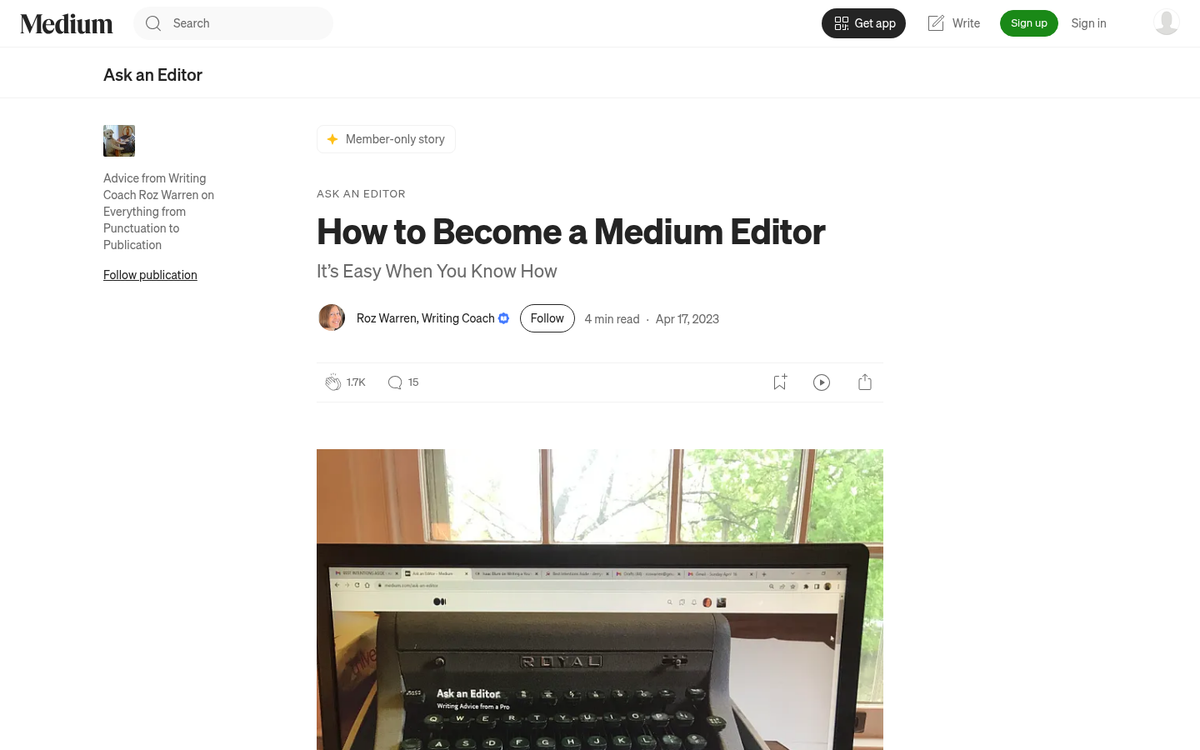
Medium's composition editor is easy to use. Once you register - an easy process that can be as easy as authorizing a Google or Apple account - you can click on your avatar and choose New Story. You're immediately taken to a composition window; you can write a title and start writing your story.
When you hit Enter to start a new line or paragraph, a circle with a + in it appears to the side. If, instead of typing, you click this, it expands into a few options.
- Image upload: Your basic "add an image" option. You can upload your own media here.
- Unsplash search: A search option through Unsplash, a large network of free stock photos integrated directly into Medium's editor.
- Embed: This button allows you to add an embedded piece of media from another location. Medium uses Embedly, which allows seamless embedding of content from hundreds of sources. If you want to learn more about embedding specific media types, check out our guide on whether it's legal to embed YouTube videos in your posts.
- Divider: This puts a centered separator in your post, as a visual break between sections.
That's it. There are no distracting formatting options, no mucking about with raw HTML or BBCode or anything goofy. Medium has formatting options, though they are intentionally limited. When you select a section of text, a context toolbar appears. In it, you can bold, italicize, or hyperlink text. You can make text H1 or H2 scale. You can also indent it as a quote or block quote. If you're looking for a distraction-free writing experience, there are dedicated tools that offer a similarly focused environment.
How You Should Use Medium
Medium is great when used in one of a few ways. If you're just looking to keep a semi-personal journal, that's fine. But you aren't likely to gain traction without concerted effort.
Here are ways businesses have successfully used Medium.

- Putting the whole company blog on Medium. Many brands use Medium as their primary publishing platform and enroll in the Partner Program for additional promotion and monetization. It alleviates the need to maintain your own blogging software as well.
- Keeping a core blog on your own domain, and using a niche-focused blog for Medium. Maintaining two blogs can be a lot of work, but the Medium blog can dig into deeper territory - or spin off into interrelated subjects - without jeopardizing the focus of your main site.
- Keeping a core blog and using Medium for a CEO's Insights blog. Mid-to-large sized companies often like to showcase the thought leadership of their executives, and a semi-branded Medium blog can do this quite well.
- Using a Medium publication to connect with influential writers. A Medium publication is like a magazine you control; you can recruit individual writers who wouldn't otherwise write for you, or use it as a gateway into deeper content relationships.
- Publishing "greatest hits" blog posts with updates and reworks to Medium, or vice versa; using Medium as a testing ground for content you then refine for your own site.
- Using Medium as a teaser. Write lengthy posts - 3,000 or more words - for your main blog, and publish excerpts of 500-1,000 words on Medium with a link to keep reading on your main site.
Promoting your Medium articles through your main site's blog can be a great extra source of traffic, and the cross promotion can be helpful. Just remember that Medium is itself engineered to retain readers on Medium, so you can't be laser-focused on bringing traffic to your main site.
How you use Medium is up to you, your brand, and your goals. Making that choice is the first step.
Successful Promotion of Medium Posts
So, what can you do to promote content you publish on Medium? Here are some ideas.
Fill Out Your Bio Completely
Consider your bio like a social media bio. It has a 160-character limit. With that limited space, you'll have to be concise. A few short phrases separated by | symbols works, as does one punchy sentence. Make it reflect who you are and what you write about.
Organize a Publication
On Medium, there's a difference between your profile and a Publication. A profile is the content your account produces. A publication is like a blog with multiple authors; it accumulates content posted by those authors. Some Medium publications have grown to more than 100,000 followers, giving them significant reach within the platform.
A publication is a good idea if you have multiple writers for your blog, or if you want to recruit more writers, or if you want to accept a roster of guest contributors. The added follower base of a well-run publication can dramatically improve each post you publish under its banner.
Syndicate Your Best Content
Medium doesn't care if something you post on their site has been posted elsewhere, provided you have the legal right to publish it. Don't publish something you sold exclusive rights to, don't publish something you didn't write, and don't publish something you've already posted on Medium before unless you're meaningfully updating it.
In general, it's fairly helpful to publish content from your core blog to a Medium account just as the first wave of traffic is dying down. Make some edits to the calls to action or internal links to more appropriately direct to your site, and add a line like "this post was originally published on MySite.com" for full disclosure and an extra link.
Don't be afraid to populate your Medium blog with your "greatest hits" or best evergreen content from your site. Anything that's still relevant and performed well when first published can do well on Medium's recommendation engine.
Link to New Posts on Social Media
Medium has historically had strong ties to Twitter/X - its main account has over 2 million followers, which it uses to promote great articles. That said, you can and should link to Medium articles from across your social channels. LinkedIn works especially well for professional and thought leadership content. But Facebook and X remain defaults. Use whatever channels your audience actually lives on.

Don't Forget to Tag
When you publish a draft on Medium, it will show you a preview and will allow you to add up to five tags on your post. Tags work like keywords and help readers find your content in search, also influencing how your content is treated in the algorithm.
When you add a tag, Medium will show you how many other posts are using it. Since you only have five available tags, you want tags that have a healthy readership but aren't so saturated that your post gets buried immediately. Choose a combination of large and niche tags to maximize your chances of being found.
Mobilize Your Audience Early
One of the most reliable ways to get Medium's algorithm to take notice of your post is to drive a surge of engagement immediately after publishing. Getting 100 claps in the first hour - via your existing followers, email list, and social media - is usually regarded as an important threshold for trending on Medium. Alert your audience the second a post goes live and make it easy for them to engage immediately.
Pay for a Boost
You're allowed to pay to promote your Medium articles through external ad platforms like Facebook or X ads. Even a modest budget matters - spending as little as $50 on social ads can be enough to push a post past 200 claps within 24 hours, at which point Medium's algorithm is more likely to feature or trend it. If you can get enough traffic and enough engagement fast enough, Medium has a higher chance of surfacing your post to a wider audience.
The referral traffic can be valuable, and contributing to established publications with large follower bases is one of the fastest ways to grow your own Medium presence.
Do you have any tips for Medium success? If so, let me know below. Help me help you help yourselves!