




For website owners, this matters more than it might seem at first glance. AI-powered answer engines - like Google's Search Generative Experience, ChatGPT, or Perplexity - don't scan your content for keywords. They review the tone and trustworthiness of what you've written. Content that reads as authoritative, helpful, and legitimately user-focused tends to perform better in AI-generated replies than content that feels promotional, vague, or emotionally hollow.
In the context of Answer Engine Optimization (AEO), sentiment analysis is a two-way street. AI systems are looking at the sentiment of your content to decide if it's worth surfacing to users, and at the same time, the sentiment behind a user's query helps these engines match intent more precisely. A search that carries an anxious or urgent tone, for example, calls for a different answer than a casual or exploratory one.
Quick Answer
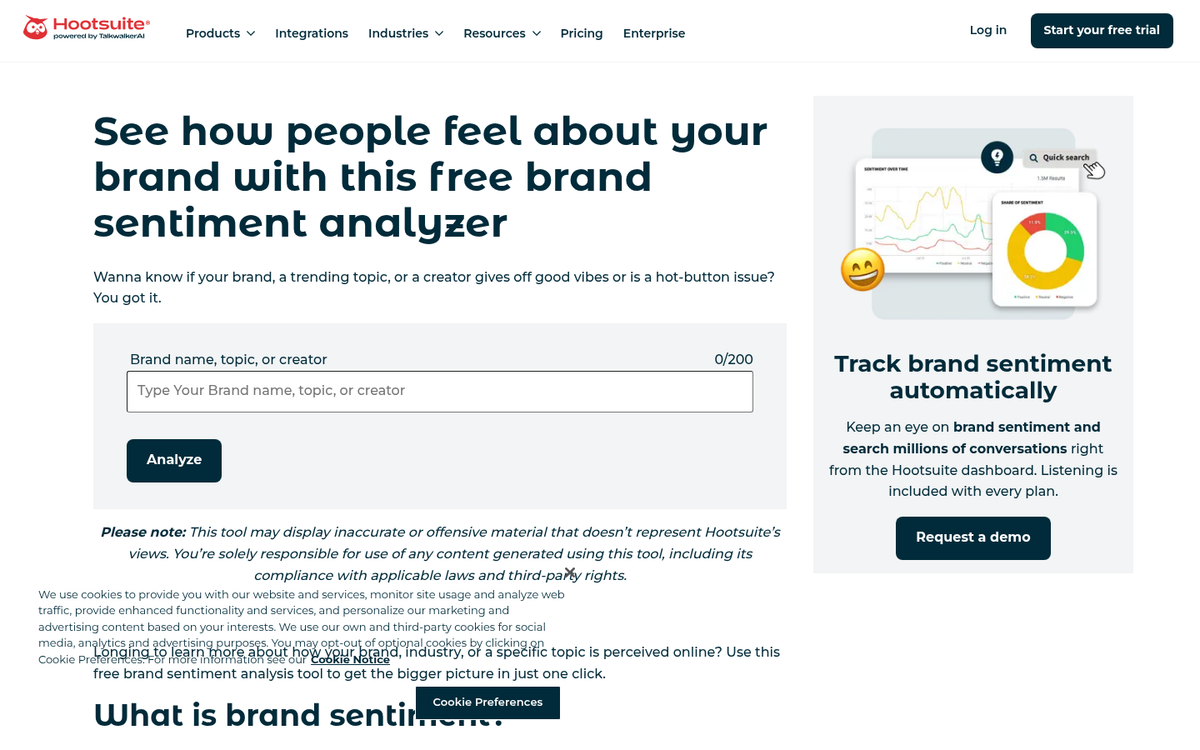
Sentiment analysis is a natural language processing (NLP) technique used to identify and classify the emotional tone of text as positive, negative, or neutral. It analyzes opinions, feelings, and attitudes expressed in written content such as reviews, social media posts, or surveys. Businesses commonly use it to monitor brand reputation, understand customer feedback, and gain market insights. Machine learning models and lexicon-based approaches are the primary methods used to automate this process at scale.
How AI Answer Engines Use Sentiment Signals
Tools like ChatGPT, Perplexity, and Google's AI Overviews don't read your content only for facts. They also pick up on the tone and framing of what you've written, and that can affect how likely they are to recommend or cite your pages.
Answer engines are built to give users helpful, honest replies, so they lean toward content that sounds helpful and honest too. A page that feels robotic, cold, or emotionally flat is less likely to be pulled into a generated answer - even if the information itself is accurate.
From the AI's perspective, it's trying to serve a human who wants a helpful answer. Content that reads like it was written for a human - with warmth, care, and a helpful attitude - fits that goal much better than content that lists data without any sense of purpose.
Positively framed content tends to perform better in this context. That doesn't mean you have to sound overly enthusiastic or fill your pages with exclamation points - it means your content should come across as helpful and written with the reader in mind.
Negative or dismissive language, on the other hand, can work against you. Content that's heavily focused on what can't be done, or that uses an aggressive or pessimistic tone, can signal low trust to these systems.

Your tone also factors into how AI systems look at your site's credibility. Answer engines are trained on giant volumes of human-written content, and they've developed a sense of what honest sources sound like. A site that uses language connected with expertise and helpfulness will hold up better than one that sounds uncertain or disengaged.
Every piece of content shapes the overall picture of your site's tone. This applies whether you're writing long-form guides or shorter posts - even blogging in a non-native language can come across as warm and credible when the intent to help is clear.
The relationship between sentiment and AI recommendations is still evolving as these tools develop. But the direction is already fairly clear: content that is legitimately trying to help a reader is the content answer engines want to put in front of users. Your tone is part of your credibility, and AI systems are starting to treat it that way.
The Emotional Tone Hidden in Your Website Content
Your own pages carry emotional tone whether you planned it or not. Every product description, blog post, FAQ answer, and customer review sends a signal about how your brand sounds - and AI reads those tells the same way it reads anything else.
Think about a product description that says "this item may work for some users." That language sounds hesitant, and unsure content reads as low-confidence to humans and AI systems. Compare that to something like "this tool handles heavy loads without slowing down." The second version is direct, and directness tends to read as positive and honest.
Blog posts are another place where tone shows up in ways writers don't always see. A post that spends most of its time listing problems without pointing to answers can register as negative content - even if the intent was to be helpful. You want to sound like a person who knows what they're talking about and wants to help - not a person who is still working it out.
FAQs are worth paying close attention to. A lot of FAQ pages answer questions in a way that sounds defensive or overly cautious, which can pull the tone of the page down. Short, confident answers do better here.
Customer reviews are harder because you can't control what people write. But the way you respond to reviews can add its own layer of tone to the page. A calm, helpful response to a negative review can keep the sentiment from tipping too far in the wrong direction. If you want to see who has liked and shared your blog posts, that context can also help you understand how your tone is landing with real readers.
The U.S. Bureau of Labor Statistics found that 42% of small businesses have a hard time putting sentiment tools in place. That number matters because it tells us this isn't a problem that needs expensive software to fix. A lot of what makes content sound positive or negative can depend on word choice and structure - and those are things any writer can work on without a dedicated tool.
Read your own content out loud and ask if it sounds confident and helpful or vague and uncertain. That check can surface tone problems that no automated scan would catch. The pages that perform well in AI-driven results tend to have one thing in common: they sound like a knowledgeable person giving a direct answer. If you're also thinking about ways to promote your WordPress blog, getting the tone right first will make every other effort more effective.
Positive, Negative, and Neutral - What the Categories Actually Mean for SEO
Sentiment analysis breaks content into three large categories: positive, negative, and neutral, and each one sends a different signal to AI systems that crawl and interpret your pages. Those signals can shape whether your content gets surfaced as a trusted answer or passed over entirely.
Positive sentiment includes more than happy language - it includes confident, answer-focused writing that frames information in a way that helps the reader move forward. AI systems that power answer engines tend to favor this tone because it goes hand in hand with what users are actually looking for - a resolution, not a problem.
Negative sentiment is harder. A FAQ that leans heavily on what something can't do, or that frames every answer around limitations and warnings, can undermine how authoritative your content seems. That doesn't mean you should scrub out every honest caveat - it means the framing matters. One balanced warning inside a helpful answer reads very differently than a page that opens with roadblocks at every turn.
Neutral content is its own challenge. Flat, purely descriptive product copy that takes no position and expresses no practicality can register as low-value to AI crawlers - it's not penalized the way negative content could be. But it doesn't earn much trust either.
| Sentiment Type | Typical Characteristics | AEO Performance Tendency |
|---|---|---|
| Positive | Solution-focused, confident, helpful framing | Tends to perform well as a cited or featured answer |
| Negative | Warning-heavy, limitation-focused, problem-framing | Can reduce perceived authority if it dominates the content |
| Neutral | Descriptive, no clear stance, minimal emotional tone | Less likely to be selected as a direct answer |
A page can include honest, balanced information and still read as positive if the structure guides the reader toward something helpful.
Star ratings are one data point and they don't tell the full story. The written content around a rating - the explanation, the context, the tone - carries as much weight for sentiment analysis as the number itself; it's where the interpretation happens. This is especially relevant when evaluating tools like comment systems such as Spot.im, where the framing of user-generated content can shift overall page sentiment in ways that affect how AI crawlers assess your site.
User-Generated Content and the Sentiment You Don't Write
Your website copy could be polished and well-structured. But it's not the only thing AI answer engines read. Reviews, forum threads, social media posts and comment sections all shape how your brand gets seen across the web. That perception feeds directly into how AI tools look at your authority and trustworthiness.
AI systems actively pull from this content to build a wider picture of what people think about a brand, a product, or a claim.
The social media sentiment analysis market was valued at $3,944.8 million in 2024 and it's growing at a 27.6% CAGR. That growth reflects how businesses and platforms are treating this data - it isn't a niche concern anymore.
A brand can have a well-optimised site with legitimately helpful content. But if external sources paint a negative picture, that contrast creates a credibility gap. AI answer engines are designed to synthesise information from multiple sources, so a pattern of negative sentiment in user-generated content can quietly work against your AEO visibility - even when your own copy says the right things.

This doesn't mean you need to control every conversation happening about your brand online; that's not realistic. But writers and content teams should stay aware of the external sentiment associated with their brand and factor it into their content strategy.
If users are repeatedly frustrated by a product feature and talking about it in forums, address it in your content. If reviews show a misconception, create content that corrects it. You want to close the gap between what your site says and what users actually experience and express.
User-generated content also gives AI systems a social proof layer. Positive patterns across reviews and community content reinforce the credibility of what your site already says. The two work together - or against each other.
Writers who focus only on on-site copy are only looking at part of the picture. The sentiment that lives outside your site, in the words of users, carries weight with the systems that choose whose content gets surfaced in AI-generated answers.
Tools That Help You Measure Sentiment Across Your Site
There are a number of tools available so you can track how readers feel about your content, and the cost difference between them can be dramatic. Enterprise-level sentiment analysis platforms can run as high as $200,000 a year according to the U.S. Small Business Administration. But you don't need that budget to get helpful data. Smaller sites and independent publishers have plenty of affordable options that still give you actual information.
When looking at different tools, a few things are worth prioritizing. You want something that connects to the platform your site already runs on, because a tool that sits separately from your workflow tends to get ignored. Real-time feedback is also worth having. It lets you catch a drop in sentiment before it can become a pattern.

One pitfall that's easy to fall into is relying on a single data source to tell everything. A comment plugin might show positive engagement while your survey replies show something very different. At least two types of tools give you a more honest picture.
Here is a general overview of the tool categories available to most site owners and what you can expect from each:
| Tool Type | Key Features | Typical Cost Range | Best Use Case |
|---|---|---|---|
| Basic survey tools | Rating scales, open text fields, simple reporting | Free to $50/month | Small sites wanting direct reader feedback |
| CMS-integrated plugins | Comment sentiment flags, moderation assist | Free to $100/month | Blogs and content-heavy sites |
| Mid-tier analytics platforms | Keyword sentiment scoring, trend tracking | $100 to $1,000/month | Growing sites with moderate content volume |
| Enterprise platforms | AI-driven analysis, cross-channel monitoring, API access | $10,000 to $200,000/year | Large-scale content operations |
Ease of use matters more than feature count, and that's also the case if you don't have a dedicated analyst to interpret the results. A tool that produces data you can read and act on is far more helpful than one that generates dense reports no one opens. Start with what fits your current setup and grow from there.
Adjusting Your Content Strategy Based on Sentiment Data
Once you have sentiment data in front of you, the next step is to choose where to focus your energy first. Pages with neutral or negative sentiment scores are the best place to start. Neutral content is not necessarily bad. But it tends to feel flat and gives AI systems very little to work with when they are looking for a confident, direct answer to surface.
Start by looking at your highest-traffic pages that scored poorly. A page that gets visitors but reads in a passive or uncertain tone is a missed opportunity. Rewriting even a few key sections to sound more direct and helpful can change how the page performs in AI-generated replies.
FAQ sections deserve attention here. People like to phrase questions in an emotionally loaded way - they're frustrated, confused, or nervous when they search. If your FAQ answers feel cold or overly technical, they won't match the tone of the query.
The language pattern to look out for is passive, hedging phrasing. Phrases like "it may be possible to" or "users might want to consider" signal uncertainty. Replacing these with confident, action-oriented phrasing does two things: it reads better to human visitors and it gives AI tools a cleaner signal that your content is a reliable source.
What Small Language Changes Actually Do
It does not take a full content overhaul to see a difference. A handful of sentences changed per page from uncertain phrasing to direct phrasing can be enough to move a piece from neutral to positive sentiment. Think of it as tuning instead of rewriting.

For example, "there are some cases where this strategy could work" can become "this strategy works well when you need to move fast." The second version takes a position. That is what AI citation tools look for.
You can also match your content more deliberately with the emotional framing used in their searches. If your analytics show that visitors land on a page after searching in a worried or confused tone, your opening paragraph should acknowledge that awareness - it does not need to be dramatic, just honest about what the page is there for. Once you have the tone right, auto-sharing your updated posts can help get that improved content in front of more readers quickly.
Sentiment data is most helpful when you treat it as a standard signal instead of a one-time audit. Build a habit of checking your scores after updates to see if the tone is moving in the direction you want. Pairing this with tools like Buffer to increase your blog traffic means your better-performing content reaches a wider audience over time.
Your Content Has a Mood - Make Sure It's Working for You
A helpful place to start is a focused content audit. Choose one section of your website - a product page, an FAQ, or a service description - and read it as a first-time visitor would. Ask yourself: does it sound honest, helpful, or evasive and overly promotional? Small, deliberate adjustments to tone can change how users and AI systems respond to your content.
With the sentiment analysis market expected to reach $11.4 billion by 2030, the technology powering AI search will only grow more refined in detecting emotional nuance. Staying intentional about your content's tone is not a one-time fix - it's a standard discipline that will become increasingly important as AI-driven search continues to change how people find and trust information online.
FAQs
What is sentiment analysis in the context of AEO?
Sentiment analysis evaluates the emotional tone of content. In Answer Engine Optimization, AI systems use sentiment signals to determine whether content is trustworthy and helpful enough to surface in generated responses.
Does content tone affect AI answer engine recommendations?
Yes. AI answer engines favor content that reads as confident, helpful, and human-focused. Content that feels robotic, overly cautious, or emotionally flat is less likely to be cited, even if the factual information is accurate.
How does user-generated content impact sentiment signals?
Reviews, forum posts, and social media content contribute to how AI systems assess your brand's credibility. Negative patterns in user-generated content can undermine your AEO visibility even when your own site copy is well-optimized.
What tools can smaller sites use for sentiment analysis?
Affordable options include basic survey tools, CMS-integrated comment plugins, and mid-tier analytics platforms ranging from free to around $1,000 per month, making sentiment tracking accessible without enterprise-level budgets.
How can I improve my content's sentiment quickly?
Replace hedging phrases like "it may be possible to" with direct, action-oriented language. Even small wording changes across a few sentences can shift a page from neutral to positive sentiment without requiring a full rewrite.