




For website owners, long-tail queries represent one of the most actionable opportunities in Answer Engine Optimization (AEO). These phrases are how people ask questions - and they're the input that AI systems are designed to match with direct, confident answers. If your content is structured to answer these queries, you dramatically increase the chances of being cited, surfaced, or quoted by an AI engine.
The mechanics behind why long-tail queries matter for AEO are grounded in intent alignment. AI models are trained to understand nuance, context, and conversational phrasing. A well-designed piece of content that directly answers a long-tail query signals relevance in a way that large, generic content simply can't. This post will cover what long-tail queries look like in practice, why they carry outsized value in an AI-first search environment, and how to build a content strategy that puts them to work for your site.
Quick Answer
A long-tail query is a search phrase typically consisting of three or more specific words that targets a narrow audience. Unlike broad, high-volume "head" keywords, long-tail queries have lower search volume but higher conversion rates because they reflect more specific user intent. For example, "buy red running shoes size 10" is a long-tail query versus simply "shoes." They are easier to rank for in SEO and are valuable for targeting users further along in the buying or research process.
Where the Term "Long-Tail Query" Comes From
The phrase "long tail" didn't start in SEO - it came from economics, specifically from a 2004 post in Wired magazine by writer Chris Anderson. His argument was about how online retail was changing the way demand works - and it turned out to apply to search too.
Anderson's core idea was about demand curves - it's a graph where the most popular products sit on the left in a tall spike and less popular products stretch out to the right in a long, flat line. That flat line is the tail - it covers a giant number of products that each sell in small quantities. But together they can add up to more volume than the spike at the top.
The same shape appears in search data. A handful of short, popular queries get searched millions of times a month. Then there's a long stretch of more obscure, less common queries - each with low search volume. But giant collectively; it's where the term "long-tail query" comes from.

Anderson was talking about Netflix and Amazon at the time - not Google. But marketers and SEO practitioners picked up the concept because it mapped well onto how search behavior works. The migration from retail economics into content strategy happened slowly through the mid-to-late 2000s as search became central to how businesses reach customers online. If you're focused on driving traffic, understanding how popular content surfaces on platforms like Pinterest follows a similar logic.
What stayed steady across contexts is the relationship between popularity and specificity. The head of the curve is broad and competitive. The tail is narrow and precise. A long-tail query carries more intent and context than a short query with extra words attached, which is what makes it helpful to know as its own category.
That distinction is worth holding onto as you read more. The "long tail" is a structural idea borrowed from economics, and it describes a pattern in data instead of a strict rule.
How Long-Tail Queries Differ From Head Terms
Head terms are short, usually one or two words, and they pull in giant search volume. Think "running shoes" or "email marketing." They sound like the obvious targets. But they have strong competition and very little signal about what the person actually wants.
Long-tail queries are longer and specific, and they tell you quite a bit about intent. Someone searching "best running shoes for wide feet under $100" has already done most of their choice-making. That extra context is what makes long-tail queries so helpful - for SEO and for AI-generated answers.
It's also worth learning about just how lopsided the distribution is. SEO PowerSuite found that one- and two-word queries make up only about a quarter of keyword databases, which means the majority of search activity happens in longer, more specific territory. Understanding how to convert that traffic into revenue is where the real opportunity lies.
| Feature | Head Terms | Long-Tail Queries |
|---|---|---|
| Word count | 1-2 words | 3+ words |
| Monthly search volume | Very high | Low to moderate |
| Competition level | Very high | Low to medium |
| Conversion potential | Low | High |
| User intent clarity | Vague | Clear and direct |
The conversion gap is the part that gets ignored. A head term like "protein powder" could come from a curious teenager, a nutritionist, or someone ready to place an order. A long-tail query like "whey protein powder for lactose intolerance under 30g sugar" is almost always close to a buy - lower volume, but much stronger signal.
Head terms aren't useless - they have their place in building brand visibility. But they don't tell you enough about the person on the other end of the search to do much with that traffic. Tools like Buffer can help you drive more targeted visitors once you know which queries you're actually ranking for.
Why AI Answer Engines Favor Long-Tail Queries
AI tools like ChatGPT, Perplexity, and Google's AI Overviews are built for one thing well: give a direct, confident answer to a question. These systems are designed around intent, and that's why long-tail queries are a good fit for them.
Consider searching a vague head term like "mortgage." An AI engine has almost no way to know what that person wants. Are they looking for a definition? A calculator? Rates in their area? The query gives so little to work with that the engine can't follow a single confident answer - it has to hedge, or present multiple directions at once.
A long-tail query removes that ambiguity entirely. When someone asks "can I get a mortgage with a 580 credit score and 5% down," the intent is unmistakable. The AI knows what to look for, and it will pull from content that answers that question as directly as possible. The more a piece of content matches a question, the better its chances of being surfaced.

That's what makes long-tail content such a good fit for AI-driven search. These engines don't scan for keyword matches - they evaluate whether the content resolves the query. A well-written page that speaks to a narrow question will outperform a large page stuffed with general information, because the AI can extract a clear answer from it. This is also why blogging tends to outperform social platforms for capturing specific, intent-driven traffic.
There's also a conversational layer to this. People talk to AI engines the way they'd talk to a knowledgeable friend, in full questions with context included. Long-tail queries match that pattern, which means content written to answer them goes hand in hand with how AI engines interpret and process language. If you're thinking about building a blog that earns income, targeting these kinds of specific queries is one of the strongest starting points.
The connection between long-tail queries and AI answer engines is structural - the way these tools work rewards content that goes narrow and deep instead of wide and shallow.
The Types of Long-Tail Queries and What They Signal
Long-tail queries fall into a few categories, and each one tells you something different about what the person actually wants. That distinction matters more than most realize.
An informational query is when someone wants to learn something - think "how does compound interest work on a savings account." A transactional query tells you that someone is ready to act, something like "buy noise-canceling headphones under $100." Navigational queries point toward a destination, like "Spotify login page," and conversational queries read like a question you'd ask a friend, like "what's the difference between a dietitian and a nutritionist."

| Query Type | What It Signals | Example Phrase |
|---|---|---|
| Informational | User wants to learn or understand something | "how does compound interest work on a savings account" |
| Transactional | User is ready to buy or take action | "buy noise-canceling headphones under $100" |
| Navigational | User wants to reach a specific place or page | "Spotify login page" |
| Conversational | User is asking a natural language question | "what's the difference between a dietitian and a nutritionist" |
A competitor chasing large traffic with a page titled "headphones" isn't speaking to the person who's ready to spend money right now. A page built around a transactional long-tail query meets that person at the right moment with the right information. If you run a Shopify store, for instance, including calls to action on your blog can help capture visitors who arrive through exactly these kinds of purchase-ready searches.
Conversational queries are worth a look because they align well with how people talk to AI assistants and voice search tools. They are longer and specific, which makes them easier to answer well. If your content is written in a natural, direct way, it's much better positioned to satisfy this type of query than content that reads like a keyword list. This principle also applies when growing a blog on platforms like Medium, where natural, conversational writing tends to perform especially well.
How to Find Long-Tail Queries Your Audience Is Actually Using
There's a difference between how businesses describe themselves and how customers talk about what they need. Closing that gap starts with going where your audience already is and paying attention to the exact words they use.
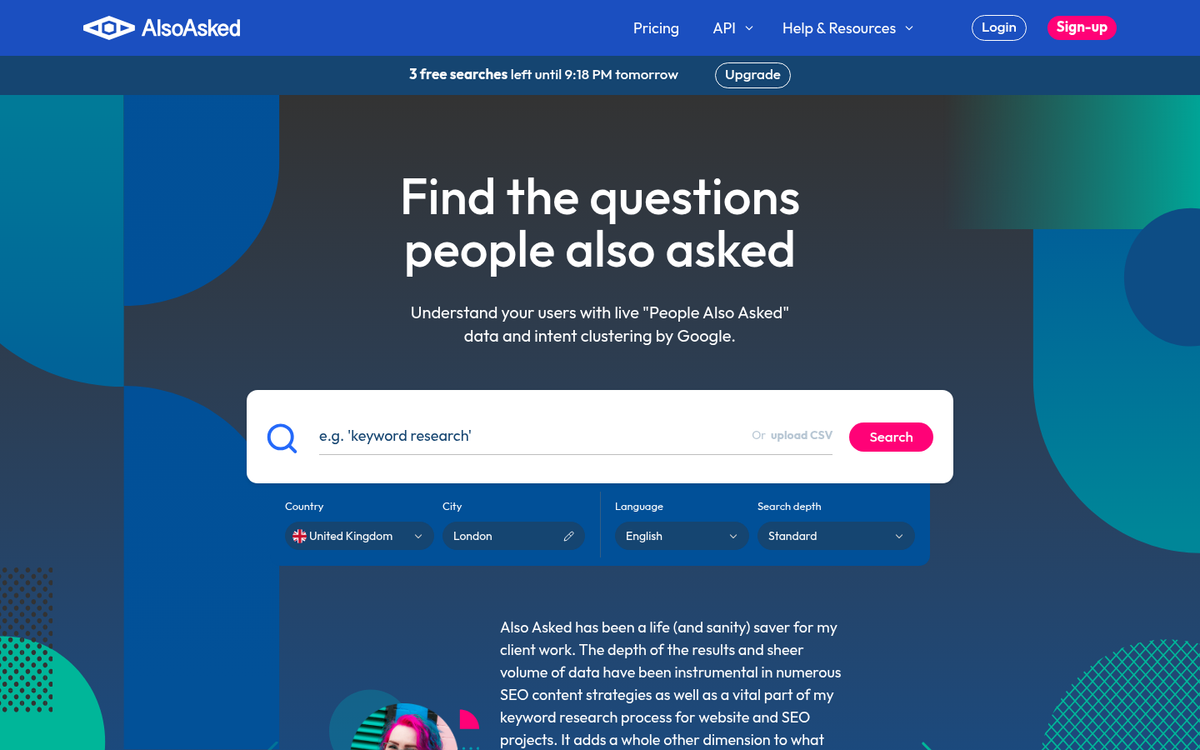
Google's autocomplete feature is one of the easiest places to start. Type a broad topic into the search bar and watch what it fills in - those suggestions come from searches people have typed. The People Also Ask" boxes on search results pages are just as helpful because they surface follow-up questions related to your topic, which tells you what people still want to know after their first search.
Forums like Reddit and Quora are worth bookmarking. People there ask questions in a natural, unfiltered way that mirrors how they'd search for something, and the most upvoted replies show you what answers they find helpful. Product and service reviews are another underrated source - the language customers use to describe a problem or a result is usually the same language they'll type into a search bar. If you're looking to get free products and services to review on your blog, that's another way to generate this kind of authentic content.
Keyword research tools like Ahrefs, Semrush, or the free Google Search Console can filter for longer phrases with lower search volume. Don't write those off. A query with 50 monthly searches and high intent is more helpful to you than a broad term with thousands of searches but no clear intent behind it.

Around 82% of voice searches related to local businesses use long-tail phrasing, which makes sense - people speak in full sentences. Someone might type "plumber Brooklyn" but say out loud "who's a good plumber near me open on Saturday." Those are two very different queries, and the spoken one tells you much more about what the person wants.
A helpful exercise is to write down how you'd explain your product or service to a friend, then compare that to your website copy. Where you find the biggest difference in tone and phrasing, that's where your content probably needs to catch up with how people actually talk. This is especially true if you're working on a niche site - for example, those starting a travel blog often underestimate how differently their readers phrase searches compared to industry jargon.
Structuring Content to Answer Long-Tail Queries for AI
Pages optimized for long-tail keywords move up an average of 11 positions in search rankings, and that movement doesn't happen by accident- it comes from writing content that directly answers the question a person actually typed or spoke.
The most helpful strategy is to lead with a direct answer. Put the answer in the first one or two sentences, then use the rest of the section to add context and detail. AI answer engines pull from content that gets to the point fast, so burying your answer three paragraphs down works against you.
Use Question-and-Answer Formatting
Structuring your content around questions makes it easier for AI tools to surface the right passage. Write the question as a subheading, then answer it in plain language underneath- this mirrors how people ask things, and it tells search engines and AI models that your content is a direct match for that query.
FAQ sections work especially well for this- each question can become a natural entry point for a long-tail search, and each answer is a self-contained unit that an AI can pull and present. Keep each answer focused on one thing at a time.
Match the Language of the Query
Use the same words your audience uses- not formal alternatives or technical terms unless your audience legitimately uses those too. If someone asks "how do I get my dog to stop barking at night," your content should align with that phrasing instead of something like "methods to reduce nocturnal canine vocalization."
That's where content goes wrong. Writers swap natural language for keyword-stuffed phrases or write in a way that feels optimized for crawlers instead of people. That strategy hurts more than it helps, and that's especially true as AI systems get better at recognizing natural conversational tone. If you're also using plugins that could affect your rankings, it's worth auditing those decisions alongside your content strategy.
Short, scannable paragraphs help too. A reader who lands on your page from a very specific query wants to find their answer fast and trust that you understood their question. Formatting that respects their time goes a long way toward building that trust. The same principle applies whether you're writing for a niche audience or building a blog meant to earn real income.
Measuring Whether Your Long-Tail Strategy Is Working
Once your content is live, the temptation is to check rankings and call it a day. But long-tail success shows up in places that a simple position tracker won't catch.
Start by watching your organic traffic at the query level in Google Search Console. You want to see a growing number of low-volume queries sending you steady streams of visitors. One query with 8 clicks a month might not look like much. But hundreds of them add up to real traffic from visitors who are ready to act.
Conversion data is where this strategy proves itself. WordStream found that 90% of conversions came from keywords generating less than 100 clicks per month. The cost-per-conversion for those terms was less than half what competitive terms showed - it's not a small difference. It means a focused long-tail strategy can be more efficient than chasing high-volume terms, even when you factor in the time it takes to rank for them.
Beyond conversions, keep an eye on bounce rate and time on page. Long-tail visitors land on content that matches what they searched for, so they stick around longer and explore more. If your bounce rate is high on these pages, that's a signal to re-examine the match between the query and what your content actually delivers.
For AEO specifically, watch for AI citation appearances and featured snippet wins. Use an AEO readiness checklist to make sure your content is structured to be pulled as a source. Tools like Google Search Console (for snippet data) and manual spot-checks in AI tools like Perplexity or ChatGPT help you see when your content is being pulled as a source. These appearances don't always generate a direct click. But they build authority over time.
The biggest pitfall to watch for is chasing volume metrics at the expense of intent quality. A page that ranks for a precise query and converts at 10% is more valuable than one that ranks broadly and converts at 1%. Understanding how on-page elements like popups can hurt your traffic is equally important when optimizing these pages for intent-matched visitors.
| Metric to Track | What It Tells You | Where to Find It |
|---|---|---|
| Query-level clicks | Growth in low-volume, high-intent traffic | Google Search Console |
| Conversions by keyword | Which queries are driving real results | GA4 + Search Console |
| Bounce rate by page | Whether content matches visitor intent | Google Analytics 4 |
| Featured snippet wins | Content being chosen as the best answer | Google Search Console |
| AI citations | Visibility in AI-generated responses | Manual checks in AI tools |
Start Small, Go Specific, Win the Answer
Competing on specificity is usually a better move than fighting for large, high-volume terms dominated by businesses. A well-designed page that answers one precise question with genuine depth will outperform a generic overview page that tries to say everything to everyone. AI answer engines are built to surface the most helpful response. That reward goes to whoever wrote it best, not whoever has the largest domain.
To find a place to start, open a browser and search for your main topic. Look at the People Also Ask box and write down three questions that your latest content does not answer. Pick one, write a focused page built around that question, and publish it. That single action puts you ahead of the majority of websites still chasing terms that were competitive five years ago. The long tail is not a consolation prize - it's where the most motivated readers are waiting to find you. If you're running your site on WordPress, make sure you're also thinking about whether to install your blog on a separate domain to maximize how your content gets indexed and discovered.
FAQs
What is a long-tail query?
A long-tail query is a specific, multi-word search phrase that signals clear user intent. Unlike short head terms, long-tail queries are more conversational and precise, making them easier for AI engines to match with direct, relevant answers.
Why do AI engines favor long-tail queries over head terms?
AI engines are designed to deliver direct, confident answers. Long-tail queries provide clear intent and context, allowing AI systems to match them with specific content far more effectively than vague, broad head terms.
How do long-tail queries impact conversion rates?
Long-tail queries attract visitors who are closer to taking action. WordStream found 90% of conversions came from keywords generating fewer than 100 clicks per month, with cost-per-conversion less than half that of competitive terms.
Where can I find long-tail queries my audience uses?
Google Autocomplete, People Also Ask boxes, Reddit, Quora, and customer reviews are strong sources. Keyword tools like Ahrefs, Semrush, and Google Search Console can also surface longer, lower-volume phrases with strong intent.
How should content be structured to target long-tail queries?
Lead with a direct answer in the first one or two sentences, use question-based subheadings, and match your audience's natural language. FAQ-style formatting works especially well for helping AI engines extract and surface your answers.