Key Takeaways
- Bing ads cost roughly 22-42% less than Google Ads, with average CPCs around $1.07, while delivering higher CTRs.
- Bing's audience skews older and wealthier - nearly 40% aged 35-54, one-third earning over $100K annually.
- Reducing costs requires three levers: refining demographic targeting, improving ad copy quality, and selecting better keywords.
- Building aggressive negative keyword lists prevents wasted spend on irrelevant searches, significantly improving campaign efficiency.
- Quality score (1-10) directly impacts costs and placement - align keywords, ad copy, and landing pages tightly.
Bing Vs Google
Bing - now more commonly referred to as Microsoft Advertising - remains Google's most persistent search competitor, though its market share has shifted considerably. According to StatCounter, Bing holds roughly 6.75% of the global search market and about 12.76% in the USA. That's a far cry from the "20%" figure that used to get thrown around, but don't let that fool you into dismissing it. Microsoft's search network still reaches 63 million searchers that Google does not, and the audience it does reach tends to be older, wealthier, and surprisingly engaged.
Bing does have a few genuine advantages over Google. There's a reason advertisers keep coming back, after all.
- Bing ads are significantly cheaper. The average CPC on Microsoft Advertising is around $1.07 for search ads and $0.95 for display ads - approximately 22% and 56% lower than Google Ads, respectively. Some sources peg the average even lower, with Bing at $1.54 vs. Google's $2.69, a difference of about 42%.
- Bing has a higher click-through rate than you might expect. Data shows Bing Ads averaging a 2.83% CTR compared to Google's 1.91%. Lower competition, better ad placement visibility, and a less ad-saturated environment all contribute to this.
- Bing's audience skews wealthy and mature. Nearly 40% of Bing users are between the ages of 35-54, and one-third have a household income over $100,000. If you're selling premium products or B2B services, this is a meaningful advantage.
- Bing has more granular ad scheduling options, with control at the ad group level rather than just the campaign level - giving you tighter control over when your budget is being spent.
- Bing offers more transparent search partner targeting. Unlike Google, which doesn't reveal which partner engines are distributing your ads, Microsoft Advertising lets you see and select from the networks they operate.
- Bing is more accessible for smaller advertisers. Google increasingly caters to enterprise-level spenders. Microsoft Advertising has historically been more willing to work one-on-one with businesses spending as little as $500/month.
- Bing offers demographic targeting layered onto search campaigns, including age and gender targeting - something Google has become more restrictive with over time. This allows you to fine-tune who sees your ads without relying purely on keyword intent.
At the end of the day, nothing stops you from using both - and I'd strongly encourage it. Everything you build out in Google Ads can be imported into Microsoft Advertising with minimal adjustment, and you'll often run it for significantly less. The volume will be lower, but the math frequently works out in your favor.
So if you're going to use Microsoft Advertising, how do you squeeze even more efficiency out of it? It's already cheaper by default, but we can drive it lower still.
When you boil it all down, there are really only a few levers you can pull to reduce ad costs on any platform:
- Change your demographic targeting to reach cheaper or more convertible audiences.
- Change your copy to be more relevant and compelling to your audience.
- Change your target keywords to find terms with less competition and lower bids.
Let's dig into each of these.
Changing Demographics

Microsoft Advertising offers a solid range of targeting options. Here's how to work through them strategically.
Geographic targeting is your first consideration. As with any PPC platform, going too broad too fast can waste budget on traffic that'll never convert. Targeting only the USA will typically be your most expensive geographic option, but that doesn't mean you should blindly expand. If you sell digital products or services, consider expanding to other English-speaking markets - the UK, Canada, Australia, and parts of Europe - where competition is lower and costs can drop meaningfully.
Time-based targeting lets you schedule ads by day of week or hour of day. Use your existing analytics to identify when your audience is most active and most likely to convert. You won't necessarily lower your base CPC by scheduling smarter, but you'll stop burning budget during dead hours and get more return from every dollar spent. On a platform where volume is already lower than Google, wasting impressions on off-peak hours is especially costly.
Demographic targeting is where Microsoft Advertising genuinely shines compared to Google. Given that nearly 40% of users are in the 35-54 age bracket and a third earn over $100K annually, you have a ready-made audience for premium and considered purchases. Use age and income-level targeting thoughtfully - narrowing too aggressively will raise CPCs, but a well-matched demographic layer can dramatically improve your conversion rate without increasing spend.
Device targeting in Microsoft Advertising remains more granular than Google's, with tablets broken out as a separate category and independent bid adjustments available per device type. If your landing page doesn't convert well on mobile, suppress or reduce bids there. If you're running an app or a desktop-heavy B2B tool, lean into those device segments accordingly.
Remarketing (retargeting) is available and worth using. Because remarketing audiences are specific to your website visitors, you're not competing with other advertisers for the same pool of people. CPCs tend to be lower, and conversion rates tend to be higher. Set it up early so the audience has time to build before you lean on it heavily.
Changing Copy

Your ad copy needs to revolve around the intent behind your keywords, not just the keywords themselves. What is the user trying to accomplish? What problem are they solving? The tighter the connection between the search query, your ad copy, and your landing page, the better your click-through and conversion rates will be.
Copy doesn't directly reduce your CPC, but it absolutely affects your quality score - and quality score does affect your costs. Better copy drives higher CTR, higher CTR improves quality score, and a better quality score earns you lower costs and better placement over time. It's an indirect but very real lever.
Beyond relevance, match your tone to your audience. Microsoft Advertising's user base tends to be older and more professionally established - casual, trendy copy often underperforms here compared to clear, benefit-driven messaging. If you're targeting B2B buyers or high-income consumers, write like you understand their priorities.
Also consider where your audience is in the buying cycle:
- Discovery stage: Users are aware of a problem but not yet solution-aware. Ads here should focus on the problem and introduce your category of solution.
- Consideration stage: Users are comparing options. Ads pointing to comparison pages, case studies, or detailed product pages work well here.
- Purchase stage: Users are ready to buy and often looking for a deal or a reason to choose you. This is where remarketing audiences, promotional copy, and direct CTAs perform best.
Run multiple ad variations, measure CTR and conversion rate over time, and cut what isn't working. Don't guess - let the data tell you what resonates.
Changing Keywords
There are two main approaches to building a keyword list for Microsoft Advertising campaigns, and honestly, the best strategy borrows from both.
The first is the scattershot approach: use keyword research tools to compile a large list of hundreds of keywords, then run ads across all of them at low bids to see what gets traction. This approach can surface surprisingly cheap clicks - often well under a dollar - though you'll need to monitor which keywords are actually converting rather than just clicking.
The second is the curated approach: start with a focused set of high-intent, long-tail keywords that closely match what your ideal buyer is searching. These keywords typically have lower competition and lower CPCs on Microsoft's network compared to Google, and because they're more specific, they tend to convert better.
In practice, I'd recommend starting broad to discover opportunities, then tightening your list around what's converting. Use Microsoft's keyword planning tools within the platform itself, or third-party tools like SEMrush or Ahrefs to supplement your research. Look for keywords with reasonable monthly search volume and low estimated CPCs.
One critical step regardless of approach: build out your negative keyword list aggressively. If your core keyword is "tennis shoes," searches for "tennis courts" or "tennis balls" will trigger your ads and waste budget. Catch these early, add them to your negative keyword list, and your spend will become far more efficient over time.
Keep your bids conservative, especially early on. Microsoft Advertising will charge you up to your maximum bid, so setting it artificially high in hopes of winning more auctions just means you're paying more per click than you need to. Start low, review performance, and adjust upward only where the data supports it.
A Note on Quality Score
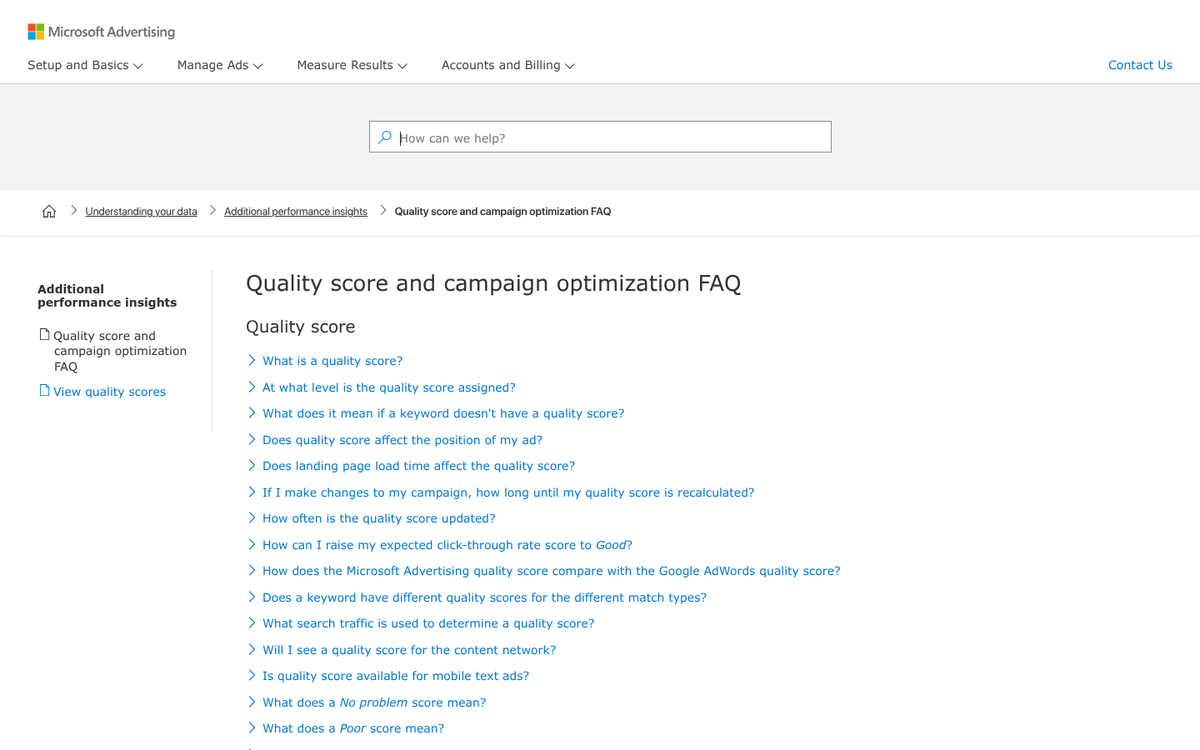
Microsoft Advertising uses a quality score system rated 1 to 10, just like Google. A higher score means better ad placement at lower costs. A lower score means you're paying more for worse results.
Quality score is influenced by your expected CTR, your ad relevance to the keyword, and the quality and relevance of your landing page. Keeping these three things tightly aligned - keyword, ad copy, landing page - is the most reliable way to maintain a strong quality score over time.
The tricky part is that some cost-cutting tactics, like broadening your keyword targeting or running low-bid scattershot campaigns, can temporarily drag your quality score down. Keep a close eye on it as you optimize. A few cents saved on CPC isn't worth it if your quality score drops enough to hurt your placement and raise your effective costs elsewhere in the campaign.