Key Takeaways
- Avon's affiliate program offers 10% commission and a 30-day cookie, run through trusted network CJ Affiliate.
- Unlike Avon's MLM structure, the affiliate program requires no buy-in, inventory, or recruitment from participants.
- Beauty is one of affiliate marketing's most saturated niches, with Avon reps adding extra direct competition.
- Earning $1,000 monthly requires driving $10,000 in sales, making this unsuitable for beginner affiliates.
- Avon works best as one of several affiliate partnerships on a broader beauty site, not a standalone strategy.
Avon Affiliate Program Review (Updated 2026)
Avon is one of the oldest and most recognizable names in the multi-level marketing (MLM) world. Founded in 1886, it has grown into one of the largest beauty-focused companies on the planet, surviving well over a century of market shifts, economic downturns, and the rise of e-commerce. That's no small feat for any company, let alone one built on a direct sales model.
Name recognition in the MLM space is a double-edged sword. For many people - especially younger consumers who've grown up watching MLM horror stories go viral on social media - recognizing a brand as an MLM is enough to trigger skepticism. Words like "scam" get thrown around quickly, and frankly, not always without reason. The MLM model asks participants to build a micro-business in a marketplace already saturated by their direct competition, with a meaningful slice of their profits flowing upward to whoever recruited them.
On the other hand, Avon's sheer longevity is hard to dismiss. Most MLMs burn bright and collapse within a decade. Avon has been operating for over 130 years. It's worth asking: how? The answer likely lies in the fact that Avon does sell real products that people genuinely want, and it has adapted its model over time - including building out a legitimate affiliate program.
I'm not here to be a cheerleader or a critic of MLMs broadly. What I am here to do is look at the Avon affiliate program specifically - which is meaningfully different from becoming an Avon representative - and help you decide whether it's worth your time in 2026.
MLM Versus Affiliate Marketing
There are two crucial differences between an MLM and a standard affiliate program: a buy-in and a recruitment structure.
With a traditional MLM like Avon's direct sales program, every participant is encouraged to sign up people beneath them as sellers while also selling products themselves. New recruits typically need to purchase a starter kit - essentially a ready-made storefront - and are then nudged to build their downline. The real money, as most MLM insiders will tell you, isn't in selling the products - it's in selling the opportunity to sell. Avon's representative structure reflects this, with commission tiers that range from nothing at the entry-level "Contender" tier (under $40 in sales) all the way up to 40-50% on Beauty and Jewelry products at the President's Recognition Program (PRP) level for high-volume reps.
Affiliate marketing works differently. You don't buy inventory. You don't manage a storefront. You don't recruit anyone. You simply link to products on Avon's website using a unique tracking tag, and when someone clicks through and makes a purchase, you earn a commission. No upfront cost, no pressure to sign anyone up, no brochures eating into your margins. If you're curious how CPA compares to affiliate marketing, that's another angle worth understanding.
Because of this, I'm going to focus entirely on Avon's affiliate program and leave the MLM side of the business to someone else's review.
Avon Affiliate Details
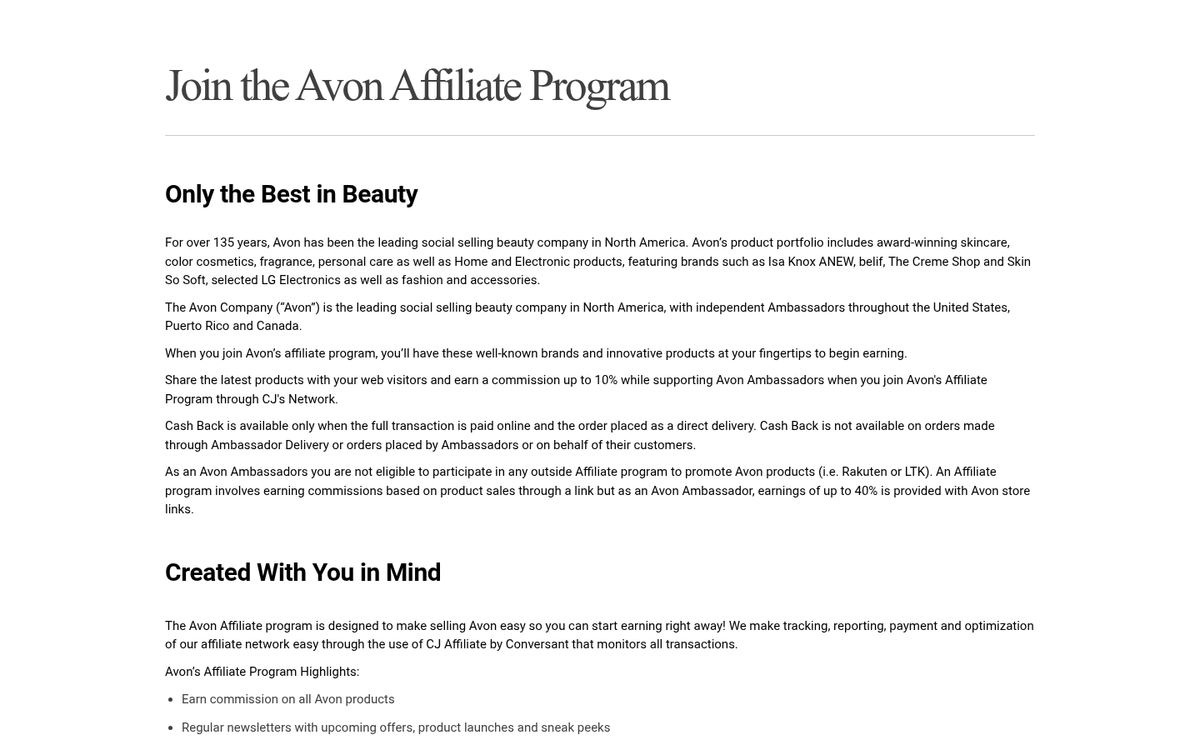
As an affiliate program, Avon runs through CJ Affiliate by Conversant (formerly Commission Junction) - a well-established, widely trusted affiliate network used by hundreds of major brands. This is a meaningful plus. You're not dealing with a shady proprietary tracking system that conveniently "loses" your conversions.
As of 2026, Avon's affiliate program offers:
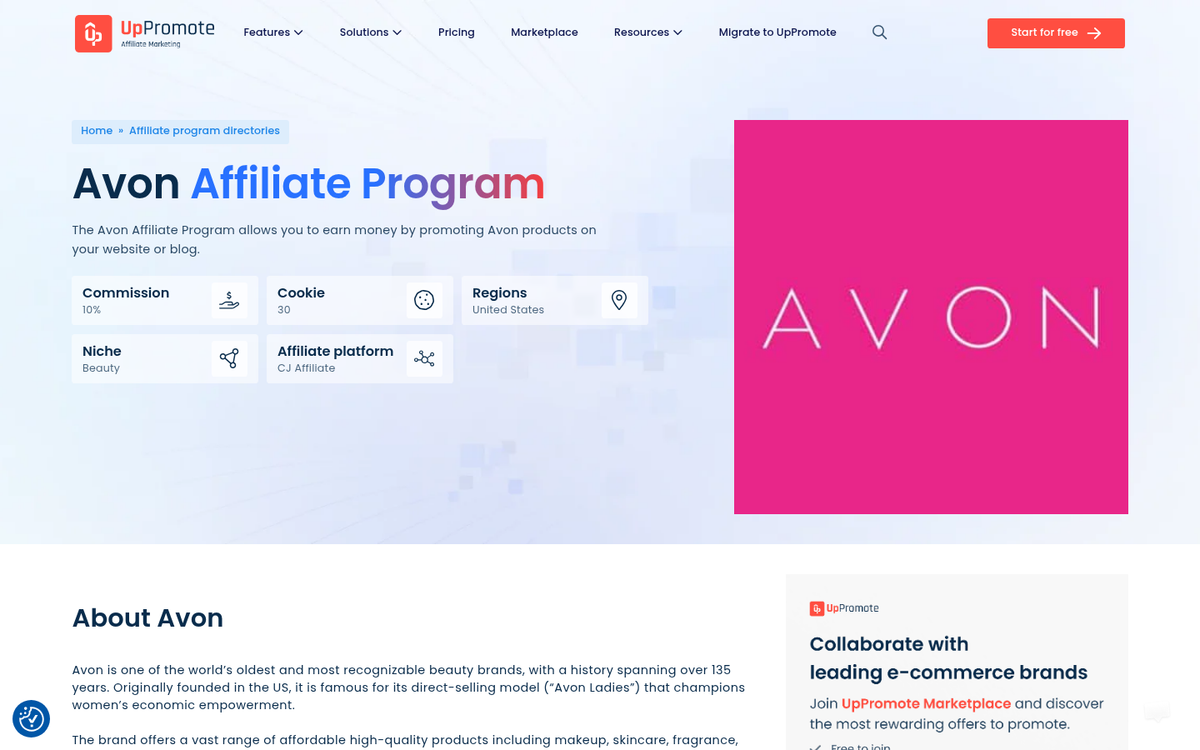
- 10% commission rate on referred sales
- 30-day cookie duration
- No minimum payout threshold
- Open to US-based affiliates
That 10% is actually a notable improvement over what the program offered in previous years, when it sat closer to 4%. It's now more competitive within the beauty affiliate space, though still not exceptional compared to some niche beauty brands that offer 15-20% commissions through platforms like ShareASale or Impact.
One thing worth noting: Avon's affiliate program is distinct from their representative commission structure. As an affiliate, you're not earning the 20-50% that active Avon Ambassadors earn on qualifying orders - that's reserved for those who sign up as direct sellers. The affiliate program is simpler, cleaner, and lower-commitment, but the trade-off is a lower commission ceiling.
There's no meaningful evidence of Avon skimming traffic or invalidating legitimate affiliate conversions, which is a complaint you often hear with smaller or sketchier in-house affiliate programs. Running through CJ Affiliate provides an added layer of accountability, and if you're new to the platform, getting started with Commission Junction is straightforward.
Competition Issues
The primary drawback to using Avon as an affiliate is competition - and it's fierce on multiple fronts.
Beauty is one of the most saturated niches in all of affiliate marketing. Competing for search traffic in beauty means going up against major publishers, established influencers, YouTube channels with millions of subscribers, and TikTok creators who can move product with a single video. Getting organic search visibility in this space in 2026 is genuinely difficult without a well-established domain and a serious content strategy.
On top of the general beauty niche competition, Avon specifically adds another layer: Avon's own representatives. There are hundreds of thousands of Avon reps actively building websites, running ads, and creating content to sell the exact same products you'd be promoting as an affiliate. They're motivated, often experienced, and in many cases earning higher commissions per sale than you are through the affiliate program.
Avon's product catalog, while large, is also relatively contained compared to a marketplace like Amazon. There's limited room to find an underserved sub-niche within Avon's offerings. You're not going to stumble across some obscure Avon product that nobody else is writing about - the catalog is well-trodden.
This doesn't mean it's impossible to compete, but it does mean you need a clear angle. A general "Avon review" site is unlikely to gain meaningful traction. A tightly focused approach - say, targeting a specific demographic, skin type, or product line - gives you a better chance of carving out some space. If you're struggling to get results, it's worth reviewing the most common reasons affiliates fail to earn before doubling down on a competitive niche like this.
Potential Earnings
As with any affiliate program, your earnings are a function of your traffic, your conversion rate, and your commission percentage. Avon places no cap on affiliate payouts, so there's no ceiling beyond what the market will bear.
At 10% commission, you'd need to drive $10,000 in monthly sales to earn $1,000 per month. That's achievable with a well-optimized site and strong traffic, but it's not a beginner's game. Beauty shoppers also have a lot of alternatives - Amazon, Sephora, Ulta, and direct-to-consumer brands all compete for the same wallet.
The competitive dynamics are worth taking seriously. Some Avon reps engage in aggressive tactics to protect their territory, including heavy investment in paid ads, content spinning, and in some cases more adversarial moves like sending junk traffic to a competitor's affiliate links to trigger account reviews. These aren't hypothetical risks - they're documented behaviors in competitive affiliate niches.
Is Avon Recommended?
The honest answer in 2026 is: as a standalone affiliate strategy, no. As one piece of a broader beauty affiliate site, it can work.
The 10% commission is more respectable than it used to be, and CJ Affiliate provides a reliable, trustworthy platform. But the beauty niche is brutal, Avon's catalog is limited, and the competition from Avon's own representative army is a real and ongoing challenge.
The smarter play is to build a general beauty or skincare site and use Avon as one of several affiliate relationships. Pair it with Amazon, Sephora's affiliate program, Ulta, and some direct-to-consumer brands. Some of your readers will be loyal Avon fans - great, you have a path for them. Others will actively avoid MLM-affiliated brands - and you'll have options for them too.
If you're new to affiliate marketing, I'd recommend staying away from the beauty niche entirely until you have some experience under your belt. It's one of the most competitive verticals online, and Avon doesn't make it easier. For experienced marketers who already have an established beauty or lifestyle site, adding the Avon affiliate program as a supplementary income stream makes reasonable sense - just don't build your strategy around it.