





Quora is a bit of a strange platform. Over the years they have experimented heavily with monetization, evolving from what many dismissed as a Yahoo Answers clone into one of the more authoritative Q&A platforms on the web. Along the way, they launched a Partner Program, introduced a subscription tier called Quora+, and continued refining how they generate revenue from their massive base of user-generated content.
Some of you might know about the Quora Partner Program. This program allowed people who asked questions to earn money based on the quality of the answers and the traffic the page acquired. However, as of 2026, the program has been closed to new participants and is largely considered a chapter in Quora's history rather than an active opportunity. We'll cover what it was, what it paid, and what your actual options look like today.
Key Takeaways
- The Quora Partner Program, which paid users for asking questions, is closed to new participants as of 2026.
- Most participants earned modest amounts, typically under $100 monthly, despite some early adopters earning over $10,000.
- Quora withheld approximately 30% in taxes and only paid earnings on questions for the first 12 months after asking.
- Quora+ is now the platform's main monetization focus, a $5/month subscription offering premium content without direct creator payouts.
- The most practical way to earn via Quora today is indirectly, using detailed answers to drive traffic to your own business or site.
The Quora Partner Program FAQ

The partner program was quite interesting in that it operated like a revenue share program, similar to how sites like HubPages pay their writers. Some of you may remember when these programs were everywhere, roughly 10 to 15 years ago. A huge portion of them folded in 2011, primarily due to Google's Panda update. Since most of these sites relied on pageview monetization via hundreds of thousands of thin, keyword-optimized pages, Panda's push toward higher quality content crushed them.
It was interesting, then, that Quora decided to launch this kind of business model in 2018. Their site often relied on mediocre questions with a flood of answers from businesses shilling their own services. The program was invite-only at launch, meaning you couldn't apply directly. You simply used the site and waited to receive an invitation. Notably, Quora didn't appear to have consistent standards for who got invited. Some users with very little activity were invited, while active contributors were not.
At launch, the program was restricted to U.S. residents eligible to work in the country, and it was only available in English-language sections of the site.
There was no stated limit to the money you could make from the Quora Partner Program. As long as you asked questions that met their minimum standards and attracted answers that met their quality bar, you'd get paid. Payments were processed through Stripe only. No checks, no PayPal. You needed to earn at least $5 before linking a payment account, and at least $10 before any payout was issued.
The earnings window was also limited. You only earned on questions for 12 months after asking them. After that, Quora continued monetizing those pages while you received nothing. It was an efficient setup for Quora: incentivize users to generate high-quality, rankable content quickly, let it mature in Google's index, then keep the ad revenue indefinitely.
Anonymous questions did not count toward earnings, since they couldn't be tied to your account.
Quora Partner Compensation: What People Actually Earned
Here's where things get sobering. For a period, some high-performing users were reportedly earning over $10,000 per month from the program. These were outliers with enormous reach and years of accumulated questions ranking in Google.
For most users, reality looked quite different. One user with 247,000 followers and 5 to 6 million monthly views reported earning between $60 and $75 per month by the later years of the program, down significantly from an average of $9 to $11 per day back in 2019. Quora also withheld approximately 30% as tax, further reducing actual take-home earnings. Another user reported earning roughly $2 per day in typical months, up to $3 per day in good months, and never exceeding $100 per month total.
The trajectory tells the story clearly. Early adopters who asked a high volume of well-answered questions during the program's peak years saw the best returns. Over time, earnings per question declined substantially. By the time the program wound down, most participants were earning what amounted to modest beer money at best. If you're exploring other ways to make meaningful money from content, it's worth comparing platforms carefully.
What Quora said about compensation was always vague. Their official line was that "questions are compensated based on how well-answered they are and how many people find them interesting." The exact formula was never disclosed publicly. For those who used Quora primarily to drive traffic back to their own sites, the partnership program's decline was less of a blow than it was to those relying on direct earnings.
Quora+ and the Current Monetization Model
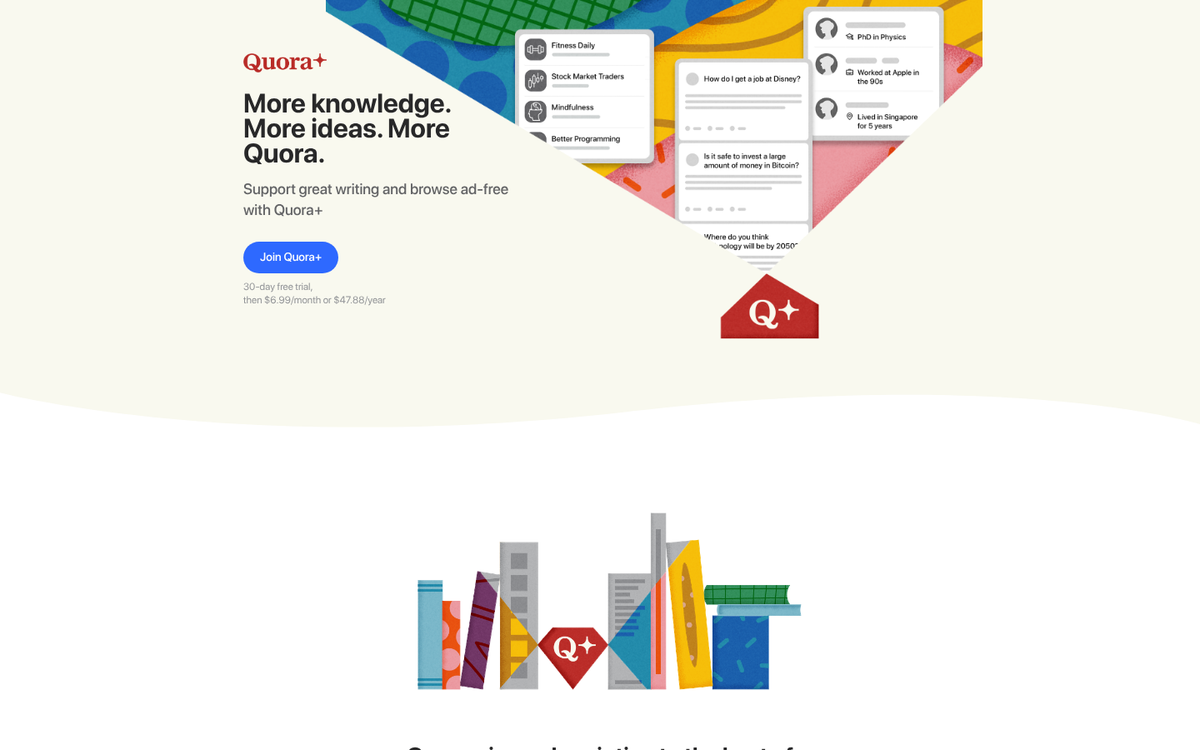
With the Partner Program now closed, Quora's current monetization focus has shifted. Quora+ is a subscription tier priced at $5 per month or $50 per year. It gives subscribers access to exclusive content from selected writers and removes ads from the browsing experience. This model puts Quora more in line with platforms like Medium, where the emphasis is on premium content rather than revenue sharing with question askers.
For most everyday users, Quora+ doesn't represent a direct earning opportunity. It's a reader-facing product, not a creator payout program. Whether Quora expands its creator monetization in a meaningful way beyond this remains to be seen.
Alternative Money-Making
Since the Partner Program is no longer available, the most practical way to extract value from Quora is through indirect means. If you own a business or run a content operation, answering questions remains a legitimate and often underused traffic strategy.
Answer questions that are relevant to your product or niche. Follow the spaces and topics most aligned with your brand. Look for questions where your product solves a clear problem. When you find one, write a thorough, genuinely useful answer.
Focus on questions that are relatively recent and don't yet have a dominant top answer. Answering older, well-answered questions is less likely to get you meaningful exposure. Your goal is to write an answer good enough to rank in Google and float to the top of Quora's own feed.
Write real tutorials, not just product pitches. If someone asks how to accomplish a specific task, walk them through it step by step, and naturally incorporate your product where it makes sense. Step-by-step answers consistently outperform vague recommendation answers because they're more useful and more likely to be upvoted and referenced by other publications.
Top answers on Quora regularly get cited in blog posts, newsletters, and roundups across the web. A single well-placed, highly upvoted answer can generate referral traffic for months or years.
Of course, none of this is actually making money from Quora directly. It's an inbound marketing strategy. You're using Quora as a channel to attract qualified visitors to your site, where you then convert them on your own terms. The ceiling on what you can earn from this approach is determined by your conversion rate, your offer, and how well you target the right questions, not by anything Quora pays you.
With the Partner Program gone, this indirect approach is now the primary way Quora delivers value to most marketers and content creators. It won't make you rich on its own, but as a free traffic channel that takes relatively little time per answer, it's worth adding to your rotation.

35 responses
Thoughtful replies only - we moderate for spam, AI slop, and off-topic rants.
Very interesting update by Quora to earn money as well as driving the traffic to our sites.. thanks for the post Kenny.. please keep updating the latest changes in Digital marketing.
Hi I've been answering questions for awhile now on Quora, they seem to not be moderated as some of my answers are sketchily Hilarious, well at least to me anyway, I was recently asked to join the partner program, asked a couple of mundane questions and suddenly earned $7 bucks. It says on the site some of their top earñers are making over a thousand a month on it. I've had over 50 thousand views on my answers but that doesn't pay. Just letting you know.
Couple of points as of some time end of last year I (in Scotland, UK) was invited to join the program. I had answered a few biology questions ages before and had no idea about payment.
I have answered many more questions than I have written. I have been paid maybe £15 and spend far too much time answering questions in some detail. It's no way to make money as far as I am concerned. Dim, unlikely questions about bodily functions and family sex (ending boringly and predictably in "What do I do?" seem to attract) a lot of views and hence cash. I am not going sit fabricating those for any amount of money.
Most of my questions earn about 1 cent . so .....
I joined the partner program about 2 months ago. I was making about $300 a month but about 3 weeks ago Quora did some changes in the way questions earn money and now the earnings have been reduced by around 90%. Rather earning on average $10 - $12 a day I'm now lucky if earn $2 per day.
I was asked to join in Jan 2019 after a couple of months on Quora. 20% of my questions earn nothing, even good solid questions that get quality answers and thousands of views. Inexplicably, some questions get no answers and hundreds of views and earn a few cents or slightly more. I've had twenty or so questions earn a few dollars or more and one question about $20. Also, oddly, one question has well over 300k views and 12k ad impressions but didn't earn as much as others with much lower numbers. So, there must be another factor Quora uses to calculate earnings, such as number of answers received, upvotes on the answers, etc.
Of course, the number of followers you have also helps. Some Quorans have thousands of followers and millions of views so their questions will naturally get a lot more attention and earn more money.
Quora stats show that some people are earning over $10k per month on the program but I doubt this is sustainable. Some people say they write 40-60 questions per day but if they're writing quality that's a full time job. And those aren't the people earning $10k/month according to what they post.
Quora also now pays for the questions for one year, instead of 4 weeks. But frankly, questions really stop earning after the first few days. You can ask for more answers from specific people but it doesn't generate much money. If an answer someone wrote to your question gets into Quora Digest that can help it go viral and then apparently you can get a bigger payout. But that's a shot in the dark.
I've been on the partner program since August 2018 and have asked 300 questions and made $60.
Thanks for sharing! That gives us a good idea of how much work you have to put in versus the earnings that work results in. Have you noticed some of your questions being more successful and earning more than others? Any patterns you picked up along the way?
Hey bro, update your article because now u can earn by requesting answers too! Ive been on the partner program about 4 months now and have asked 805 questions. Im averaging $100/month and get paid every time. It's not a lot but I look at it as easy money for the kids or gas money etc. Either way, I love it.
Hey Garrett, thanks for letting us know! How many answers are you requesting to hit that $100/month mark?
Does anyone have their math story problems demonetized? Ive had thousands of view but no money or add impressions.
I've been in the program for a month and have earned just over $350. I'm still trying to figure it out as to which questions will or earn or not. I normally write around 20 questions a day which seems to earn me the most money. I did have a couple of days where I wrote 30 questions but didn't see a difference in earnings. Questions do earn for a year but chances are your question will end up getting merged which means earnings will be cut off. Allowing other users to merge and edit questions is a real problem on this site.
A lot of work for very little return?
Quora pays Partners for questions for 12 months now instead of 4 weeks.
Thank you! We've updated our article.
I've been answering Quora for a few weeks, but didn't know about joining or much about asking. Am I worth inviting? You have my name and recent record. Please let me know.
I am a Quora Partner but I don't have much spare time, I only ask questions about things I am interested in. I average maybe 1 or 2 questions a day, mostly about history, medicine and psychology and I've earned about 85 dollars this year. I think if I had more time and energy to devote to Quora I could have doubled or tripled that. I don't see this as being anything other than a little extra pocket money for most folks though. The partners who are earning big are likely people that had thousands of followers and were fortunate enough to get an invite.
I would like to get an invite to join Quora Partners. I've been answering questions for a year or more and get a lot of upvotes. I just found out about posting questions to get paid on Quora Partners and I would find it very interesting to post quality questions that most people are interested in hearing and answering. I would find it very challenging to be at the top for posting interesting questions.
That's great that you've been active on Quora for over a year, Ernest! Having a strong answering history with solid upvotes definitely works in your favor. Unfortunately, Quora Partners invitations are sent out by Quora directly, and there's no official way to request one - they typically reach out to engaged users on their own schedule. Just keep doing what you're doing - answering quality questions and staying active. Many people report receiving their invite unexpectedly after consistent engagement. Fingers crossed yours comes soon!
Extremely informative !!
I think you can guide me on this topic. I too am a regular expert on Quora hoping one day it will start paying.
I am a retired Supply Chain Manager from a big industrial manufacturing plant. Which program shall I join which can pay for my expertise ??
Looking forward to hearing from you soon
Regards
Hi Vijay! Thanks for your kind words! With your Supply Chain Management background, you're sitting on a goldmine of expertise. We'd recommend starting with Quora's Partner Program if it's available in your region, as it pays for questions that drive traffic. Additionally, your specialized industrial knowledge would be perfect for monetizing through Quora Spaces. The key is consistently sharing your real-world experience - that practical expertise is exactly what readers crave! Keep building your audience, and the opportunities will follow. Best of luck on your journey!
This is very informative as I've been wondering how to earn extra money being a Quora lurker.
Great to hear you found it helpful, Mahal! The good news is that transitioning from lurker to active contributor on Quora isn't as intimidating as it sounds. Start by answering questions in topics you're genuinely knowledgeable about - authenticity really shines through and helps build your following. Once you're more comfortable engaging, the earning opportunities become much more accessible. The key is consistency! Even a few quality answers per week can make a difference over time. Good luck on your Quora journey! 😊
Do we need to post questions publicly? Or putting it anonymously could also make you Quora Partner?
Great question, Cheeks! To qualify for the Quora Partner Program, you need to post questions publicly under your name. Anonymous questions won't count toward your eligibility since Quora needs to be able to track and attribute the engagement to your account. So make sure your profile is set up properly and start asking questions publicly to increase your chances of getting an invite!
Quora needs quite a following up for an excellent understanding of what works and what makes this platform tick. This is a new and enervating platform shrouded in mystery
You're absolutely right, Joy! Quora does have its own unique rhythm that takes time to figure out. The good news is that once you start understanding what topics resonate with your audience and how to craft answers that genuinely help people, things start clicking. The "mystery" fades pretty quickly with consistent effort. Keep experimenting and don't get discouraged early on!
I am interesting in becoming a member of Quora, but don't know how? Could you please help to become a Quora member? I am an experienced person who would love to have all my questions answer.
Hi Nehwon! Joining Quora is really simple. Just head over to Quora's website and click "Sign Up." You can register using your email address, Google, or Facebook account. Once you're in, you can start asking questions, answering others, and exploring topics that interest you. It's a great community for experienced people like yourself to share knowledge. Hope you enjoy it!
Dude. Seriously glad I read this article.
I've been intensively replying to questions with a view to helping others for the last month and have begun to feel like I'm talking to a Bot. This feeling started to form due to the banality of the questions and some were even downright odd.
I'm not interested in earning money. I"m genuinely interested in helping - particularly people who are feeling alone and have no one to talk to.
Seems like I'm completely wasting my time here.
You seem very knowledgable - any suggestions?
Thanks
Hey Mark! Your intentions are genuinely admirable, and that kind of authentic helpfulness is rare. Quora can feel hollow sometimes, but don't give up entirely. Try focusing on specific niche topics where real, passionate communities gather - mental health, grief support, or loneliness-related spaces tend to attract genuine people seeking real connection. The meaningful conversations ARE there, they just require some digging. Your empathy is valuable - keep going!
am currently a contributor/writer on Quora. I received 355,638 views yesterday, 2,213,786 views this week and 7,774,579 views in the past 30 days.
My goal is to learn how to Monetize this as Quora is earning its money through its shares with Google. While Quora pays me fractions of a penny for each post.
Like so many things these days I can easily find Quora Pages that will take me on a lengthy tour of all the information they have on Contributors.
Although there's such a vast amount of information that trying to find the relative information I need is worse than taking a shot in the dark.
I simply don't have the time to sit and read anything and everything Quora puts out in my efforts to learn how to Monetize my posts.
This is why I came to you, looking for some assistance. If you're not familiar with the over 300M viewers a day on Quora that's OK.
But, if you can assist me, by pointing my in the right direction a few times, I'd be happy to pay you a reasonable fee for your time and knowledge on this topic.
If you don't know enough about Quora to be of assistance please let me know that and I'll start looking in different directions for help.
If you have any suggestions on where I should be looking for this type of information I'd be grateful if you'd kindly provide it for me.
Thanks,
Hey Kirk, those are impressive view numbers - you're clearly creating content people love! For monetizing on Quora, your best starting point is the Quora Partner Program and Quora+ - both are designed for high-traffic contributors like yourself. Given your volume, you might also explore brand partnerships outside Quora directly. We're not consultants, but honestly, with stats like yours, reaching out to Quora's creator support team directly would likely get you the fastest, most tailored answers. Good luck!
Hi,
I've been through A LOT the past 15 years of my life. Addiction struggles, failing careers, losing four loved ones in 3 months, and just finished my Master's to become a Psychiatric Social Worker. I used to answer ppl all the time and enjoyed it. A lot of ppl ready stuff and asked me questions, directly. However, time = money... and since I wasn't getting anything in return, I said, "F it. They can go pay for a therapist, when I could probably have answered most of their questions if it would have been worth my whole. I was getting thousands of views, a lot of likes, etc. If there is an actual way to grow the traffic for ppl asking questions directly, please let me know.
Thanks!
Hey Matthew, first off - respect for everything you've been through and the work you're doing now. Your expertise is genuinely valuable! On Quora, the key is joining the Partner Program to monetize your answers, and focusing on specific, searchable questions in your niche. Mental health topics get massive traffic. With your background, you could absolutely turn those direct questions into real income. Worth revisiting!