





Quora is one of the largest general question and answer sites on the web today, but it is by no means the only one. You also have Answers.com, Stack Exchange, Reddit, and a whole lot more. They all serve different purposes, too. Answers.com handles a broad range of general knowledge questions. Quora is built for more serious, in-depth discussion across virtually every topic imaginable. Stack Exchange remains heavily focused on programming, development, and other technical topics. Reddit, while not a traditional Q&A site, functions similarly through its subreddit communities.
When you think about marketing on the web, one of the ways you can go about creating content is by looking at the questions your users need answered. By providing those answers, you create quality content that draws in users. So it stands to reason that a Q&A site is going to be a good hub of possible traffic and information. The only question is, how can you leverage it to best effect? Here are ten methods you can use on Quora and any other applicable site you can find.
Before we dive in, it's worth understanding just how large the opportunity is. As of late 2025, Quora pulled in over 442 million visits in a single month, with organic search driving roughly 82% of that traffic. In February 2026, it still attracted over 318 million visits with an average session duration of more than eight minutes. These aren't casual browsers - Quora's audience skews affluent and professional, with users being 28% more likely to have a household income over $100K and 37% more likely to be in management positions than the general adult population. The platform also secured a $75 million investment from Andreessen Horowitz in early 2024, signaling that it isn't going anywhere anytime soon.
Key Takeaways
- Authority is everything on Quora - optimize your profile, claim relevant topics, and display credentials to build credibility.
- Great answers need depth, storytelling, images, and links back to your site to effectively drive traffic.
- Target high-follower questions with few answers, trending topics, and popular evergreen threads for maximum visibility.
- Engage influential writers, monitor brand mentions, and respond honestly to product-related questions to build trust.
- Track results with UTM parameters, identify what drives traffic, and answer consistently daily - authority compounds over time.
The Key to Quora
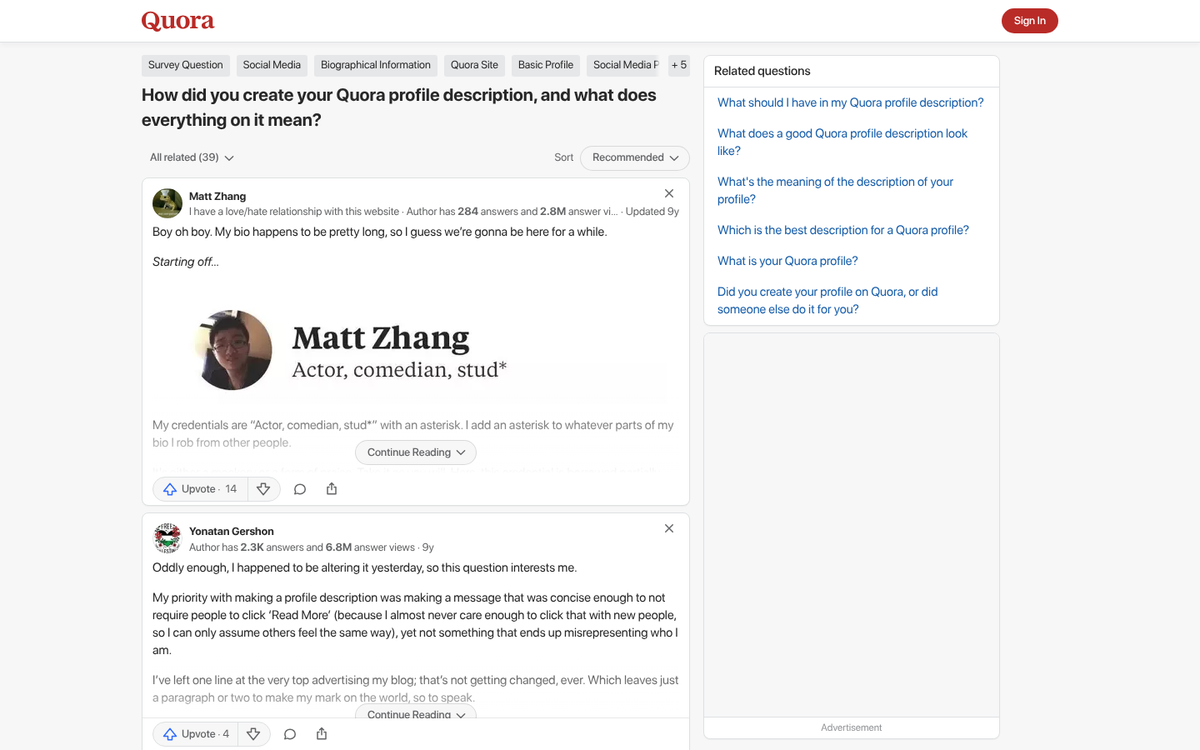
The key to Quora, and any other question site, is to speak from a position of authority. Anyone can come by and answer any question they like, and with enough talent for writing, they can produce something plausible. They can also be completely wrong. The key to getting the "best answer" position, and consequently the most traffic, is to write from a position of authority. You want to stick to topics you know a lot about, and you need to format your profile on the site such that it displays your expertise. For example, when you visit a high-profile user's profile, you'll see their title displayed right next to their name on every question they've answered.
You can also strive to get two things that help your answers: verification and features.
Verification on Quora works much the same as on other social networks. You need to be sufficiently high profile, with enough name recognition that users would benefit from knowing you are who you claim to be. You can read more about verification and submit a request directly through Quora's help center.
Features are instances where your answer has been linked to or highlighted in a high-profile publication. You can also see cases where an answer is upvoted by a notable, verified user - high-profile upvotes give your answers more visibility and authority, and Quora's algorithm takes engagement signals like these seriously.
Neither one is something you can realistically chase from day one, nor are they guaranteed. The techniques below are all ways to use the site to drive traffic regardless of your verification status or support, and will work on other Q&A platforms as well.
1. Set the Stage with a Great Profile
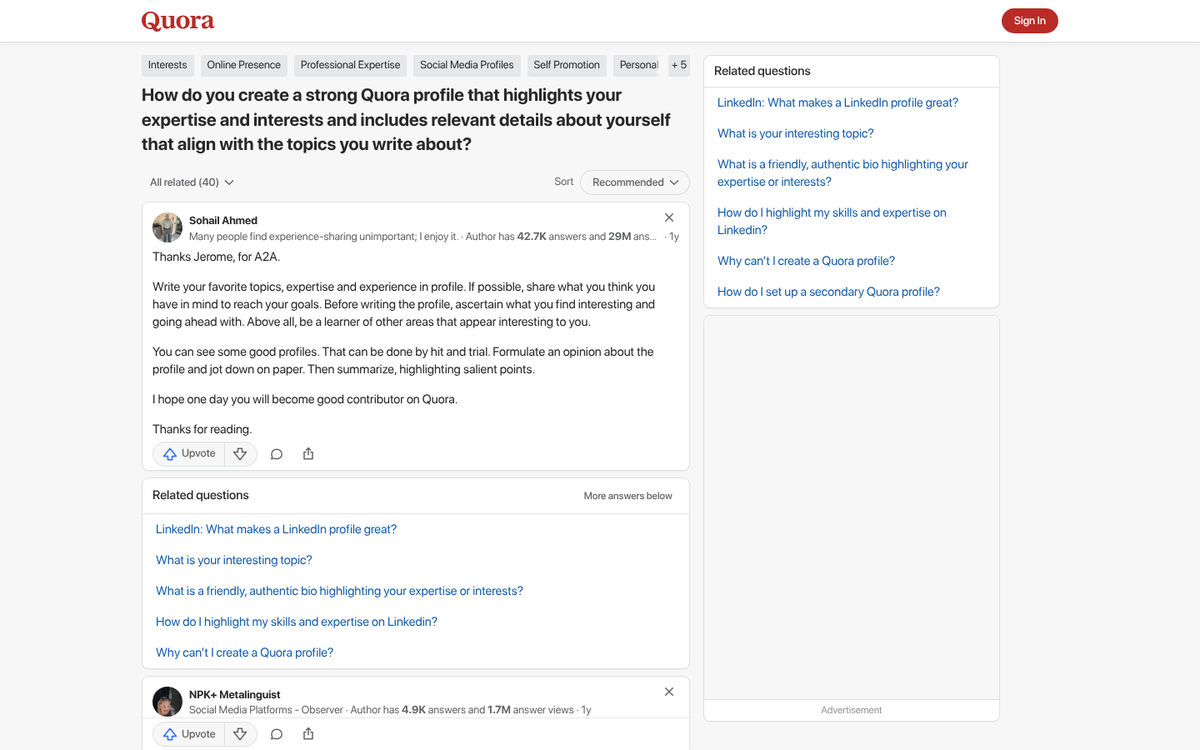
Filling out a complete profile is a prerequisite for using literally any site for traffic generation, but you should give some special attention to optimizing yours for traffic, as well as for expertise. Be aware of how little space you have to work with.
Your profile on Quora has a headline, a bio, and a profile summary. The headline functions as your job title and will appear next to your name on every question you answer or ask. I highly recommend something that showcases your authority. Your bio shows up when you answer questions and gives users a quick snapshot of who you are. It does not support links, so save those for your summary.
Your summary is only available on your full profile page, but gives you much more space to work with, along with formatting options and link support. It's a good idea to include a few authoritative pieces you've written, mentions of publications you've contributed to, awards you've received, and a touch of personality.
Next, claim topics. Search for industry-relevant keywords and look for topics you're an expert in, then claim them. Adding them to your profile lets you signal expertise in those areas, and you can write a special topic-specific bio. These topic bios show up when you answer something within that subject, rather than your generic bio. Aim for larger, active communities rather than obscure niche groups.
2. Write Great Answers
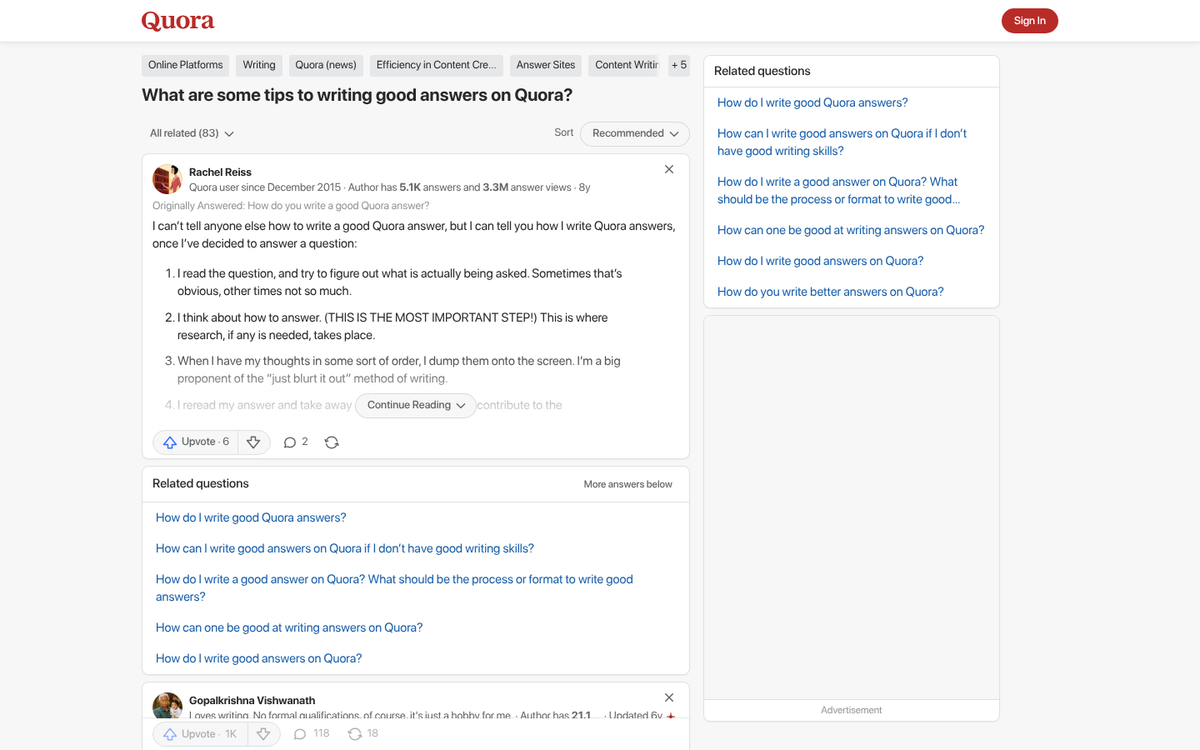
The other "before we begin" tip is to write top-tier answers whenever you sit down to write one. You're not going to get much traffic or recognition for a two-sentence reply, unless the question explicitly calls for one.
Good answers have four qualities.
- They have depth. You're looking for the kinds of answers that run about half the length of a typical blog post - enough room to give real instructions and insight, with plenty of opportunity to expand on key points.
- They tell stories. A narrative style tends to be very effective at getting people emotionally engaged, and they're more likely to upvote your answers when they feel connected to what you're saying.
- They include images. A well-placed image every hundred or so words makes your answer stand out visually and is more likely to draw in attention as users scroll.
- They leave you wanting more. This is where traffic driving really comes in. Add links to your answers with "further reading" pointing back to your blog or site. If you don't have a suitable post yet, write one - the question isn't going anywhere. This is also a good opportunity to think about how you include calls to action in your content.
You can also write "bait" answers if you have content that covers a topic in detail. Write a solid short answer and link to your post for the full breakdown. People generally appreciate it, as long as you don't use that technique for every single answer you post. If your blog isn't getting enough traffic yet, this kind of approach can be a meaningful step in the right direction.
3. Hit the Big Game

All of the big niches have great open-ended questions. You'll see things like "What can I learn right now in 10 minutes that will be useful for the rest of my life?" Questions like this are excellent because they don't have one fixed answer. These popular evergreen questions can have thousands of answers and tens of thousands of followers - each new answer gets surfaced to people following that thread, which is essentially like tapping into someone else's audience while also publishing publicly for organic discovery.
Yes, there is a lot of competition for those questions, and you're unlikely to land at the very top. However, you will gain visibility and can still provide a fresh, original take. That's the key - come up with angles others haven't covered, and check to see if anyone has said them before. You don't need to be 100% original in your answer, but you should be original in how you tell it.
4. Follow the Trends

Just like when marketing on social media, you can keep an eye on the trending topics Quora and many other Q&A sites surface. These are topics getting a lot of attention and follows, though not necessarily a lot of quality answers yet.
A lot of trends won't be relevant to your niche - if you're a marketing specialist, you're probably not going to be able to meaningfully answer a question about monetary policy in Southeast Asia. You won't find a large volume of on-topic trending questions, so make the ones you do find count. Put real effort into these answers and make them among your best.
5. Write Alternative Answers
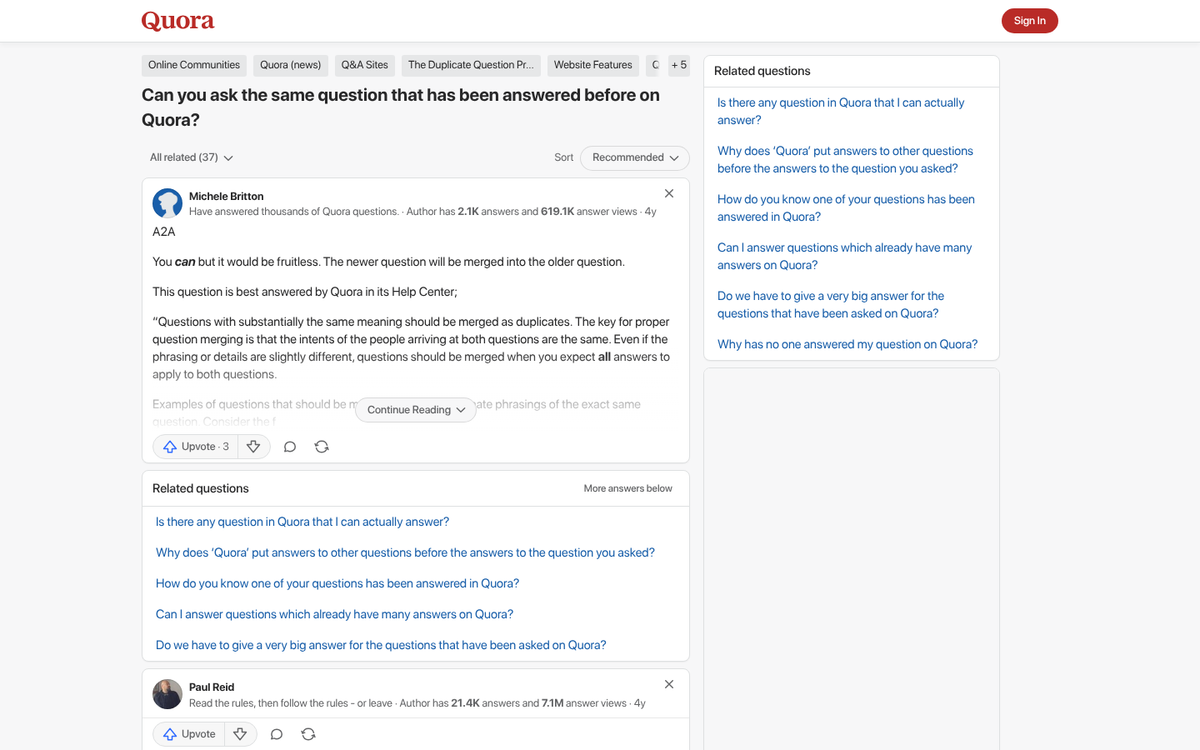
The beauty of a site like Quora is that even if a question already has a strong accepted answer, you can still drive significant traffic with your own response. Generally, the easiest way to do this is to go against the grain and write an unorthodox answer. Start by acknowledging the existing answers, then say something like "but my take is a little different." This immediately hooks people who are tired of reading the same response repeated twelve times.
Most answers are truncated until the user expands them. Make sure your opening lines are strong enough to earn the click, because that's often all they'll see at first.
Don't go in just to stir up controversy, and don't say something obviously wrong just to stand out. Where opinions are concerned, you can absolutely take an unorthodox stance. With facts, you don't have that luxury - you'll simply be downvoted and ignored.
6. Do Some Networking
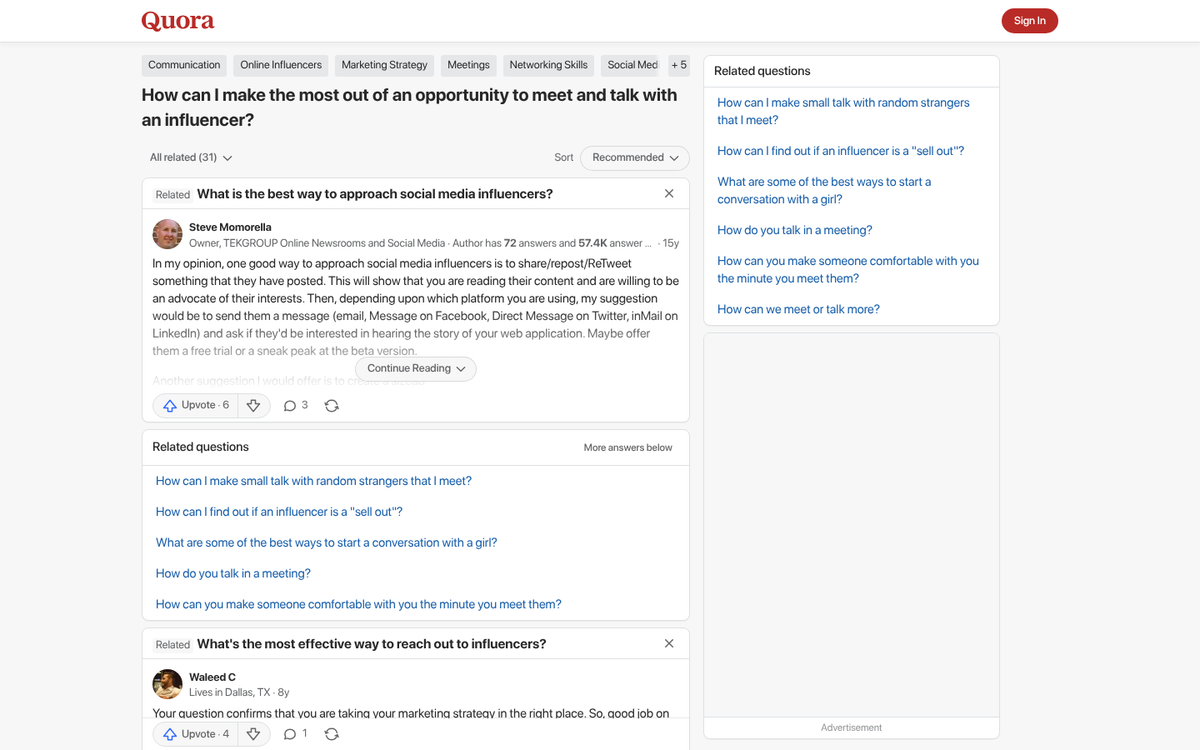
When you answer a question that has responses from other well-known writers - particularly if they've answered recently - engage with them directly. Reference their answers thoughtfully in yours, or tag them where relevant. When you do, they get notified and have the chance to read your answer. If they like it, they can upvote it. If they disagree, they might respond. Either way, you kick off a discussion or pull in upvotes from people who are already influential on the platform.
The biggest long-term benefit here is name recognition. You start to become someone people in your space have seen before, and that familiarity builds trust and authority over time - the kind that leads to more upvotes, more follows, and eventually more organic traffic back to your site.
7. Tackle the Difficult Questions
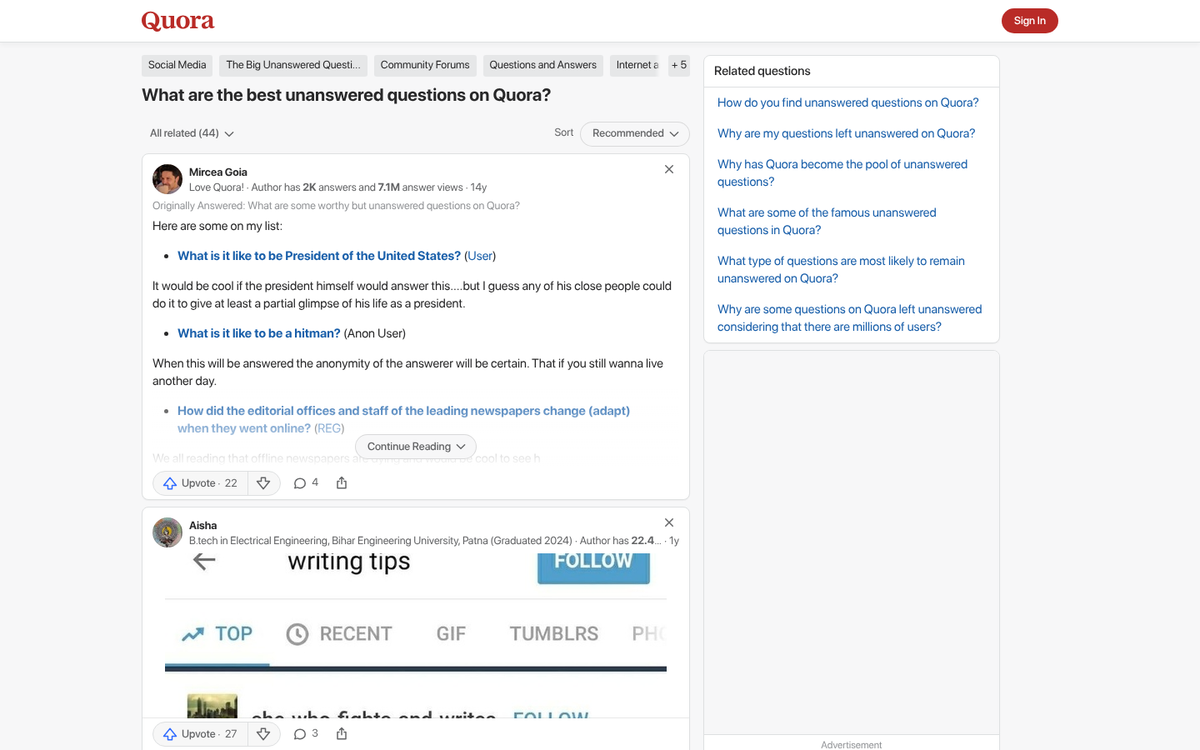
Some questions have a lot of followers but very few answers. You can get quite a bit of traffic from these if you answer them well - but the reason they're unanswered is usually that they're hard. They require firsthand experience, accurate proprietary data, or some niche expertise that most people don't have. You might not be able to answer all of them, but digging through the archives for questions that fall squarely in your wheelhouse can pay off significantly. These are the ones worth spending extra time on.
8. Follow Your Brand
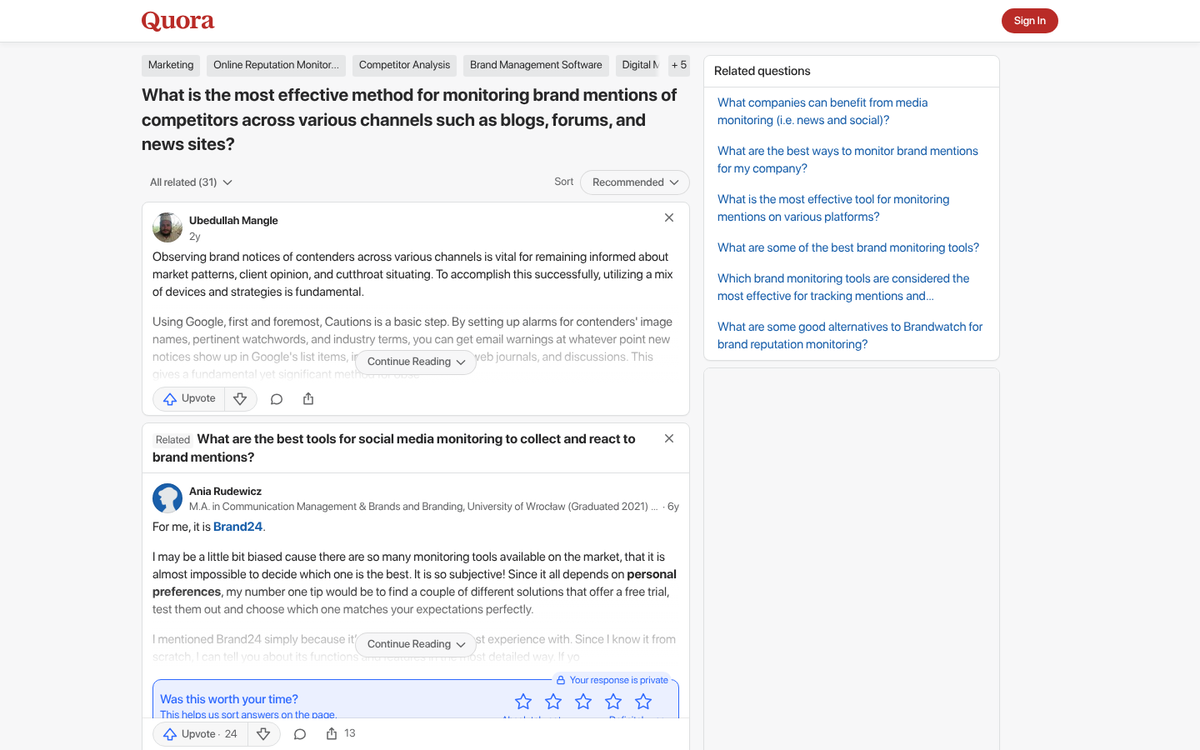
Quora is commonly used as an informal review platform and FAQ hub for products and services, particularly in niche markets. People ask things like "what's the best tool for accomplishing X" but they'll also ask "is product Y actually worth it for this use case?" Look for specific mentions of your brand or product, as well as questions about the core problems your product solves, and respond to those directly.
The key here is to be honest. If your product is lacking in a certain area, say so. If you're actively working on a feature someone is asking about, let them know. Quora's audience is sophisticated - they can smell a sales pitch from a mile away, and a dishonest or evasive answer will do more damage to your reputation than saying nothing at all.
9. Track and Iterate

You should be using Google Analytics with UTM parameters to track the traffic you're bringing in from Quora or any other Q&A platform you're active on.
Figure out which answers, which topics, and which answer styles are driving the most traffic and conversions. Double down on those, and spend less time on the formats that don't move the needle. With Quora allowing up to 50 answers per day, there's no shortage of volume - but quality and targeting will always beat raw output.
10. Answer Something Every Day
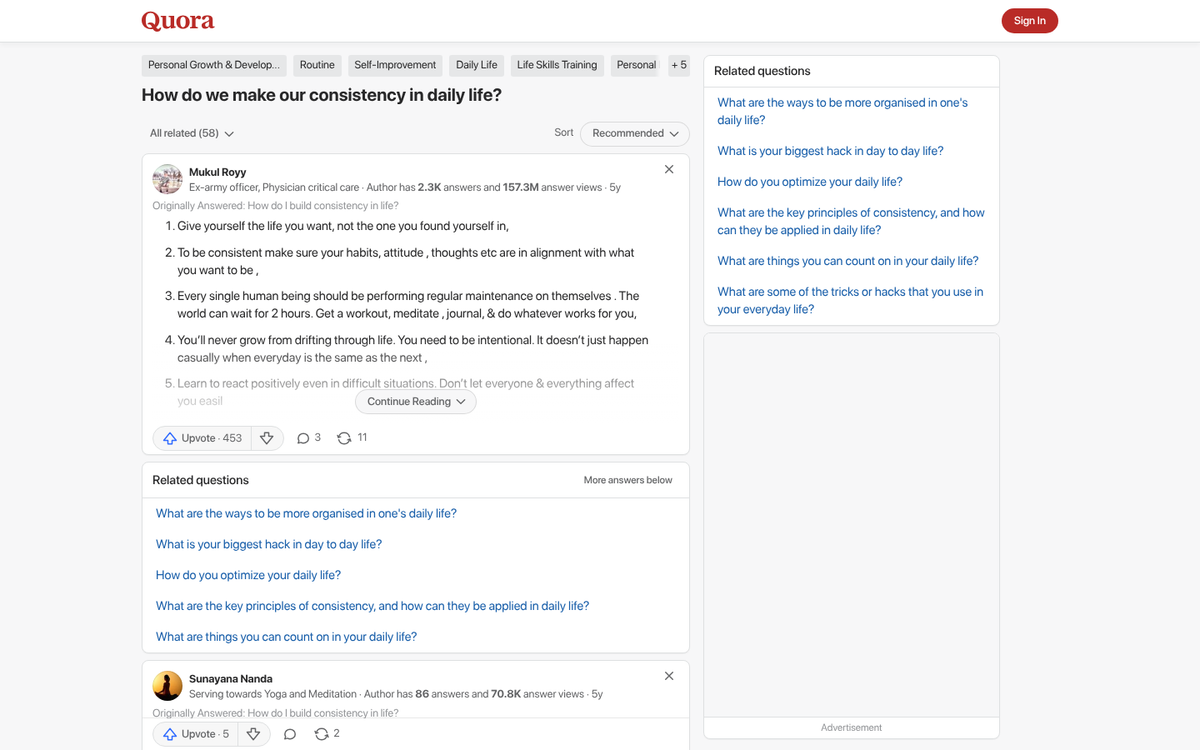
In many ways, building authority on Quora is like blogging was in the early days - consistency compounds. You get the most benefit from the platform when people recognize your name, and that happens fastest when you're showing up regularly.
Keep an eye on all of your major question categories and monitor them for new questions you can answer. If several good ones appear on the same day, answer one and bookmark the others for later. Prioritize questions with the most followers or the fastest follower growth. With users posting between 5,000 and 7,000 questions every single day on Quora, there's no shortage of material.
By answering one question per day, you build up a portfolio quickly and establish yourself as a recognized voice in your niche. It shouldn't take more than six months of consistent work to become one of the more visible contributors in your topic areas - and within a year, you could be featured in the top writers lists for your chosen subjects. Quora has over 400 million monthly active users, but the top contributors in any given niche are still a relatively small and recognizable group. That's your opportunity.


2 responses
Thoughtful replies only - we moderate for spam, AI slop, and off-topic rants.
It is informative and helpful. I need a lot to learn yet as a new user of this great site. I hope to have more and the latest things.
Thank you so much, Majeed! Welcome to Quora - it's a fantastic platform with so much potential for driving traffic. The great thing is that the more you engage and contribute genuine answers, the faster you'll learn what works. Don't feel overwhelmed as a new user - just start small, be consistent, and you'll get the hang of it quickly. Best of luck on your journey!