The numbers back this up: 73% of programmatic content never achieves meaningful search visibility. That's not because programmatic SEO is broken. It's because most teams treat it like a numbers game - publish more, rank more. In reality, search engines are looking for something more deliberate: a signal that your site has genuine authority around a topic - not just a pile of loosely related pages.
That's where a programmatic content cluster changes things. Instead of scattering dozens of pages across a large keyword community with no connective tissue, a content cluster builds outward from a single core keyword - intentionally, structurally, and in a way that compounds over time. Every page you create reinforces the others, and together they send a much stronger relevance signal than any one page could on its own.
I'll walk through the full process of building one, from picking the right anchor keyword and mapping your cluster architecture, to generating pages at scale without sacrificing the coherence that makes the whole thing work. No vague strategy advice, just a sequence you can follow from start to finish.
Key Takeaways
- 73% of programmatic content never gains search visibility because teams publish without intentional structure or topical authority.
- A strong anchor keyword must support 15-20 related angles; too narrow limits scale, too broad loses coherence.
- Content clusters work best when each supporting page serves a distinct search intent, feeding relevance back to the pillar.
- Lean pages pull in context-specific data per variable; thin pages that simply swap one word drag the entire cluster down.
- Descriptive internal link anchor text and schema markup help search engines understand page relationships and boost cluster-wide visibility.
What a Keyword-Led Content Cluster Actually Looks Like
A content cluster has one keyword at its center - the pillar - and a set of supporting pages that branch out from it. Kind of like a center with spokes. The center is your main page and each spoke is a separate piece of content that covers a related angle of the same topic.
It's helpful to try to know the difference between a keyword and a topic. A topic is large, like "email marketing." A keyword is more focused, like "email marketing for e-commerce." That tighter focus is what makes a keyword worth building around - it has enough search intent to anchor a page. But enough related angles to support a whole cluster beneath it.
One focused keyword can realistically support dozens of pages and each supporting page targets a variation, a sub-question, or a use case that connects back to the pillar. None of these pages compete with each other because they each serve a slightly different intent.
This is where programmatic content comes in. Instead of writing each supporting page from scratch, you use a template and a data source to generate pages at scale. The structure is the same across pages. But the variables change - a location, an industry, a product type. The pillar page ties everything together and links out to each of these variations.

Before you build anything, it's worth asking yourself if you have ever mapped your content out before publishing it. Most write pages one at a time without a structure in mind; it's how you end up with a site full of content that doesn't reinforce itself.
Research from Semrush found that 98% of SEOs rate keyword clustering as medium to high value. That number aligns with how much the practice has grown in importance as search engines get better at understanding content relationships instead of just matching individual keywords to individual pages.
Finding the Keyword Worth Building Around
Not every keyword can hold a cluster together. The one you build around needs to do three things well: draw enough search volume to be worth the effort, carry intent that spans multiple angles, and sit in a space where content gaps are out there instead of where competition is already thick.
That last point matters more than most act on. Moz found that 67% of programmatic SEO opportunities live in content gaps instead of in direct head-to-head competition. So instead of targeting a keyword because it's popular, look for one where there's genuine demand and not much to satisfy it.
The keyword also needs some room to branch. An anchor term opens up into supporting questions, audience variations, and related subtopics that each deserve their own page. If you pick something too narrow, you'll run out of angles fast. If you pick something too large, you won't have a clear path to rank for the core term at all.
It's helpful to think past the obvious head terms. Seasonal demand can open up a whole set of pages that a static keyword wouldn't support. Audience segment variations - the same topic framed for different types of users - can each become their own supporting page. Long-tail offshoots with lower competition but clear intent are sometimes the strongest place to start building traffic.
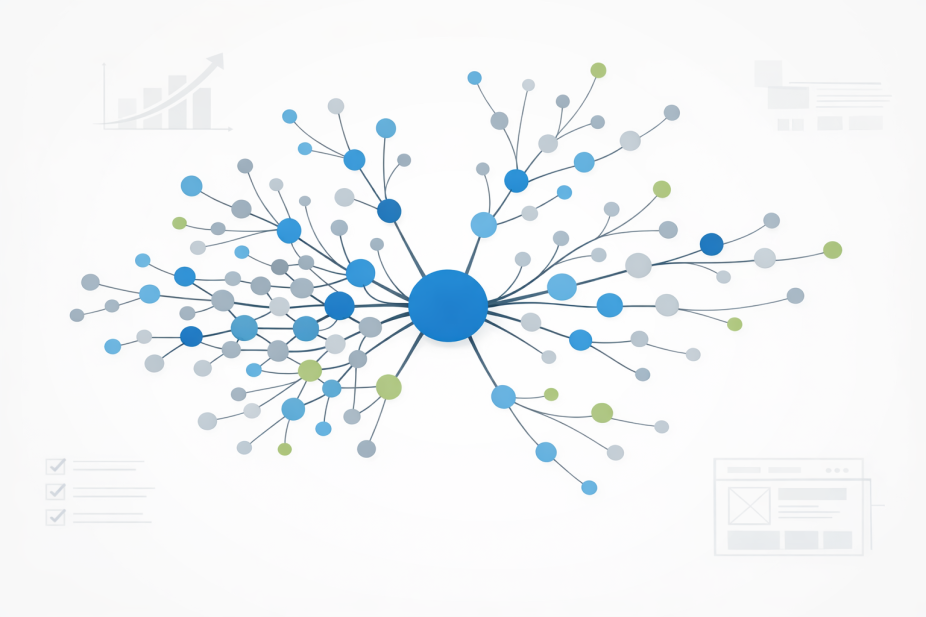
A helpful exercise is to take your candidate keyword and try to list fifteen to twenty related angles from memory. If you get stuck at five, the keyword is probably too narrow to anchor a cluster. If your list has no connecting thread, it may be too scattered to build a coherent structure around.
The right keyword sits in the middle: large enough to support a full cluster and focused enough to hold it together as one topic. That balance is the work before any content gets planned.
Mapping the Cluster: Pillar Pages, Supporting Pages, and the Logic Between Them
The pillar page sits at the center and covers your core keyword in full. Every supporting page in the cluster connects back to it, and it links outward to them. That two-way linking is what gives the structure its strength.
Supporting pages each have a job to do, and that job is shaped by search intent. A comparison page targets a person who is close to making a choice. An FAQ page pulls in users who are asking questions early in their research. A local or variant page brings in traffic from a more specific angle, like a geographic area or a niche use case, and each one feeds relevance back to the pillar.
| Page Type | Search Intent | Role in Cluster |
|---|---|---|
| Pillar Page | Broad / Navigational | Central hub; links to all supporting pages |
| Supporting FAQ Page | Informational | Captures question-based queries; links back to pillar |
| Comparison Page | Commercial | Targets decision-stage searchers; strengthens topical authority |
| Local / Variant Page | Geographic / Niche | Expands reach across segments; feeds traffic to pillar |
When you plan internal links, you should think bigger. Research from Zyppy SEO found that pages can handle as many as 45 internal links without running into trouble. That gives you room to connect pages generously across the cluster instead of keeping things sparse.
The logic to follow is to link with purpose: each link should move a reader closer to something useful, and each page should belong in the cluster for a reason. When every page earns its place, the whole structure can become more than the sum of its parts.
Generating Pages at Scale Without Losing Search Relevance
A content cluster only works at scale if every page has a reason to exist beyond filling a slot in a spreadsheet. Scaling to 50, 100, or 500 pages requires that each page earns its place rather than just adding to the count.
The foundation of programmatic content is the data template. You build a repeatable page structure, then pull in variables - location, industry, use case, product type - to populate it. The structure stays steady while the content changes to match what a person in that context would actually want to know.
Here is where teams go wrong. They treat every variable swap as a finished page without asking if the result is legitimately helpful. A page that swaps "Chicago" for "Dallas" in three sentences is thin. A page that pulls in local salary data, relevant job titles, or city-specific context is lean - short but purposeful.
The difference matters to Google. According to HireGrowth, clustered content drives 30% more traffic and holds rankings 2.5 times longer than standalone pages. That stat only applies when the pages in your cluster hold up individually. A weak page drags the whole cluster down instead of lifting it.

A helpful filter before publishing at scale is to ask one question about each page type: what does the reader get from this that they can't get from the pillar page alone? If the answer is nothing, the page is not ready. AI tools can help evaluate page-level value at scale, but a human judgment call still matters here.
| Thin Page | Lean Page |
|---|---|
| Swaps one variable with no added context | Pulls in relevant data or examples for that variable |
| Reads like a copy-paste with a find-and-replace | Feels written for that specific reader |
| Adds page count but not value | Earns its place in the cluster |
Publishing at scale without a quality filter is the fastest way to dilute the work you put into the cluster structure. Understanding what makes a content block citation-ready can sharpen how you build templates that hold up under scrutiny. Build the template well and the pages take care of themselves.
Using Structured Data and Internal Links to Activate the Cluster
Once your pages are live, the next job is to make sure search engines understand how they connect and what each one is about. Schema markup is a place to start. BrightEdge found that pages with structured data are 30% more likely to appear in rich results, which means more visibility without needing more backlinks.
The Schema type you add can depend on the page. A page built around a question deserves FAQ schema. A comparison page might suit Product or Review schema. Getting this right means each page has a better shot at earning the search result that takes up more space on the page.
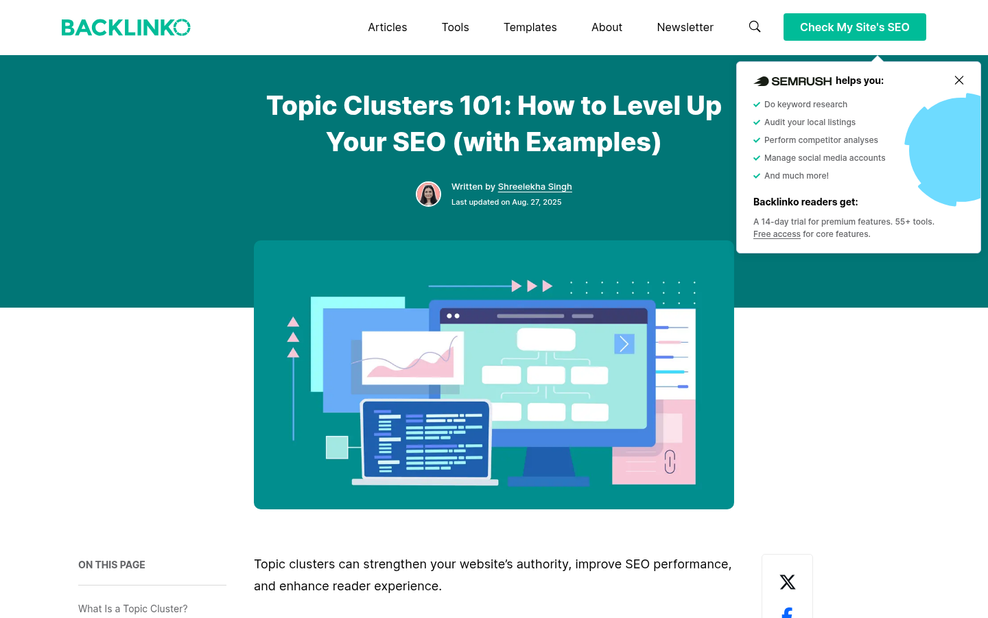
Internal linking is where the cluster starts to work as a system, and each link you add between pages passes authority and tells search engines that these pages are related. Backlinko has documented a content cluster that ranks for over 29,000 keywords, and a disciplined internal linking structure is a big part of why that reach is possible.
Anchor text matters more than most give it credit for. When you link to a supporting page, the words you use in that link tell search engines what the destination page is about. Generic phrases like "click here" waste that opportunity. Descriptive anchors that align with the target page's topic send a much stronger signal as a ranking signal.
It also pays to remember which pages you want to lift the most. If a supporting page is close to ranking for a competitive term, pointing more internal links at it with strong anchor text can be the thing that pushes it over. You have control over this and it costs nothing to adjust.
A well-linked cluster also helps users move through your content naturally, which tends to improve time on site and cut back on bounce rates. Those behavioral signals are not a replacement for content. But they do reinforce the work you have already done.
Your Cluster Won't Build Itself - But Now You Know Where to Start
You don't need hundreds of templates to start. Pick one keyword, sketch the cluster map, and find the three to five page types that surround it. Build those first. See how they perform, how they interlink, and where the gaps are. Momentum in programmatic SEO doesn't come from launching everything at once - it comes from building a structure that compounds as you add to it.

It's worth remembering that even the most recognizable clusters in the SEO space started with a single topic choice. A site's core subject gets defined before scale can become a concern. That's what makes everything else possible. If you're still figuring out your foundation, learning how to build a niche site is a solid place to begin. Your cluster works the same way. Get the core right, and the rest follows.