
Topical map cannibalization happens when multiple pages on your site are too similar in focus, intent, or target keywords - to the point where search engines struggle to determine which one deserves to rank. It goes deeper than two pages sharing a keyword. When your topical map has structural overlap, whole clusters of content can dilute each other's authority, confuse crawlers, and split ranking signals that should be concentrated on a single, strong page.
Your content calendar looks thorough. Your coverage feels complete. But thoroughness and overlap can look nearly identical from the outside - and only one of them helps your SEO.
This guide breaks down what topical map cannibalization is, how to find the patterns that signal you have it, and what to do to fix it without dismantling the content strategy you've worked hard to build.
Key Takeaways
- Topical map cannibalization is an architecture problem where multiple pages cover the same conceptual territory, diluting authority and confusing search engines.
- Unlike keyword cannibalization, topical overlap can occur even when pages use different keywords, making it harder to catch through standard audits.
- Sites with well-structured topical maps earn roughly 2.5x more organic traffic and triple the chance of ranking on page one.
- Ranking drops from cannibalization often appear 4-6 weeks after publishing, making the cause-and-effect connection easy to miss.
- Fixes include merging overlapping pages with 301 redirects, differentiating by search intent, or restructuring internal links to clarify content hierarchy.
What Topical Map Cannibalization Actually Means for Your Site
A topical map is the planned structure of your content - the way your pages connect to cover a subject completely and logically. Think of it as a blueprint that tells search engines what your site is about and which pages manage which parts of a topic.
Topical map cannibalization happens when that structure breaks down because multiple pages cover the same ground, and it goes further than classic keyword cannibalization, which is usually about two pages targeting the same search term.
Classic keyword cannibalization is a targeting problem. But topical map cannibalization is an architecture problem. That distinction matters because the fix is different and the damage runs deeper.
With classic cannibalization, you might have two blog posts optimized for "best running shoes." With topical map cannibalization, you might have two separate pillar pages that claim to be the definitive resource on, say, content strategy - even if they use different keywords. Search engines read the intent and structure of pages and find the overlap confusing.
The issue is that Google has to make a judgment call about which page to rank. If you haven't made that clear through your content structure, internal links, and page scope, Google will make that call for you - and it won't always get it right.
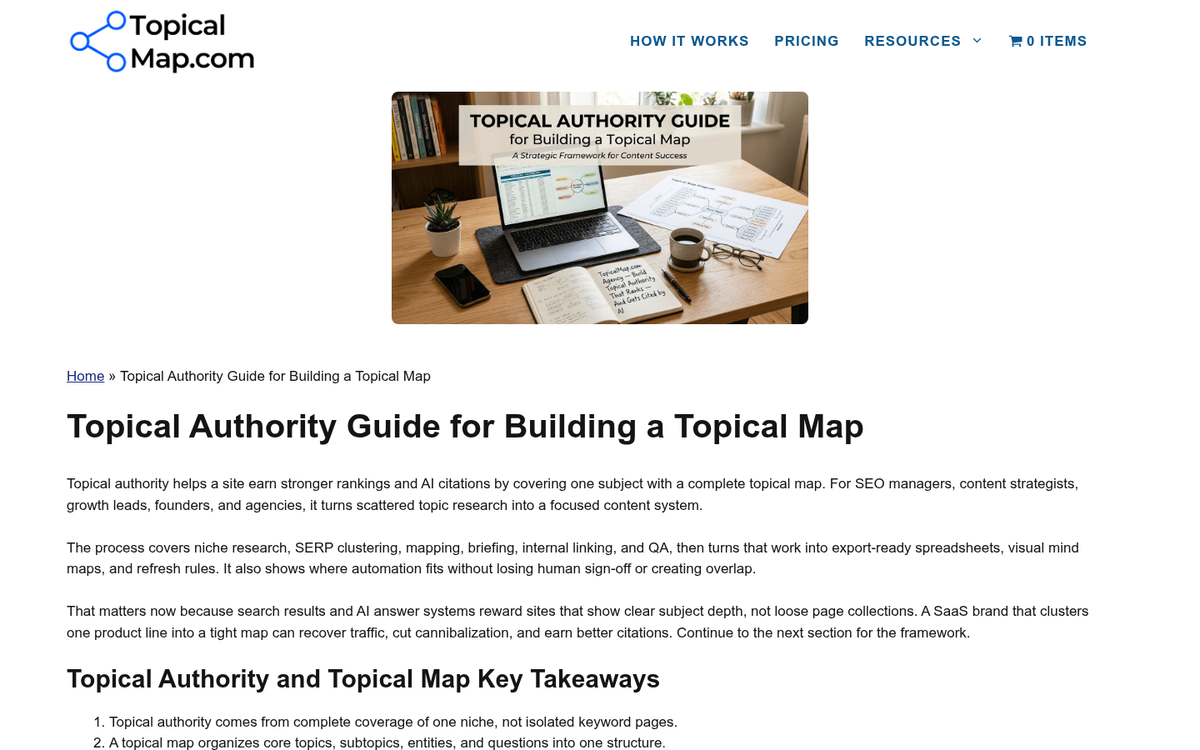
This overlap weakens your topical authority because your site is basically sending mixed signals. Instead of one strong, well-supported page on a subject, you have two pages dividing the attention, the links, and the relevance signals that should be concentrated in one location.
Here is an easy way to see how the two types compare:
| Type | Root Cause | What Gets Confused |
|---|---|---|
| Keyword Cannibalization | Two pages target the same keyword | Which URL to rank for a query |
| Topical Map Cannibalization | Two pages cover the same conceptual territory | Which page holds authority on a subject |
Topical map cannibalization can happen even when your keywords look different on the surface; it's what makes it harder to catch through a standard keyword audit alone.
How Topical Overlap Silently Kills Your Authority
When two or more pages compete for the same topical ground, the authority that should build behind one page gets spread thin across a few. Search engines receive mixed signals about which page actually deserves to rank, so instead of pushing one strong page up, they pause on them.
This matters more than most realize. Over 90% of SEO practitioners see topical authority as a key ranking factor, and sites with well-structured topical maps see around 2.5 times more organic traffic than the ones without. Content on a structured site also has roughly three times the chance of ranking on page one. That gap is hard to close through other means.
The frustrating part is how long it takes to feel the damage. Search engines usually take four to six weeks to register ranking changes after content is indexed, so if you published two overlapping articles in January, you might not see the drop until March - then the connection between the cause and the effect is easy to miss.

That delay is what makes cannibalization so damaging over time. You keep publishing, the overlap grows, and the authority that should be stacking up behind your best pages never gets the chance to consolidate. Each new piece of content that edges into an existing topic can add another split in the signal instead of strengthening what you already have.
Authority accumulates in one location. Links, clicks, time on page, internal link weight - these flow toward a URL. When two pages cover the same ground, that flow gets divided. Neither page builds the concentrated authority that pushes rankings higher over time. This is one reason why your rankings can quietly erode without a single dramatic event to point to.
The pages themselves may look fine on the surface. Traffic numbers might hold steady for a while, which makes it easy to assume things are working. But underneath, you're losing ground in small increments that only become visible when you step back and look at the full picture. Even something like changing a URL can further divide authority if it isn't handled carefully.
This slow erosion is why structured topical maps matter - not just as an organizational tool, but as a way to keep authority pointed in one direction. When the structure breaks down, so does the signal.
Signals That Your Topical Map Has a Cannibalization Problem
Keyword cannibalization is easiest to spot by starting with Google Search Console. Pull up your performance data and filter by query, then look at how different URLs are ranking for the same or very similar search terms. If you see two or three pages from your site taking turns in the top positions for one query, that rotation is a problem worth addressing.
Stagnant traffic is another signal. You keep publishing, but your numbers barely move. That will happen when new pages absorb ranking signals that were already spread too thin across older related pages - none of them gets strong enough to hold a top position. If you want to find high traffic blog topics that do not overlap with existing content, researching demand before you write helps prevent this problem from starting.
Click-through rates are worth checking too. When multiple pages compete for the same query, they sometimes all land on page one but with low CTR across the board. That tends to mean searchers are not finding any single result convincing enough to click, which traces back to pages that look and sound too alike.
A quick audit table can make the problem more visible.
| Signal to Check | Where to Find It | What It Looks Like |
|---|---|---|
| Multiple URLs ranking for one query | Search Console → Performance → Pages | Two or more URLs trading positions for the same search term |
| Low or flat CTR on similar pages | Search Console → Performance → Queries | Pages with impressions but weak click-through rates |
| Traffic plateau despite new content | Analytics traffic over time | Publishing increases but overall traffic does not follow |
| Overlapping target keywords | Your keyword map or content brief | Two pages targeting nearly identical primary or secondary terms |
One thing to keep in mind is that topical map tools are not foolproof. Most land between 60 and 80 percent accuracy, which means overlaps can slip through even after a careful planning process. That is why search data matters more than your content outline when you go to audit. Trust the data over the plan. If you have older content that has lost traction, knowing how to bring an old website back to life can be a useful complement to fixing cannibalization issues.
Consolidation, Redirects, and Restructuring - Your Fix Toolkit
Once you know which pages are competing with each other, you have a few ways to fix it. The right choice can depend on how much the pages overlap and if they each carry any authority.
The most direct fix is to merge competing pages into one stronger piece. Take the best content from each, combine it into a single authoritative page, and redirect the old URLs to the new one via a 301 redirect - this passes the link equity from the removed pages to the surviving one, so you don't lose the value those pages had built up.
Not every overlapping page needs to be merged though. Sometimes two pages cover similar ground but can be pulled in different directions. A change in angle - targeting a different search intent, a different audience, or a different stage of the buyer process - can give each page a reason to stand out on its own. This is called differentiation, and it works best when the overlap is partial instead of total.

Internal linking is the piece that ties everything together. If your site structure does not make it clear which page is the main one on a topic, search engines will have a hard time figuring it out too. Link from supporting pages to your primary page with consistent anchor text, and make sure that primary page sits higher in your content hierarchy. Understanding how pages and posts rank differently can also help you decide where each piece of content belongs.
| Approach | When to use it | What it preserves |
|---|---|---|
| Merge and redirect | Pages cover nearly identical ground | Link equity from both pages |
| Differentiate by intent | Pages overlap but serve different goals | Both URLs and their individual traffic |
| Restructure internal links | Hierarchy is unclear across the site | Existing content with better signals |
| Redirect and retire | One page is weak and adds no value | Authority of the stronger page |
There is documented evidence that this structural cleanup delivers results. One known case study tracked a site that grew from zero to 100,000 monthly visitors in 18 months - and clean topical structure was central to that growth. Fewer competing pages meant stronger signals and faster rankings across the board.
Cleaning Up Your Map Is a Ranking Strategy, Not a Chore
The most helpful thing you can do is pick one cluster - just one - and run it through the audit process covered above. Check for keyword overlap, compare performance metrics, and choose if those pages need to be merged, redirected, or restructured. Then step back and give it four to six weeks. Watch your rankings, your crawl data, and your organic traffic. You will probably see the consolidation gains that remind you why a leaner map usually outperforms a bloated one. Treat your topical map as a living document that you revisit and smooth out as your site evolves - not a blueprint you finalize once and forget.
If this sounds easy in theory but a bit stressful in practice, that's where BlogPros comes in. We manage the full content lifecycle - topical mapping and cluster strategy to AI-assisted writing, human editorial review, and on-page SEO and schema optimization - so your site builds authority without the guessing. A tighter map means stronger rankings, and stronger rankings mean more of the right people finding your business. If you are ready to see what a well-structured, expertly executed content strategy looks like, start your free month with BlogPros. No contracts, no credit card, no commitment - just content built for results.