Pinterest has evolved dramatically from its early days of basic pin tracking. Today it's a full-scale visual discovery and shopping engine with over 578 million monthly active users and $1.15 billion in revenue in Q4 of 2024 alone. The analytics dashboard has grown to match that scale, now offering over 170 available metrics to help businesses make smarter decisions. Here's how to take full advantage of what Pinterest analytics offers today.
Key Takeaways
- Pinterest Analytics offers over 170 metrics, tracking impressions, saves, clicks, and engagement rate across date ranges and device types.
- Rich Pins automatically sync real-time product pricing, availability, and details from your website, eliminating manual updates entirely.
- Top of Search ads, launched September 2025, deliver 29% higher click-through rates compared to standard promoted pin placements.
- Pinterest's default attribution model uses a 30-day click and 1-day view window, reflecting its 21-30 day purchase consideration cycle.
- Video views are counted after 2 seconds of playback with 50% visibility, helping marketers evaluate whether hooks retain early attention.
1. Activity Measurement
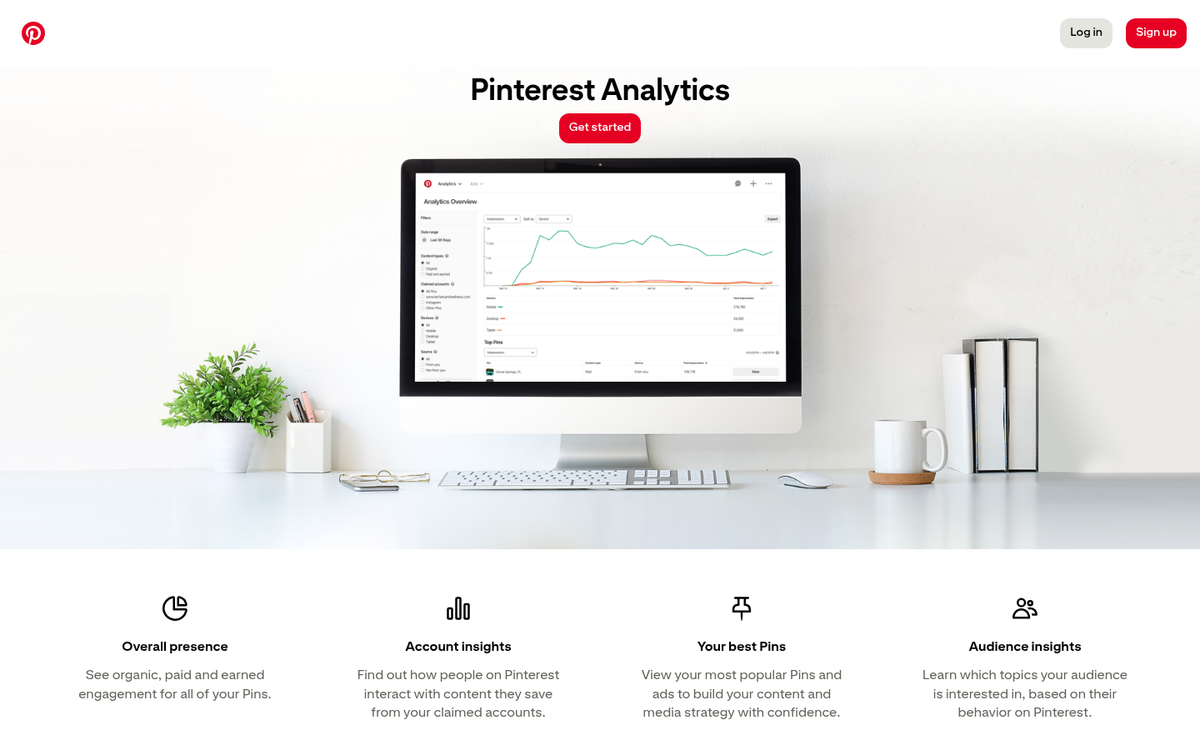
The Pinterest analytics dashboard gives you a real-time and historical view of how your content performs across impressions, saves, clicks, and engagement rate. You can filter by date range, content type, and device to understand not just what's being seen, but what's driving action.
The audience insights panel shows you what topics and interests your followers are actively engaging with, which allows you to align your content strategy accordingly. It's not as granular as Meta's interest targeting, but it's a genuinely useful signal for content planning, especially given Pinterest's well-documented 21 to 30 day purchase consideration window. The platform's default attribution model reflects this, set to a 30-day click and 1-day view window by default.
2. Rich Pins
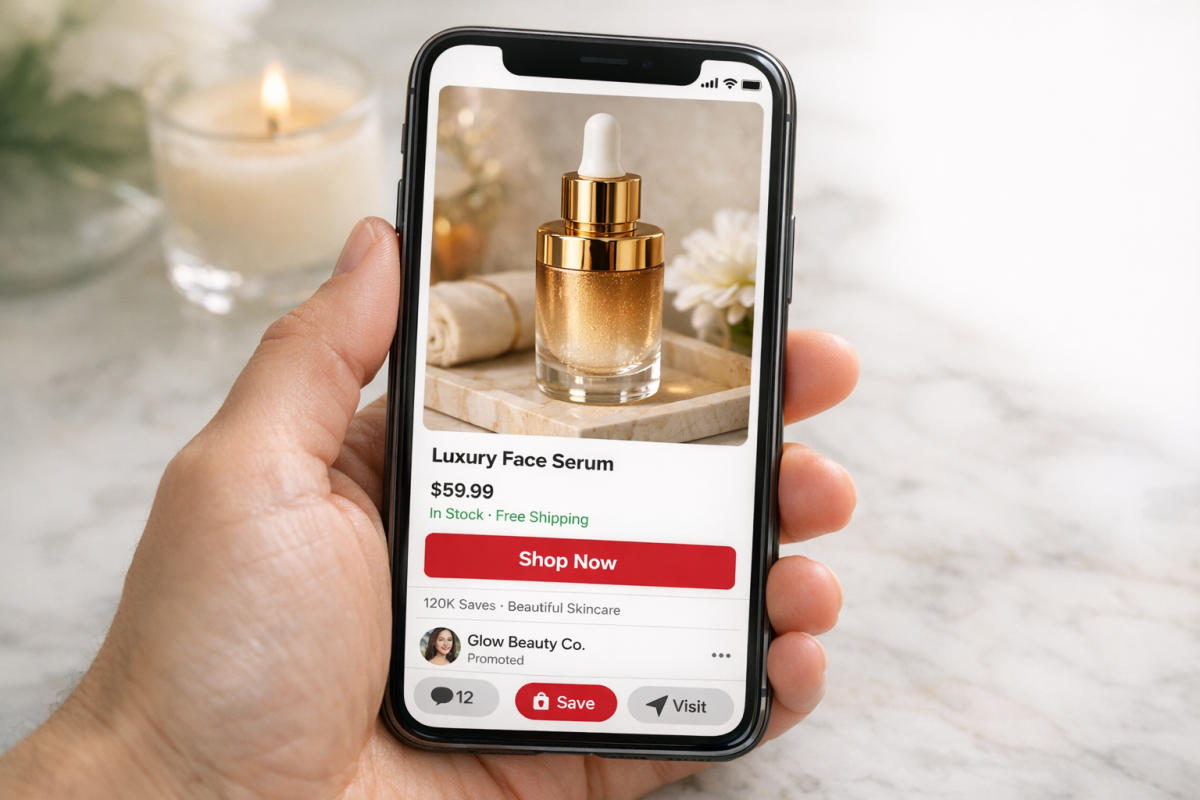
Rich pins remain one of the most practical tools available to business accounts. They pull real-time metadata directly from your website and embed it into the pin itself. A product rich pin, for example, will display current pricing, availability, and product details automatically. If you update your inventory or drop a price on your site, that change is reflected in the pin without any manual update on your end.
Rich pins are also available for recipes and articles, pulling in ingredients, cook times, headlines, and author information. For content-driven businesses, article rich pins add credibility and context that standard pins simply can't offer.
With over 1 billion shoppable product pins now on the platform and shopping engagement up more than 20% in 2025, rich pins have become a foundational part of any serious Pinterest commerce strategy rather than a nice-to-have extra.
3. Promoted Pins and Top of Search Ads
Promoted pins are pins boosted through Pinterest Ads Manager, surfacing your content more prominently in feeds and search results. The targeting options have matured significantly, with keyword, interest, demographic, and act-alike audience targeting all available.
The biggest development on the paid side in recent memory is the launch of Top of Search ads in September 2025. These placements put your promoted pins in the first positions of Pinterest search results, and they show a 29% higher click-through rate compared to standard placements. If search intent is part of your strategy, this format is worth testing.
Both organic and promoted pins have their own detailed analytics. You can compare click-through rates, save rates, outbound clicks, and conversions side by side across formats. Pinterest Ads Manager now surfaces over 170 metrics, so there's no shortage of data to work with.
4. Enhanced Demographics

Pinterest's audience demographics have shifted considerably over the years. While the platform built its early reputation on female-dominated categories like home décor, food, and fashion, that gap has narrowed meaningfully. Male users and Gen Z audiences have both grown substantially as segments.
Through the analytics dashboard, you can now segment your own audience by country, language, gender, device, and age range. More importantly, you're not relying on platform-wide statistics that may not reflect your specific community. Your audience data is your audience data, and Pinterest makes it accessible without having to dig through third-party reports.
5. Pinterest User Behavior and Video Metrics
Beyond basic click and save data, the dashboard gives you a clear picture of how users move through interactions with your content. When someone sees a pin, did they click through to your site? Did they save it to a board? Did they engage with a product tag or tap through to a collections page?
Video content has its own measurement standards worth knowing. A video view on Pinterest is counted after at least 2 seconds of playback with 50% of the video in view. This is a useful benchmark when evaluating whether your video hooks are working. If view counts are high but average watch time is low, the creative may be losing people early.
6. Website Analytics
Verifying your website with Pinterest unlocks the ability to track traffic and conversions flowing from the platform back to your site. It also enables access to the Pinterest tag, which functions similarly to the Meta pixel, firing on key site events and feeding conversion data back into your campaigns.
Verification options include:
- Adding a meta tag to your homepage, which Pinterest checks and confirms as proof of ownership.
- Uploading an HTML verification file directly to your web host root directory.
- Connecting through supported CMS platforms like Shopify or Squarespace, which can handle verification automatically through their native Pinterest integrations.
Reasons to Use Pinterest for Marketing in 2026

Pinterest's combination of visual discovery, high purchase intent, and long content shelf life makes it genuinely worth your attention, especially compared to platforms where content disappears within hours.
- Integrate it with your product catalog. Pinterest's shopping integrations with Shopify and WooCommerce make it easier than ever to sync your products directly to the platform and make them shoppable without manual pin creation.
- Create boards with specific sub-interests of your business in mind. Whether you sell home goods, software, apparel, or services, organized boards help users find what they're looking for and signal relevance to Pinterest's algorithm.
- Use the "Pin It" button on your website imagery. Enabling this widget on product and blog images allows visitors to save your content to their own boards, extending your organic reach without any ad spend.
- Follow industry influencers to stay current on what content is resonating in your space. Pinterest creator content has expanded significantly, and seeing what formats and aesthetics are gaining traction can sharpen your own strategy.
- Interact with your community. Pinterest still rewards accounts that engage authentically. Responding to comments and staying active signals relevance and can improve your content's distribution.
- Create collaborative group boards with complementary brands or creators to broaden your reach and build community around shared interests in your niche.
The one reality worth acknowledging is that Pinterest remains a highly visual platform, and it does compete for mindshare with Instagram. But the key difference is intent. Pinterest users are often in planning and discovery mode, which means they're further along in the consideration process than passive social scrollers. With a mature analytics suite and a growing commerce infrastructure behind it, the platform in 2026 is a meaningfully different and more capable tool than what most marketers originally dismissed it as.