





If you've looked into PPC advertising any time over the past few years, you've probably seen mention of retargeting or remarketing, especially with Facebook and Google ads. You'll see fantastic headlines like "250% increase in ROI!" and "More than double your conversion rate!" and other pie-in-the-sky promises. But are those promises really just dreams, or is this kind of benefit achievable from retargeting?
Key Takeaways
- Watchfinder segmented retargeting audiences into 20 distinct lists, achieving 1,300% ROI and 34% lower CPAs after six months.
- Myfix Cycles combined Google Ads with Facebook retargeting, earning $15 for every $1 spent - a 1,529% ROAS.
- Lumension cut PPC budget by 30% yet increased lead volume by 81%, proving retargeting improves efficiency without extra spend.
- Yatango achieved 590% higher ROI, 200% more signups, and 33% lower CPA than their goal within just one month.
- Manscaped used dayparting, OS-specific targeting, and audience exclusions to hit a consistent 3.5x ROAS with 137% month-over-month growth.
All About Retargeting and Remarketing
Retargeting and remarketing are very similar terms, and I have to admit I'm guilty of using them basically interchangeably. I'm not alone, either - even Google uses them interchangeably within their own ads platform.
If you're going to be a pedant or if you care about historic, specific definitions, there is a difference between the two. Retargeting is focused on display advertising; reaching people through PPC advertising when those people have already taken some form of engagement with your brand. Meanwhile, remarketing is focused on email; reaching people via email when those people have engaged with your brand in some way. Remarketing involves messages like Amazon constantly sending you emails about products you clicked on but didn't buy, or any web store that sends you a message about "items still in your cart."
Both types of "Re:"-ing operate in a similar way using similar concepts. The "Re", after all, means to repeat something. You are building a list of people who have engaged with your brand in some way, typically by clicking existing broad-target advertising, visiting your website through social channels, or otherwise visiting one of your properties. You are then using that list to market directly to those users - a repetition of marketing.
Since those users have already visited your site, they have expressed interest in your brand. They are, by definition, already a more engaged audience than people who ignore your ads and don't visit your site. This makes them a better target for future advertising.
Now, of course, some of those people saw your site and decided there's some factor that prevents them from buying. Maybe they don't like your brand, maybe the price is too high, maybe you don't offer what they hoped you did. That's why a retargeting audience will never have a 100% conversion rate. Some people - we marketers in particular - also tend to click ads just to study landing pages with no intention of ever making a purchase.
Others, though, will be more than willing to make a purchase. Many people who click ads are doing so because they're interested, but are not in a position to buy right then. Maybe they need approval from a manager. Maybe they need to talk with their family. Maybe they need to wait until the next payday, or just check their budget. Maybe they just don't want to make a purchase via their mobile device and would rather wait until they're on a home computer. You never know. Through retargeting, you can remind those people of the purchase they were planning to make, and catch them at a time they're more likely to convert.
Retargeting is most commonly associated with Facebook ads and Google ads, but the case studies below showcase retargeting in other contexts as well. Instead of just targeting people through Facebook and Google search results, some companies have found retargeting success with ads in apps and ads through other advertising networks.
If you want to read more case studies beyond the ones highlighted below, here are a few resources worth exploring:
- KlientBoost's Guide to Retargeting Strategies with Case Studies
- Our List of 15 Examples of Effective Retargeting
The concept is sound, the core idea is solid. The question is, does it really work in practice? Everyone who writes about marketing says it does, but of course most of us are selling something. So instead of just assuring you it works, I've compiled a handful of verified case studies you can use to judge for yourself.
Case Study #1: Watchfinder
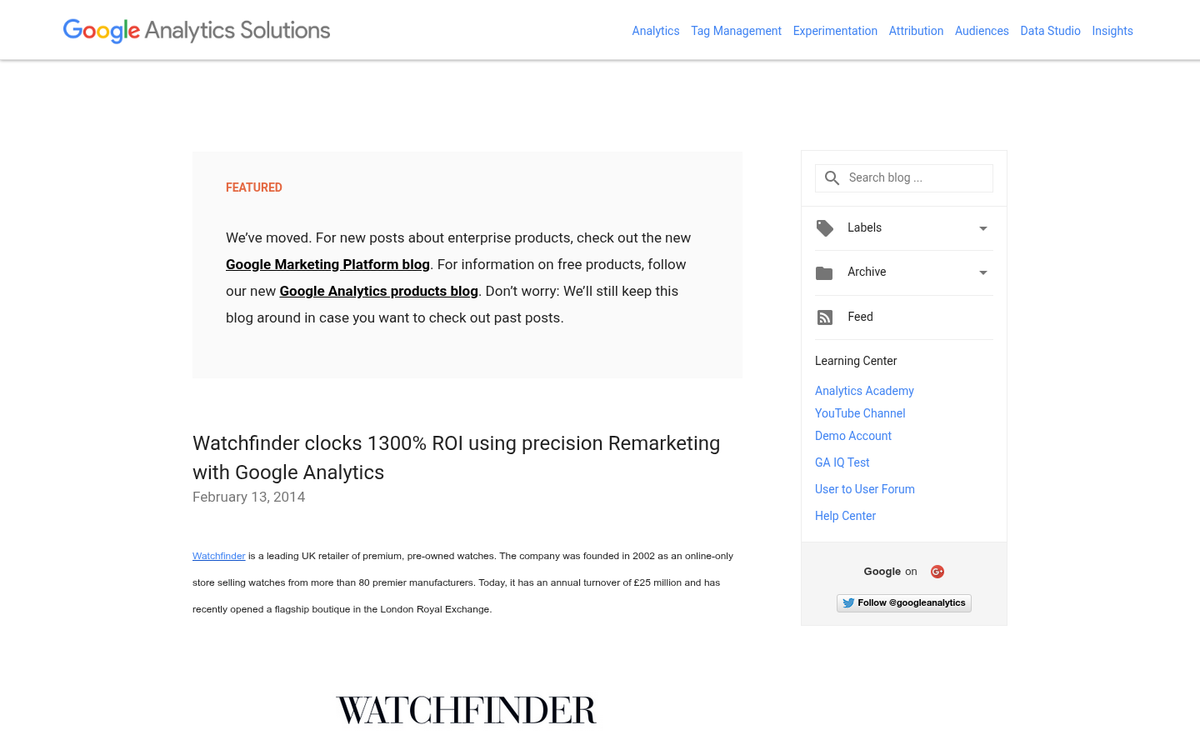
This case study focuses on the brand Watchfinder, which sells luxury pre-owned watches. Given their narrow audience and specific purchase situation, they discovered that fewer than 1% of their visitors made a purchase on their first visit. This is a classic scenario where retargeting shines - reaching and reminding those customers to come back and complete a purchase on the watch they've been eyeballing.
This case study focuses on Google Ads, using Google Analytics to gather data about their visitors and produce retargeting lists. They used this data to create 20 distinct lists of customers, segmented by location, language, depth in the sales funnel, ISP, and other factors. Watchfinder and their agency Periscopix created specific targeted ads for each list based on context. In addition to driving return visits to their website, they also emphasized driving foot traffic to the company's boutique outlet in London for geographically local users.
So what were the results? After six months of running these remarketing campaigns, with optimizations along the way, Watchfinder saw the average order size on the site increase by 13%, CPAs drop by 34%, and an overall return on investment of 1,300%. These numbers have held up as a benchmark in the industry and remain one of the most cited retargeting success stories for good reason.
Case Study #2: Myfix Cycles
Myfix Cycles is a bicycle retailer located in Toronto. They had been using Google Ads to little effect, barely breaking even with the ads they were running. Rather than focus on purely Google retargeting, they decided to combine their efforts - via their agency, Webrunner Media Group - with Facebook advertising.
Facebook allows any company to install a tracking code called the Meta Pixel (formerly Facebook Pixel) on their website. This tracks visits and user data about the people who visit, even if those people have never interacted with the business's Facebook account. Google ads brought people to their website, where the Meta Pixel would track them, and they could then run Facebook ads targeting those users with specific criteria.
Myfix chose three groups of people to target with these retargeting advertisements. The first group was people who had recently visited the website at all, within the previous 14 days. The second group was a subset of that - people who had added a product to their cart within the past 14 days. The third group was people who had made any purchase from Myfix within the previous 180 days.
The results? Myfix earned approximately $15 for every $1 spent on these ads - a verified 1,529% ROAS. That's a remarkable improvement over barely breaking even. The revenue figures were relatively modest given the size of the shop, but the return on ad spend is hard to argue with at any budget level.
Case Study #3: Lumension
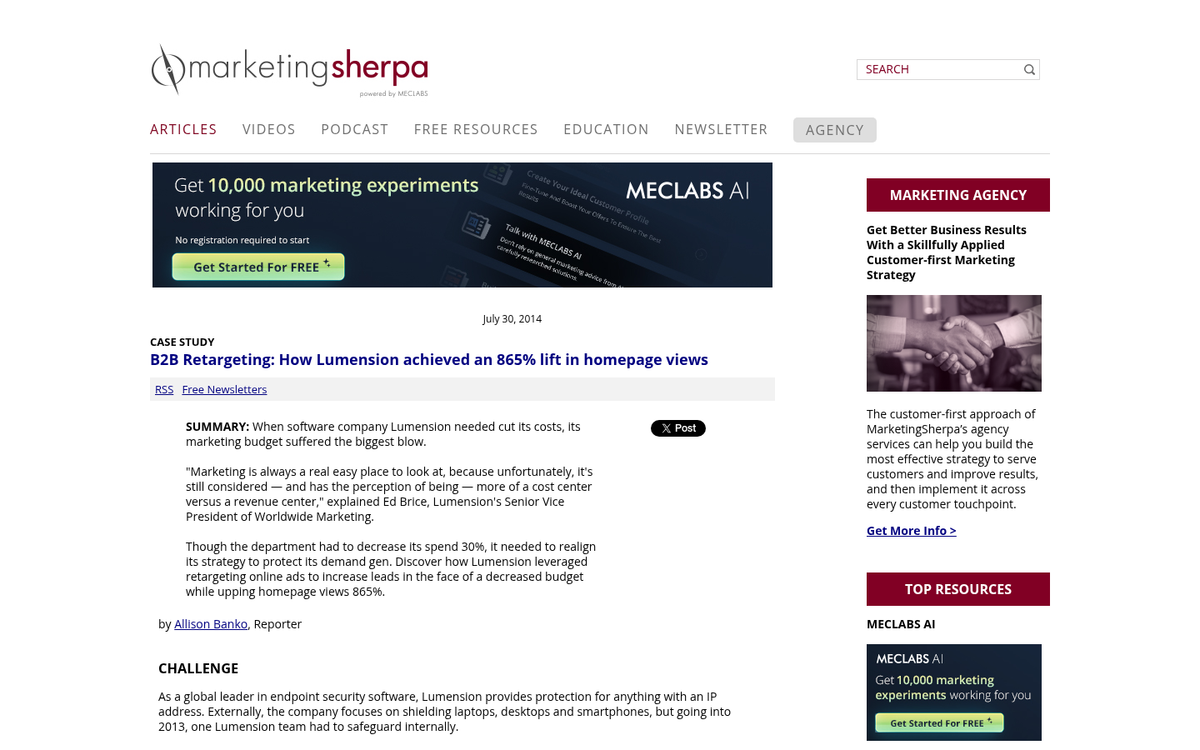
Lumension is an endpoint security company that partnered with agency Just Media on a retargeting campaign, with results reported by MarketingSherpa. Rather than pouring more money into broad PPC campaigns, they shifted strategy and leaned into retargeting as a way to get more out of a tighter budget.
The results were striking: despite a 30% cut to their overall PPC budget, lead volume actually rose by 81%. On top of that, their cost per acquisition through retargeting came in 34% cheaper than their non-brand search campaigns. This is a strong example of retargeting's ability to improve efficiency, not just scale - you don't have to spend more to get more when you're reaching people who are already familiar with your brand.
Case Study #4: Yatango
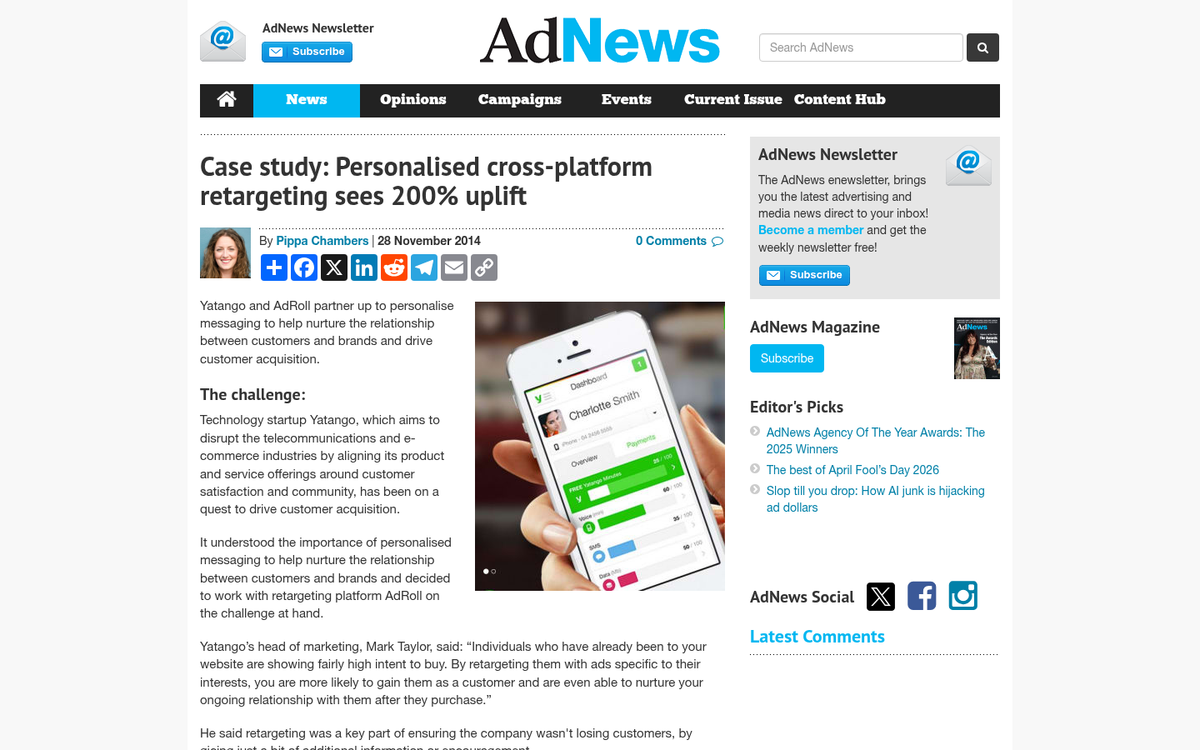
Yatango is a telecom company that ran a retargeting campaign through AdRoll, with results reported by AdNews. They were looking to grow signups and improve their return on ad spend, and the results came in well ahead of expectations.
Within a single month of running the campaign, Yatango achieved a 590% higher ROI than their baseline, a cost per acquisition that came in 33% lower than their stated goal, and a 200% increase in signups. These are the kinds of numbers that sound like marketing copy, but they were independently reported and reflect what's possible when retargeting is applied to an audience that already has brand familiarity and demonstrated interest.
Case Study #5: Manscaped

Manscaped is a male grooming brand that partnered with the agency Perfect Audience to run a retargeting campaign focused on both website visitors and mobile in-app advertising. Rather than testing retargeting to see what happens, they had clearly defined Return on Ad Spend goals from the outset and needed a partner that could reliably hit them - particularly on mobile, where they had previously struggled.
Perfect Audience employed a customized lookback window, OS-specific targeting for different mobile operating systems, audience exclusions to filter out low-intent users, and dayparting to focus spend during the highest-converting parts of the day.
The result was a consistent 3.5x return on ad spend, meeting their stated ROAS goal. As they hit their targets, they were able to confidently scale their budget and maintain performance, achieving 137% growth month over month in the process. If you're looking to understand why your traffic isn't converting into customers, studying campaigns like this one can provide valuable direction.
Your Experiences
I'm not the only one who can find case studies online, but what I'd really like to do is hear from you. Many of you have used retargeting in your own ad campaigns, and I'm curious how it turned out. Leave your data in the comments if you're willing to share - maybe your results can help convince someone else to take the plunge with retargeting, or help others calibrate realistic expectations before they dive in.
2 responses
Thoughtful replies only - we moderate for spam, AI slop, and off-topic rants.
Thanks a lot for sharing these retargeting case studies and specifying cases where Google Ads platform was employed.
Thanks for reading, Ti.! We're glad you found the Google Ads examples particularly useful. Seeing real-world applications really helps bring retargeting strategies to life, doesn't it? If you'd like us to dive deeper into any specific platform or campaign type in a future post, let us know - we love tailoring content to what our readers find most valuable!