




For website owners, this matters more than ever. AI answer engines don't pull from every source equally. They favor sources they have learned to trust - and if your site does not meet that bar, your content may be ignored - even when it's the most relevant result available. Building source credibility is how you earn a seat at the table in AI-generated replies.
In this entry, I'll talk about what drives source credibility in the context of Answer Engine Optimization (AEO), how AI systems review trustworthiness, and the helpful steps you can take to strengthen your site's standing with these systems.
Quick Answer
Source credibility refers to the degree to which an audience trusts and believes a source of information. It is typically evaluated based on two main factors: expertise (the source's knowledge and qualifications on a topic) and trustworthiness (the source's perceived honesty and reliability). Credible sources are more persuasive and influential. Factors affecting credibility include credentials, reputation, objectivity, accuracy, and transparency. In research and journalism, evaluating source credibility is essential to ensure information is accurate and reliable.
How Answer Engines Decide Which Sources to Trust
Answer engines like ChatGPT, Perplexity and Google's AI Overviews don't pull sources at random. They review content signals that have been around in SEO for years - things like domain authority, authorship, citation patterns and how steady a site's content is over time.
Think of it less as a secret algorithm and more as human trust signals applied at scale. When judging if a source is reliable, they look at who wrote it, if other credible sources reference it and if the information holds up across different places. AI systems are similar, just much faster and across far more data.
Domain authority plays a big part here. A site that has built up a strong backlink profile from respected sources signals to an answer engine that it has earned some level of trust from the wider web. Authorship matters too - content with a named expert with a verifiable track record carries more weight than anonymous writing.
Citations are another strong signal. When a piece of content references known sources and gets referenced by others in return, it can become part of a web of credibility that answer engines can trace. Consistency also counts - a site that publishes accurate, on-topic content over a long period looks more reliable than one that posts in bursts or changes focus frequently. One way to build that consistency is to breathe new life into older blog posts rather than letting them go stale.
Visibility and trust are not the same thing. A source can rank well in traditional search without being selected by an answer engine as a reliable citation. Visibility gets you in front of readers; trust gets you cited as a source of truth. For website owners, this changes the goal a little. Combining older posts into stronger, unified resources is one approach that can help signal both depth and authority to these systems.
The Three Core Dimensions of Source Credibility
The framework most scientists and AI developers still use goes back to Carl Hovland's work at Yale in the 1940s and 50s. Hovland and his colleagues identified that people judge sources on three things: expertise, trustworthiness, and likeability - this model has held up remarkably well, and it directly maps onto the tells that answer engines are trained to read.
Expertise is about whether a source actually knows what it's talking about. For a website, this translates to things like author credentials, the depth of the content, and whether other respected sources link to it. An answer engine won't read a biography and take it at face value - it looks for third-party tells that corroborate the claim of expertise.

Trustworthiness is a separate dimension entirely. A source can be knowledgeable and still untrustworthy, which is worth keeping in mind. For AI systems, trust tells include editorial consistency, factual accuracy over time, transparent authorship, and the absence of manipulative content patterns - and whether the source has a track record of getting things right and being honest about what it knows. One way to reinforce transparent authorship is understanding how ownership and identity signals appear on a blog.
Dynamism is the least obvious of the three - it refers to how engaging and confident a source comes across. In human communication, this is about delivery and energy. For written web content, AI interprets it through things like clarity, directness, and how actively a source participates in its topic area - publishing, updating, and being cited in live conversations around a subject.
| Dimension | What It Means | How AI Reads It |
|---|---|---|
| Expertise | Demonstrated knowledge in a subject area | Author credentials, inbound links, content depth |
| Trustworthiness | Reliability and honesty over time | Factual accuracy, editorial transparency, consistent tone |
| Dynamism | Engagement and active presence in a topic | Publication frequency, citations, content freshness |
This framework matters for site owners because each dimension is something you can work on. None of them are fixed properties - they're built through decisions you make about how you publish, who you credit, and how you maintain your content distribution over time.
Why Credibility Signals Can Fade Without Upkeep
Back in 1951, scientists Hovland and Weiss found something worth mentioning. Credibility effects are not permanent. A source that earns trust at one point in time does not automatically hold onto that trust later.
This matters quite a bit for website owners and content creators. Many believe that past credibility sticks around on its own. But that assumption can be expensive. Trust signals need active maintenance to stay helpful.
One of the most common ways credibility erodes is through content decay. A post published three years ago may have been accurate then. But the world moves on. Statistics become outdated, recommendations change, and search engines take note of content that no longer aligns with the latest knowledge.
Outdated author bios are another easy thing to let slip. If a bio lists credentials or affiliations from years ago and nothing has been updated since, it works against you. Readers and algorithms pick up on the difference between what a bio claims and what the rest of the page supports.
Broken citations are a quieter problem but a real one. When a source you linked to disappears or redirects to something unrelated, it weakens the case for your information being well-researched. A page full of dead links tells a story of neglect more than expertise - much like when social sharing buttons stop working and quietly undermine a page's appearance of being maintained.

Inconsistent publishing also factors in. A site that posted frequently and then went quiet for a long stretch can appear abandoned or deprioritized. That perception can affect how much weight a reader or a system gives to the content still on the page. Tools that help you auto-share new blog posts can help keep activity visible and consistent.
The underlying pattern across these is the same. Credibility is not a status you earn once and then own - it's something that gets reinforced or weakened over time based on what you do and what you let slide.
The good news is that none of these problems are hard to find once you know what to look for. A site can audit for content freshness, update contributor information, and check external links - all concrete steps to protect what it has built. If your site runs on WordPress, knowing how to actively promote your content is just as important as keeping it accurate.
What the Research Actually Says About Credibility's Impact
A large organized review pulled together 91 studies and 64,162 participants to look at how much credibility moves the needle on persuasion and trust. The findings were helpful. But they weren't clean. Of the 162 coded effects in the review, only 47.53% were statistically significant.
That means just under half of the measured effects held up. The rest were either non-significant or gave mixed results across different contexts.
| Result Type | Share of Coded Effects | What It Means |
|---|---|---|
| Statistically significant | ~47.53% | Credibility had a measurable impact on the outcome |
| Non-significant | Remainder of coded effects | No reliable relationship was found between credibility and the outcome |
| Mixed | Varied across studies | Results depended heavily on context, audience, or message type |
This doesn't mean credibility is unimportant - it matters in many situations. But it does mean credibility isn't a switch that automatically produces trust or persuasion every time it's present.
The effect depends quite a bit on the audience, the topic, and how the message is framed. A very credible source still needs to say something that resonates with the reader's existing knowledge or situation. Credibility gets you in the room. But it doesn't do the work once you're there.
For content creators and SEO practitioners, this is actually a helpful reframe. You want to build on credibility tells instead of assuming they do the job. Relevance, clarity, and genuine practicality all belong in that picture alongside those tells. How article quality is evaluated is worth understanding in this context, since surface-level signals rarely substitute for substance.
Research like this pushes back against oversimplified advice. Credibility is one strong signal in a bigger set of things that shape how readers and algorithms review content, and treating it as the whole answer tends to produce content that looks honest on the surface but still underperforms.
Credibility Gaps That AI Penalizes Most
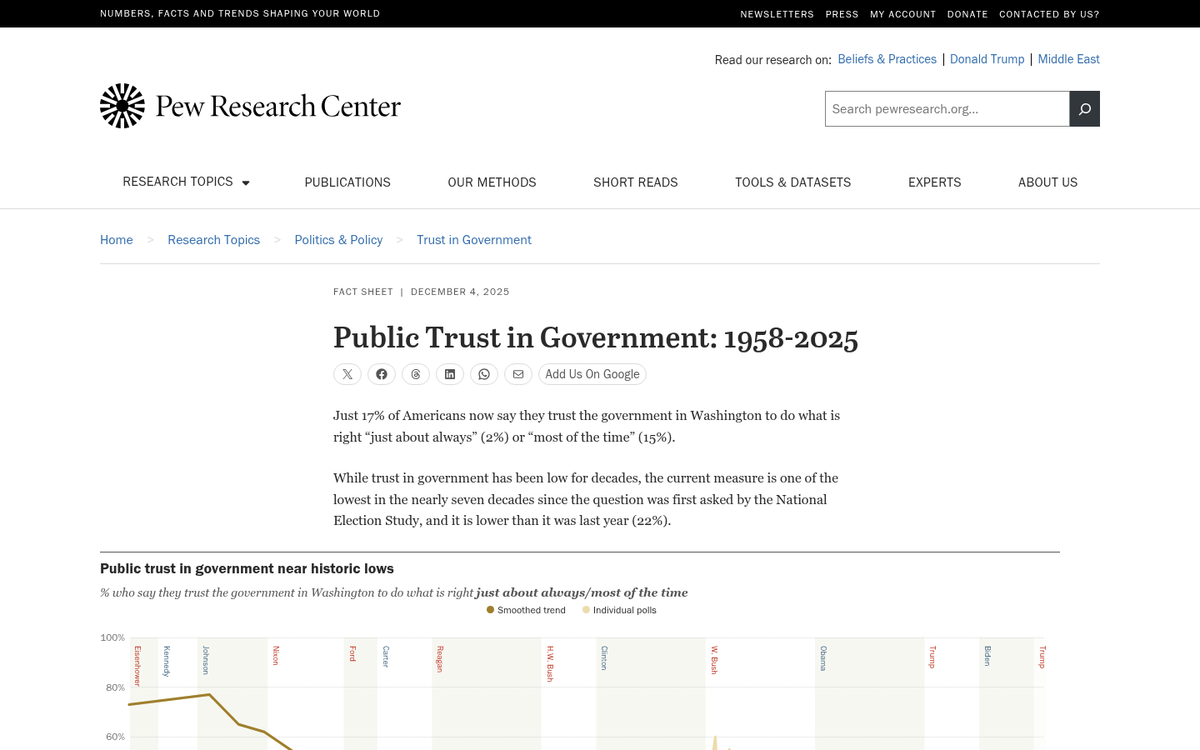
Low trust is not a vague concern - it's measurable. Pew Research found that only 24% of Americans trust the federal government to do the right thing most of the time. If trust in institutions has fallen that far, AI systems are not going to extend blind faith to a random website either.
Anonymous authorship is one of the biggest problems. When no named person takes responsibility for the content, there's no way to review expertise or accountability. AI engines see this absence.
A thin or vague "About" page is another red flag. A page that says little more than "we cover topics related to finance" tells an AI nothing about who is behind the site or why they're qualified to write about it. The more that page is like a placeholder, the less weight the site carries.
Missing external references is also a problem that compounds over time. Content that makes factual claims without linking to verifiable sources looks like opinion dressed up as fact. AI systems are trained to favor content that connects its claims to the outside world instead of treating itself as the final word.
No mention of editorial standards is another gap worth noting. Sites that never explain how they vet information, correct errors, or review content give AI no signal that accuracy is a priority. A formal policy document is not required - a quick, honest explanation of your process goes a long way.
Inconsistent factual claims may be the most damaging gap of all. When different pages on a site contradict each other, or when claims don't hold up against well-established sources, it tells AI that the content can't be relied upon. Even small inconsistencies accumulate into a pattern that's hard to recover from.
The pattern across these gaps is the same. AI systems are trying to answer one question: can this source be trusted to get things right? Anything that makes that question harder to answer tends to push a source further down the list.
Signals You Can Build Into Your Site to Strengthen Credibility
The good news is that most credibility signals are things you can start working on right away. They don't take a full site rebuild or a big budget - they take attention to detail and a commitment to accuracy.
Start with your author pages, and each person who publishes content on your site should have a bio that lists their background, credentials, and relevant experience. A name and a headshot is not enough. Link those bios to any external profiles that back up their expertise, like LinkedIn pages or published work elsewhere.
Next, add structured data markup to your pages - the technical layer that helps search engines read and verify information like authorship, publication dates, and review ratings. If you use WordPress, plugins like Yoast or Rank Math make this manageable without needing a developer.

Cite your sources. When you reference a statistic or a study, link directly to the original source instead of a secondary one - this small step shows that your content is grounded in something.
Then there's the longer-term work of building topical authority. One post on a subject does not make you an authority on it. A cluster of well-researched, interlinked content on a focused topic does. Managing how your site is structured and tagged is part of keeping that content organized and discoverable.
Citations from other respected sites are one of the strongest credibility signals you can earn. That usually comes from publishing original research, data, or legitimately helpful resources that others want to reference.
| Weak Credibility Signal | Strong Credibility Signal |
|---|---|
| Anonymous or vague authorship | Named authors with verifiable credentials |
| No structured data markup | Schema markup for authorship, dates, and content type |
| Unsourced claims and statistics | Direct links to primary sources |
| Isolated content on a topic | A connected cluster of in-depth content |
| No inbound citations from other sites | References from established, relevant websites |
Finally, keep your content accurate and up to date. A page with outdated information works against you - even if it was well-researched at the time of publication. Schedule a review cycle for your most important pages so nothing goes stale.
Measuring Whether Your Credibility Efforts Are Working
Measuring credibility is still a developing area, and it's worth being honest about that. There's no single score or dashboard that tells you how trusted your site is. What you can do is watch a set of proxy tells that, together, give you a reasonable picture of your progress.
One of the most helpful things to track is whether your content appears in AI-generated answers. Tools like Semrush's AI Toolkit, Profound, and similar services are starting to monitor brand visibility in AI search results - this matters because citation by an AI model is one of the stronger tells that your content is seen as authoritative and well-structured.
Brand mention tracking is also worth setting up. Tools like Google Alerts or Mention let you see where your name is being referenced across the web, and the pattern of the mentions tells you quite a bit. A growing number of references from respected sources is a sign that your credibility-building work is paying off.
On the technical side, it's a good idea to run structured data through Google's Rich Results Test on a schedule. Broken or incomplete schema quietly undermines the trust tells you've worked to build. A monthly check takes very little time and keeps things in shape.
Qualitative checks matter too. Read your content with fresh eyes every few months and ask if it still aligns with your expertise and the most up-to-date information available. Ask if a first-time visitor would feel confident trusting what they read. If you publish on multiple platforms, it's also worth thinking about how to grow a successful blog on Medium as a way to extend your credibility to new audiences.
You want to build a repeatable audit process instead of a one-time cleanup. A short monthly review of your structured data and brand mentions, combined with a deeper content review once a quarter, is manageable and helpful. Treat it like scheduled maintenance instead of a project.
| What to Check | How to Check It | Frequency |
|---|---|---|
| AI citation visibility | Profound, Semrush AI Toolkit | Monthly |
| Brand mentions | Google Alerts, Mention | Monthly |
| Structured data health | Google Rich Results Test | Monthly |
| Content accuracy and depth | Manual review | Quarterly |
Building a Site AI Wants to Quote
Rather than treating your website purely as a destination you want visitors to visit, try seeing it as a reference - a place other systems and readers turn to when they need something they can use. References get cited. Destinations get scrolled past. When your content answers questions clearly, backs claims with evidence, and demonstrates genuine expertise, it earns a place in that first category.
The next step is straightforward: audit what you already have. Look for unsupported claims, outdated information, or gaps where a credible source should be. Small, deliberate improvements compound over time. You don't need to rebuild everything at once - you just need to start treating credibility as a standard practice instead of a box already checked. If you're running on a hosted platform, it may also be worth considering whether to move to a self-hosted WordPress setup for greater control over how your content is structured and presented.
FAQs
What is source credibility in AI answer engines?
Source credibility refers to how much AI answer engines trust your website when selecting citations. It's built through signals like domain authority, authorship, factual accuracy, and consistent publishing over time.
What are the three core dimensions of source credibility?
The three dimensions are expertise, trustworthiness, and dynamism. Expertise reflects demonstrated knowledge, trustworthiness reflects reliability over time, and dynamism reflects how actively a source participates in its topic area.
How can credibility signals fade on a website?
Credibility erodes through content decay, outdated author bios, broken links, and inconsistent publishing. Trust signals require ongoing maintenance to remain effective with both readers and AI systems.
What credibility gaps do AI systems penalize most?
Anonymous authorship, vague About pages, unsourced claims, missing editorial standards, and contradictory content across pages are the biggest red flags AI systems use to downgrade a source's trustworthiness.
How do you measure if credibility-building efforts are working?
Track AI citation visibility using tools like Profound or Semrush, monitor brand mentions via Google Alerts, check structured data health monthly, and conduct quarterly manual content accuracy reviews.