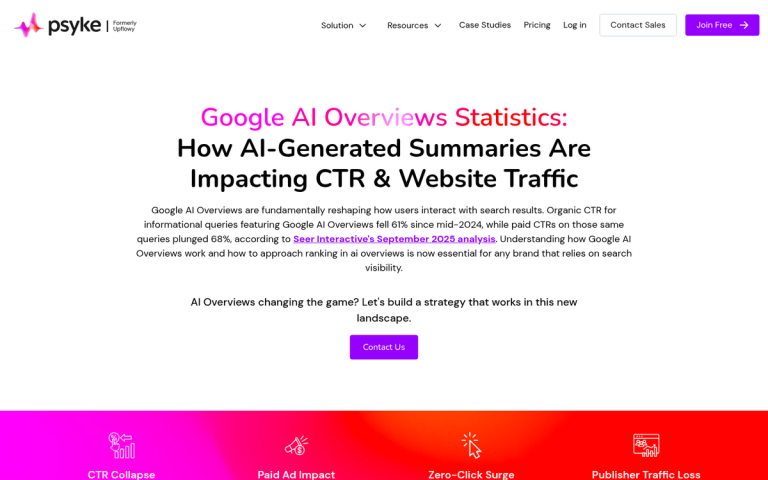
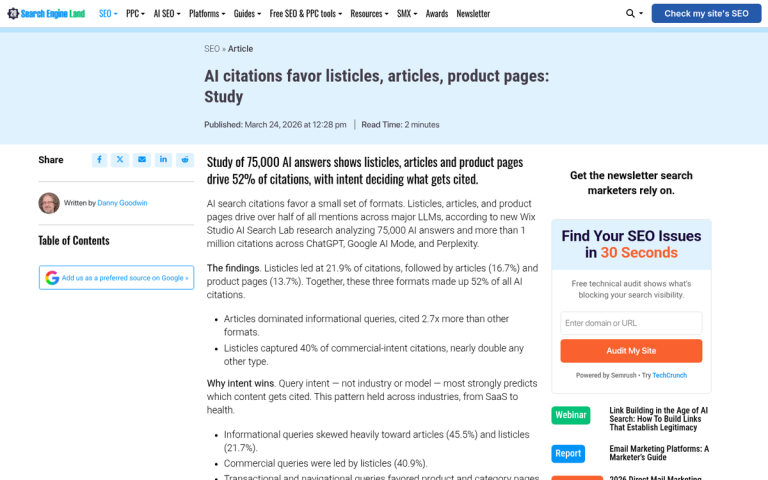
The numbers tell a clear story. Gartner predicts that 25% of traditional search volume will migrate to generative AI platforms by 2026 - a actual chunk of the audience that content has always been written to draw. And it's already accelerating: according to Semrush, Google's AI Overviews seemed to be in just 6.49% of search results at one point, then doubled to 13.14% in the span of two months. That growth doesn't slow down on its own - it compounds.
Here's the part that matters for anyone sitting on a library of existing content: most of it wasn't built with AI discovery in mind - it was optimized for keyword rankings, click-through rates and human readers scanning a results page. It's not a failure - it's just a reflection of how search worked when the content was created. The criteria for visibility are changing and content that once performed well can quietly lose ground without any obvious warning signs.
That's where an Answer Engine Optimization (AEO) audit comes in. Think of it as a structured review of your content through the lens of how AI systems source, evaluate and surface information. Rather than starting from scratch, an AEO audit lets you work with what you already have - recognizing what's well-positioned, what needs refining and what's basically invisible to generative platforms. Your existing content library is actually a strong foundation to build from. You just need a framework for seeing it.
Key Takeaways
- AEO audits evaluate how well content answers questions directly, differing from SEO audits focused on keywords and backlinks.
- Content structure accounts for roughly 30% of answer-readiness, with clear headers and scannable formatting helping AI extract information.
- Start with 25-50 priority pieces, focusing on high-traffic, conversion-related, or question-based content for maximum impact.
- AI systems may deprioritize content after roughly 13 weeks without substantive updates like new data or expanded answers.
- Poor-performing content should be restructured, rewritten, or consolidated rather than automatically deleted, depending on the underlying issue.
What an AEO Audit Actually Measures (and Why It Differs from an SEO Audit)
A traditional SEO audit looks at things like keyword usage, backlinks, page speed, and metadata. An AEO audit looks at something different: how well your content answers a question. That distinction matters more than it might seem.
AI systems like Google's AI Overviews don't rank pages the way a search algorithm does. They pull from content that's direct and well-structured. A page can sit comfortably on the first page of Google results and still get passed over by an AI overview - because it buries the answer, uses vague language, or never directly addresses the full question a user is asking.
An AEO audit is asking if this content behaves like a reliable answer. That means looking at things like how quickly the main point appears, if the structure makes answers easy to extract, and if the content covers a topic enough to satisfy the intent behind a question.

Content structure carries weight in AEO evaluation - roughly 30% of what makes content answer-ready - this includes things like the use of headers, logical flow, and if the page is broken into digestible chunks that an AI can read independently. A wall of paragraphs with no hierarchy is much harder to use as a source, even if the information inside it is accurate. Understanding what makes a citation-ready content block can help clarify what AI systems are actually looking for.
Consider a how-to post that ranks well because it has some strong backlinks and keyword placement. If that post takes four paragraphs to get to the steps, an AI system is less likely to surface it as an answer. A shorter, less-linked page that leads with the answer and uses clean formatting has an advantage in AI-generated results. This is part of why some competitors show up in AI overviews while others don't, even with comparable content.
An AEO audit evaluates answer quality, structural clarity, and how each part of content responds to a user question.
How to Choose Which Content Pieces to Audit First
You don't need to audit everything at once. A focused starting batch of 25 to 50 pieces is enough to get results without grinding your workflow to a halt.
The key is to choose pieces where the audit will actually move the needle. That means looking at traffic data, topic relevance, and how closely a piece connects to questions your audience is already asking AI tools. Content with buy decisions or vendor comparisons deserves extra attention - especially for B2B businesses. Studies show that 79% of business buyers use AI tools to review vendors, which means your B2B content may be "read" by an AI long before a human ever sees it.
Content age matters too. A piece written three or four years ago might still pull traffic, but maybe structured in a way that makes it invisible to AI-generated answers; it's a gap worth catching early.

Use the table below to get a sense of what makes a piece worth auditing sooner instead of later.
| Prioritization Factor | Why It Matters for AEO | Priority Level |
|---|---|---|
| High organic traffic | More exposure means more chances to appear in AI-generated answers | High |
| Tied to conversion or sales | These pieces influence decisions and deserve accurate AI representation | High |
| Covers frequently asked questions | AI tools draw heavily from question-based content | High |
| Targets competitive topics | Being cited in AI answers on competitive terms has real business value | Medium-High |
| Content is more than two years old | Older structure and formatting may not align with how AI reads content | Medium |
| Low traffic but strong topic fit | Could perform better with AEO improvements even without an SEO lift | Medium |
That combination alone will give you a representative first batch to work through.
The Step-by-Step Process for Auditing a Single Content Piece
Once you have your list of priority content, it's time to go through each piece with a helpful eye. You want to see your content the way an AI would - as a source it either can or can't pull a clean answer from.
Work through these steps one at a time for each piece you audit.
Step 1: Read the opening paragraph and ask yourself one question. If asked this topic as a direct question, does the first paragraph answer it? A strong AEO-ready piece opens with a self-contained answer - something an AI could lift and use without needing the rest of the post. If your intro is all context-setting and no answer, flag it for revision.
Step 2: Look at every header in the piece. Headers that read like statements ("Benefits of Email Marketing") do far less work than headers that read like questions ("What are the benefits of email marketing?"). Go through each one and ask if it maps to something a person would type or say.
Step 3: Check how the content is structured under each header. Walls of text are hard for AI to parse and hard for readers to scan. Look for short paragraphs, numbered steps where a process is explained, and direct sentences that get to the point fast.

Step 4: Map out the follow-up questions a reader may have. Think about what they would search next after reading this page. Does the content address those questions - even briefly? If there are obvious gaps, note them - you can either add a short section or link to another piece that covers the gap.
Step 5: Do a final read as if you are the AI. Pretend you'll have to pull one sentence from this page to answer a direct question. Can you find it? If you have to hunt for it, a user or an answer engine will have the same problem.
Keep an easy notes column as you go through each step - you'll use those observations to score the piece in the next stage.
Scoring Your Content for Answer-Engine Readiness
Once you've worked through a piece, you need a way to record what you found.
There are five dimensions worth scoring, and each one tells you something different about how ready a piece is to be cited by an AI answer engine.

| Dimension | What to Look For | Score (1-5) |
|---|---|---|
| Structure | Clear headings, logical flow, and scannable formatting like short paragraphs or lists | 1 = no structure, 5 = well-organized throughout |
| Directness | Does the content answer the target question in the first 1-2 paragraphs? | 1 = buried answer, 5 = immediate and direct |
| Question Alignment | How well does the content match the way a real person would phrase the question? | 1 = misaligned, 5 = mirrors natural language closely |
| Completeness | Does the piece cover the topic fully enough to stand alone as an answer? | 1 = surface-level only, 5 = thorough and self-contained |
| Freshness Signal | Are there visible dates, recent examples, or updated data points? | 1 = no signals, 5 = clearly up to date |
Structure carries more weight than the others, and it's worth putting roughly 30% of your total score to that dimension alone, because AI systems depend heavily on formatting to extract and present information.
To get a weighted total, multiply your structure score by 1.5 and add it to the remaining four scores at face value. Anything between 12 and 18 is worth a targeted fix. Scores above 18 can go to the back of the queue.
The value of this system is at the library level. When every piece has a score, your team can stop guessing and start working through a ranked list instead.
How Content Freshness Affects AI Citation Longevity
Even content that scores well on answer-engine readiness can lose its place in AI-generated replies if it sits untouched for too long. Research suggests a roughly 13-week window after which AI systems start to deprioritize content that hasn't been updated - one quarter, which is not a long time if you have a large library to manage.
The tough part is that not every update actually counts. Fixing a typo or changing a header color doesn't signal freshness to an AI system. What does signal freshness is a substantive change - new data, a revised answer, or expanded coverage of related questions that users are now asking.
A piece published 18 months ago may have been well-structured and citation-worthy at launch. But if the core answer hasn't changed since then and no new information has been added, AI tools have less reason to pull from it over something more recently revised.

The updates that carry the most weight are the ones that change the substance of the content. A recent statistic, an updated recommendation to match new input, or a new question-and-answer section all give AI systems something fresh to index. Restructured sentences without changed meaning don't do the same job.
How Often to Audit for Freshness
For most content, a quarterly review is a basic pace to stay within that 13-week window. That said, some industries need to move faster. Understanding how much content velocity you actually need can help you set realistic expectations for your publishing and update schedule.
| Content Type | Recommended Audit Frequency |
|---|---|
| General evergreen content | Quarterly |
| Legal content | Monthly |
| Healthcare content | Monthly |
| Finance content | Monthly |
In law, healthcare, and finance, answers can become inaccurate within weeks of a regulatory or policy change. Monthly reviews in those categories aren't excessive; they're just responsible. For context on how algorithm shifts can affect what gets surfaced, Google's March 2026 core update is a useful recent example of how quickly eligibility criteria can change.
As you go through your content library, flag anything that hasn't had a substantive update in three months or more. If you're also optimizing for AI citation specifically, reviewing how to structure content for Perplexity's citation algorithm can sharpen your approach during each audit pass.
Fixing the Gaps: What to Rewrite, What to Restructure, and What to Cut
Once your audit flags a piece of content, the next choice is what to actually do with it. The right choice can depend on what's wrong with the piece.
Restructuring is the right move when the information is good but hard to follow. AI systems pull answers from content that's well-organized and direct, so a page that buries its main point in a wall of text will get passed over even if the facts are accurate. Break it into shorter sections, add a direct answer near the top, and make sure headings match the questions a reader would ask.
Rewriting is the right move when the content itself is the problem - thin coverage, outdated information, or text that was written for keywords rather than to actually answer a question. This content technically exists in your library but doesn't do much work.

Removal is the hardest call but sometimes the right one. Content that doesn't address a question, duplicates another page, or sends mixed signals to readers and AI systems can drag down the authority of the pages around it. Less is sometimes more.
It's also worth thinking about consolidation before you delete anything. Two or three thin pages on closely related topics can sometimes be merged into one strong page. That single page is far more likely to get cited than three weak ones competing with each other.
The stakes here are real. Research from Search Engine Journal found that businesses with AEO-optimized content saw as high as 40% higher visibility in AI-generated answers.
| Content Condition | Recommended Action |
|---|---|
| Good information, poor organization | Restructure |
| Thin, outdated, or keyword-only content | Rewrite |
| No clear question answered | Remove or consolidate |
| Multiple weak pages on the same topic | Consolidate into one page |
Building an Audit Schedule That Actually Gets Done
A one-time audit will only take you so far. AI citations decay - pages that get referenced by tools like Perplexity or ChatGPT can drop off if the content goes stale or competitors publish something stronger.
For most teams, a quarterly review hits the right balance - it's standard enough to catch problems before they compound and basic enough that you will actually do it. If you're in a competitive space like finance, health, or software, a monthly check on your top-performing pages makes sense.
What an Ongoing Audit Workflow Looks Like
Someone needs to own this process. If you don't have a named person or team, the audit can become the job that gets pushed to next month indefinitely. Assign ownership - even if that's just one person with a shared doc.

You'll also want a way to flag content between scheduled audits. An easy column in a spreadsheet - something like "flag for review" - lets anyone on the team mark a page when they see it has drifted or a topic has changed, keeping things from slipping through.
Tracking progress over time matters more than you might expect. A basic spreadsheet with columns for page URL, last audit date, changes made, and next review date is all you need to start. A complex project management setup sounds desirable but tends to get abandoned after a few weeks. Tools like SEMRush can help you monitor content performance without overcomplicating your workflow.
A Simple Quarterly Tracker Setup
| Column | What to Record |
|---|---|
| Page URL | The full link to the content |
| Last Audited | Date of the most recent review |
| Changes Made | Brief note on what was updated |
| Next Review | Scheduled date for the next check |
| Flag for Review | Mark if something needs attention before next cycle |
You want to make the next audit easier than the last, and each time you go through the process and document what you did, you build a reference point that saves time. If you're also evaluating which AI tools produce the most citation-worthy content, that insight belongs in the same workflow so nothing gets siloed.
Your Content Library Isn't Behind - It Just Needs a New Lens
What makes this process stick over time is the system behind it. When structure is treated as an absolute must-have, when freshness is scheduled instead of reactive, and when every part of content runs through a steady scoring rubric, the audit stops being a one-time project and can become a competitive habit. Gartner projects that a share of traditional search volume will shift to AI-powered interfaces within the next few years - and most B2B content sites haven't made a single optimization with answer engines in mind. Teams that audit are already operating in a different category.
The clearest next step is also the smallest one: pull your ten highest-traffic pages from the last six months and run them through the scoring framework outlined above. Look for missing structure, stale data, and unanswered direct questions.