Key Takeaways
- Updating and republishing old posts can increase organic traffic by 106%, making repurposing more cost-effective than creating new content.
- Only repurpose content that has existing links, remains relevant, and requires minimal editing to refresh effectively.
- Three repurposing styles exist: easy recirculation, update and recirculation, and creating a spiritual sequel on the same topic.
- Keep original publish dates while prominently displaying an updated date; changing URLs means losing accumulated link authority.
- The multimedia conversion strategy lets one blog post fuel content across podcasts, infographics, slide decks, and short-form video.
As bloggers, we tend to figure that content has a certain lifespan. Other than the few pieces of evergreen content we create that maintain some semblance of traffic for years, most content gets a few days, a few weeks, or maybe a month or two of traffic and attention before falling off the map. Blogs are packed full of old content that's no longer relevant, taking up space.
But according to HubSpot, updating and republishing old posts can increase organic traffic by as much as 106%. Semrush found that 38% of marketers cite repurposing existing content as a key success factor. 46% of marketers believe repurposing content is more helpful than creating new content entirely, and 65% agree it's cheaper. With the average blog post taking 3 hours and 48 minutes to write from scratch, that's a hard argument to ignore.
You can't simply delete old content; it makes your site smaller, gets rid of any links you had pointing to that old content, and hurts your SEO. However, it doesn't all have to be a waste. It seems like you should be able to do something with that content to give it new life.
Decide if the Content is Right for a Second Chance
There are two types of content on your site that could be worth repurposing and giving new life. The first is your evergreen content, the content that already has some life in it, which you can take advantage of to give it a second footing - your popular long-term content that has value, but that for whatever reason has stopped attracting visitors over time.
Evergreen content is a natural target for more life, because it's already almost there. All it needs is a quick refresh and a new round of promotion, and you're done.
The other type of content is content that had great viral appeal, but which died off over time. Some of this content is worth repurposing. But some of it isn't.
So what makes a piece of content worth repurposing and recirculating?

- The content has existing links and, if possible, traffic.
- The content is still more or less relevant today.
- The content will take minimal editing to get up and running.
By contrast, content you don't want to try to repurpose might look like this:
- The content is based on news stories or memes or trends that have fallen out of style.
- The content includes tips that are no longer valid.
- The content refers to products or services that no longer exist.
For example, you wouldn't want to resurrect a tutorial for a defunct tool or a post built around a trend that's long since faded from the cultural conversation. That content would take a total revamp to make it helpful to a modern audience, so it's better to create a new post from scratch.
Decide on a Style of Repurposing Content
There are, in my experience, three styles of repurposing content.
The first style is an easy recirculation for content that's already ready to go - the evergreen content that's accurate and relevant for everyone currently working in marketing. You should read over the content, make sure there aren't any lingering typos, make sure any links go to valid, relevant sources and are not broken, make sure that the advice is still valid and relevant, and so forth. You can add some new content, you can update some content, you can expand on some content, and generally make some improvements. But you don't need to. For the most part, the content is fine on its own.
All you need for this style of repurposing is to basically put it through your promotion engine. Share it on social media across the places where your audience lives. Link to it in some of your new blog posts. You can even go out and write a guest post somewhere and link to that post as your one allotted link. You can put it through as much or as little circulation as you want, and can usually slip it in every month or so to get more exposure and keep it alive.
The second style is an update and recirculation for the types of content that need more work to get up to date. For example, if you wrote a post about staying away from or recovering from a Google core algorithm update, you'd want to revisit the content in light of how Google's quality standards have continued to evolve - like the growing role of E-E-A-T (Experience, Expertise, Authoritativeness, and Trustworthiness) and the increased scrutiny on AI-generated content that has defined recent core updates. You'd want to check that any statistics or data points you cited are still current, and update or replace any that have aged out.
This repurposing takes a little more work and a little more planning, because you can't simply take the post and get it going again. You need to do a dedicated read-through of the post and figure out what edits or changes you want to make to it. You also have to check the links and non-link recommendations to make sure they're still what you want to be recommending. Then, of course, you'll have to actually make those updates. Unless, of course, you decide that the edits would need to be too heavy and would remove the original value and purpose of the post, at which point you basically let it die and write a new post in the same vein, with modern information.
At this point you can put it through your promotion engine just like the above strategy. The one commonality between methods is that once you have the post up and running, you promote it to give it new life. Otherwise it won't show up as new to your audience.

The third style is the spiritual sequel. For example, if you look back in your archives and find a post about signs your blog posts are boring, you could create a new post with updated tips about that exact same topic, with updated information, new links, new ideas, and a more refined writing style.
It works especially well for data or trend-based content. An annual roundup post, a yearly predictions post, or a recurring industry survey recap are all examples of content formats that lend themselves to sequels, and each new edition stands on its own while also borrowing credibility and audience familiarity from the editions that came before it.
The drawback of this model is that you're not repurposing your old content so much as you are creating new content on the same theme. When you do this, you have to be very careful not to use basically the same content over again, otherwise you can take an SEO hit because of keyword cannibalization or because you're just publishing the same basic post again.
On the positive side, you can "brand" these posts as a series and make it into something readers look forward to.
Should You Change Publication Dates?
One question that comes up when repurposing old content is whether or not you should change the publication date on the post.
On one hand, with an old publication date, readers might think the post is old and out of date and will give it less trust. You can combat this by adding a visible "Last Updated" note near the top of the post, so readers immediately see that the content has been refreshed. Many WordPress themes and SEO plugins support a "last modified" date field specifically for this purpose, and displaying it prominently is usually considered best practice.
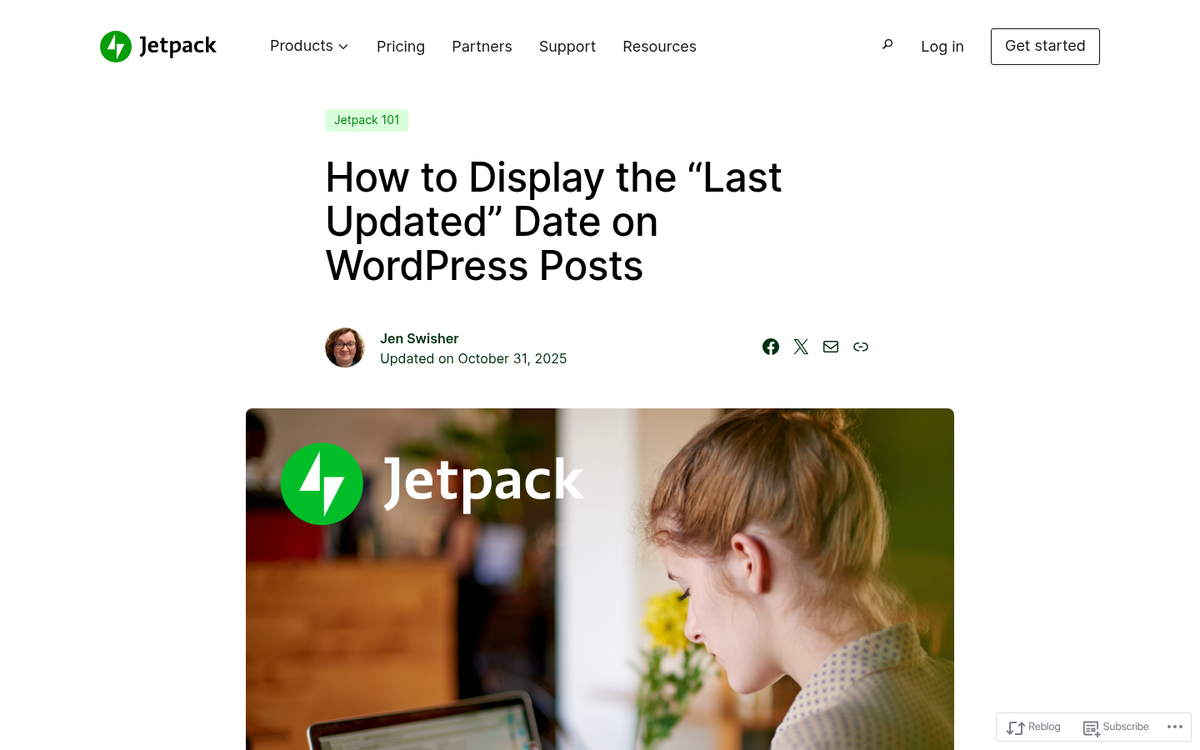
On the other hand, if you change the publication date entirely, you might lose some of the historical context that gives the post credibility. Google has long been known to factor in the original indexation date as part of how it evaluates content, which means a freshened publication date on your end doesn't necessarily change how Google sees the document's age. The safest and most transparent strategy is to keep the original publish date while prominently surfacing the updated date, both on the page itself and in your meta description.
If you're publishing a new post with a new URL, of course, it gets a new publication date. But you also lose out on links to the old content and the time-based authority it may have accumulated. You're not likely to delete the old post, so your site as a whole still gets that benefit. But the new post starts without it. Whether that tradeoff is worth it can depend on how much equity the old URL has built up.
So, there are pros and cons to each strategy. Just know that none of them are going to outright tank your SEO, nor are any of them categorically better than the others on those terms.
Assorted Tips for Better Content Repurposing
There are other strategies and other tips you might make use of when repurposing content. For example, an alternative to the third strategy above is the outline strategy.
With the outline strategy, you take the original post and use it like an outline for a series of different posts - this works best for list posts. If you publish a roundup of the top tools for blog analytics, you could then write individual posts on each one, providing full reviews and tutorials on how to use them, and each of those posts can link back to the original roundup, strengthening the internal link structure across the whole cluster.
Or you can use the same strategy in reverse. If you find you've written articles about half a dozen different pieces of software useful in marketing, you can then write one main post with your top recommendations, with short entries about each of them linking to the full posts - this content hub or pillar-and-cluster structure also happens to align with how Google evaluates topical authority, which makes it an SEO move as much as a content move.

You can also use the multimedia conversion strategy, where you take old content and repurpose it as different types of content. A popular blog post can be turned into a slide deck and shared on LinkedIn, or narrated and published as a podcast episode. You can distill the post down to its key points and create an infographic, or hire a designer to create the graphic if design isn't your strength. Short-form video content on platforms like YouTube, TikTok, or Instagram Reels is another avenue that continues to grow in reach and relevance. A single well-written post can fuel weeks of content across multiple channels when broken down. Keep in mind that Backlinko research puts the average top-10 Google result at around 1,447 words, which means a post often contains enough material to be broken into multiple smaller pieces across other formats.
At the end of the day, what it all comes down to is having enough quality in your content, in an evergreen, ever-helpful way, that the content can stand on its own. Then you just need to publish it and re-publish it every few months, sharing it around on social media and elsewhere. Great content never dies.